


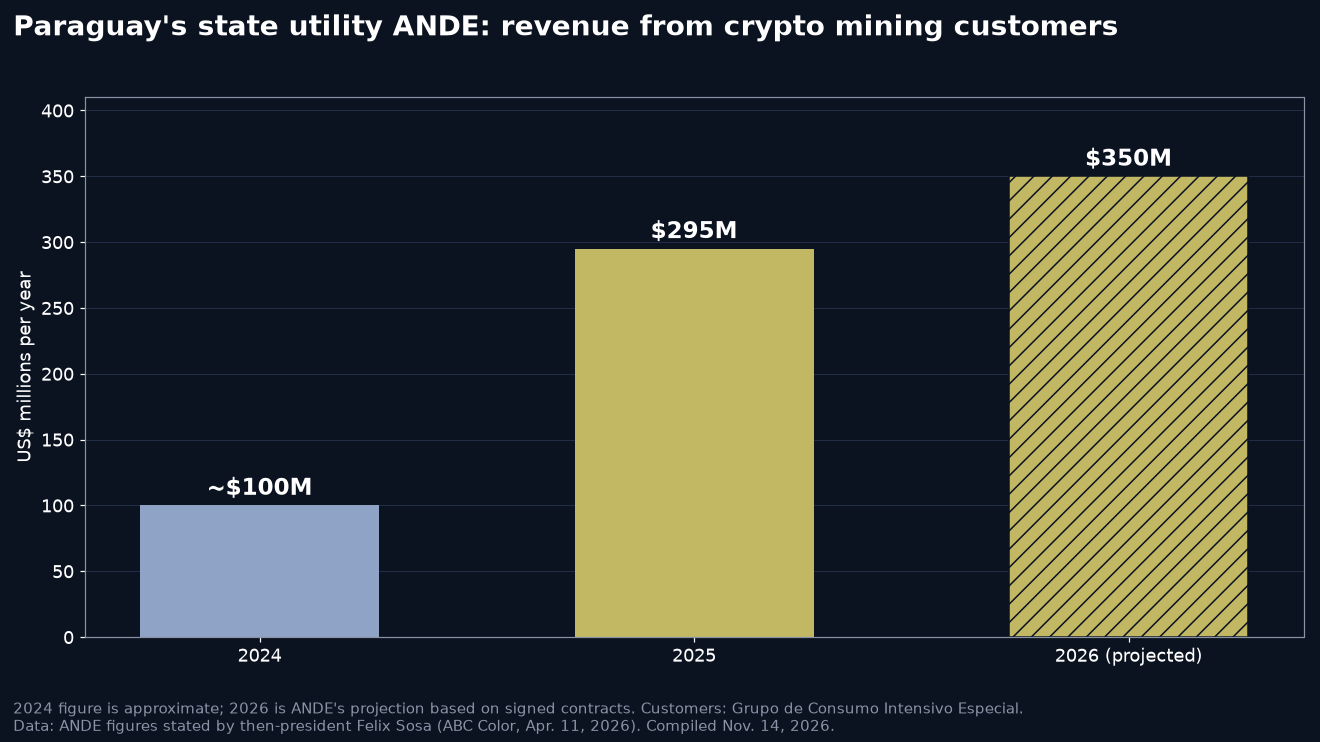
Paraguay crypto mining has turned into one of the state’s best-paying electricity businesses. The national utility, ANDE, expects to collect $350 million from its mining customers in 2026, according to figures its then-president Félix Sosa gave the Paraguayan daily ABC Color in April. That is 18.6% more than the $295 million it collected in 2025 and roughly triple the $100 million it took in during 2024.
Yet every one of those contracts has the same end date. Under ANDE’s own tariff rules, special supply contracts for the high-consumption group that covers crypto mining and data centers cannot run past Dec. 31, 2027. Officials have called that deadline final, and in October the utility signed a 15-year power deal with an artificial intelligence data center instead.
How Big Paraguay’s Mining Load Has Become
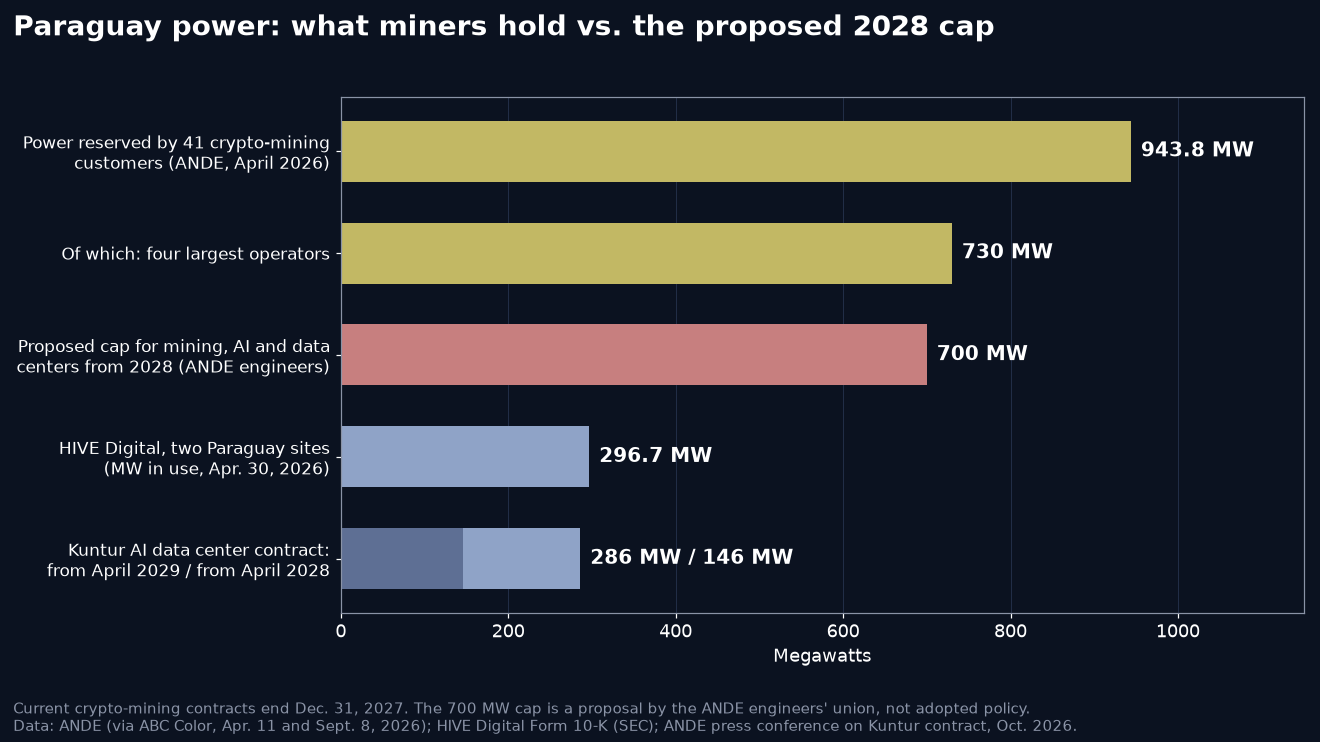
Paraguay draws most of its electricity from the Itaipu dam it shares with Brazil. ANDE’s figures put the power reserved by its mining group at 943.8 megawatts in April, about 13.5% of the 7,000 MW of Itaipu capacity that belongs to Paraguay.
That load is concentrated. ANDE counted 41 active customers in the group in 2026, down 42% from 71 at the start of 2025,. Four companies, Cademot, Zunz, Muiden and W3X, hold 730 MW between them, more than a full 700 MW Itaipu turbine. Reserved power at the very-high-voltage level jumped from 305 MW in 2024 to 705 MW in 2025 and 870 MW in 2026, according to ANDE data reported by ABC Color in September.
The Deadline Written Into ANDE’s Tariff Rules
The 2027 cutoff is not a rumor. The ANDE resolution annex that defines the Grupo de Consumo Intensivo Especial says it covers users who process data or provide storage services, “including crypto-asset mining, blockchain, token and data centers.” It then states that contracts with this group “may not exceed Dec. 31, 2027.”
ANDE wants that energy back for homes and traditional industry, as projections show its spare capacity running out within a few years. Miners, for their part, have asked for 10-year extensions.
HIVE Has the Most to Lose, and the Most to Bargain With
No listed miner is more exposed than HIVE Digital Technologies. Its annual report filed with the SEC lists two owned Paraguay sites: Yguazú, bought from Bitfarms in March 2025 for about $56 million, and Valenzuela, finished in November 2025. As of April 30, 2026, Yguazú used 193.4 MW and Valenzuela 103.3 MW, together 296.7 of HIVE’s 384.6 MW in use worldwide, or 77%.
The same filing lists W3X S.A. and Zunz S.A. as HIVE subsidiaries in Paraguay, which means two of the four largest names on ANDE’s mining roster belong to the company.
HIVE is blunt about the risk. The 10-K says the power agreements at both sites extend until Dec. 31, 2027, and that “continued operation will rely on the Company’s ability to renegotiate” them. It is still building: a 100 MW expansion at Yguazú would take its Paraguay capacity to 400 MW.

HIVE mined 1,070 Bitcoin in its latest quarter, as DCForecasts reported, and most of that hashrate sits in Paraguay. Its two sites there produced 18.9 of its 24.0 EH/s of operational hashrate in April.
An AI Contract Arrives Before the Miners’ Expire
On Oct. 22, ANDE signed a 15-year contract with Kuntur S.A., a Paraguayan company that represents U.S. firm Araico, for an AI, cloud and data center project in Yguazú, the same district as HIVE’s largest site. ANDE president Miguel Báez said supply starts with 6 MW on Dec. 1, 2026, rises to 146 MW from April 2028 and reaches 286 MW from April 2029.
The price is $48.91 per megawatt-hour at 220 kV and an average of $56.39 at 23 kV, set under a new tariff group for advanced-technology energy-intensive industries. It rises each year with U.S. inflation, with a 2.5% floor. Báez stressed that the contract excludes crypto mining.
The Engineers’ 700 MW Proposal
ANDE’s own engineers’ union has pushed for a smaller, pricier market. In June it proposed limiting all crypto mining and related sectors to 700 MW, about 10% of Itaipu’s generation for Paraguay, with contracts of three to five years. That is 243.8 MW less than miners reserve today.
The proposal has not been adopted. If AI customers such as Kuntur end up counting against the same limit, the room left for Bitcoin miners after 2027 would be smaller still.
Why Miners Still Have a Strong Case
Miners bring something AI campuses do not: flexibility. Energy policy researcher Cecilia Llamosas told a panel in August that Paraguay’s roughly 900 MW of mining load works like a “fuse” for the grid, with interruptible machines that shut down in minutes when the system is stressed. In other markets, that kind of demand response is a paid service.
They also pay. A customer group that brings in $350 million a year in hard currency, with no public investment, is not easy to replace overnight.
Miners are already squeezed by low hashprice, so cheap, stable hydropower is exactly the asset efficient operators will fight to keep. Paraguay’s choice is not mining or nothing. It is how much mining, at what price and for how long.
What to Watch Before 2028
- Whether ANDE opens an auction or tender for capacity after Dec. 31, 2027, and at what floor price.
- Whether the 700 MW proposal becomes policy, and whether AI loads count against it.
- HIVE’s next filings, which must update investors on its Paraguay talks.
For now, Paraguay’s miners keep running on cheap renewable power, with two years to prove their worth to the grid.
DC Forecasts is a leader in many crypto news categories, striving for the highest journalistic standards and abiding by a strict set of editorial policies. If you are interested to offer your expertise or contribute to our news website, feel free to contact us at [email protected]












Discussion about this post