


The GENIUS Act rulebook moved a big step closer to completion this week. Final stablecoin rules from the FDIC and from Treasury’s FinCEN and OFAC are now under White House review, 61 days before the law takes effect.
The federal government’s regulatory review portal shows that the Office of Information and Regulatory Affairs (OIRA) received both final rules on November 18, 2026.
The FDIC’s rule covers stablecoin issuers it supervises. The FinCEN and OFAC rule covers anti-money laundering and sanctions programs for every permitted payment stablecoin issuer.
That matters because the law’s start date is fixed. The GENIUS Act was enacted on July 18, 2025, and takes effect on January 18, 2027.
The bigger question now is whether the other agencies can finish in time, and what a complete rulebook could mean for the dollar tokens that sit on the other side of most crypto trades.
Which GENIUS Act Rules Reached the White House?
The OIRA list shows three Treasury and FDIC items received on November 18. Two are written specifically for stablecoin issuers.
The first is the FDIC’s “GENIUS Act Requirements for FDIC-Supervised Permitted Payment Stablecoin Issuers” (RIN 3064-AG19). The FDIC first proposed it in the Federal Register on April 10, 2026, and comments closed on June 9.
The second is the joint FinCEN and OFAC rule on issuer AML and sanctions compliance programs (RIN 1506-AB73), proposed on the same day with the same comment deadline.
A third item, FinCEN’s broader overhaul of AML programs across financial institutions (RIN 1506-AB72), arrived the same day.

OIRA lists all three as final rules with a statutory deadline. The final texts are not public yet, so we can only describe what the agencies proposed.
What the FDIC and FinCEN Proposed for Stablecoin Issuers
The FDIC’s April proposal set reserve, capital, liquidity and risk-management standards for the issuers and custodians it supervises.
It also proposed that bank deposits held as stablecoin reserves be insured to the issuer as corporate deposits, up to the standard $250,000. They would not pass through to individual token holders.
Issuers would publish the make-up of their reserves every month. The proposal also aimed to clarify how tokenized deposits are treated under deposit insurance law.
The FinCEN and OFAC proposal treats permitted issuers as financial institutions under the Bank Secrecy Act. It requires them to have the technical ability to block, freeze and reject transactions that break federal or state law.
The agencies also proposed an effective date 12 months after their final rule is issued. That timing could change in the final version.
For us, the key takeaway is simple. Issuers are getting a defined compliance checklist, not an open-ended guessing game.
The OCC Is Done, but Other Agencies Still Have Work Left
The OCC was first across the line. Its final issuer rule was published on October 23, 2026, and takes effect on January 18, 2027.
The rest are further back. The Fed’s proposal for the issuers it supervises is still open for comment until November 30, 2026.
The NCUA’s issuer proposal, FinCEN’s customer identification proposal and Treasury’s rule on stablecoin issuance and sales have all closed their comment periods. None has reached a final rule yet.
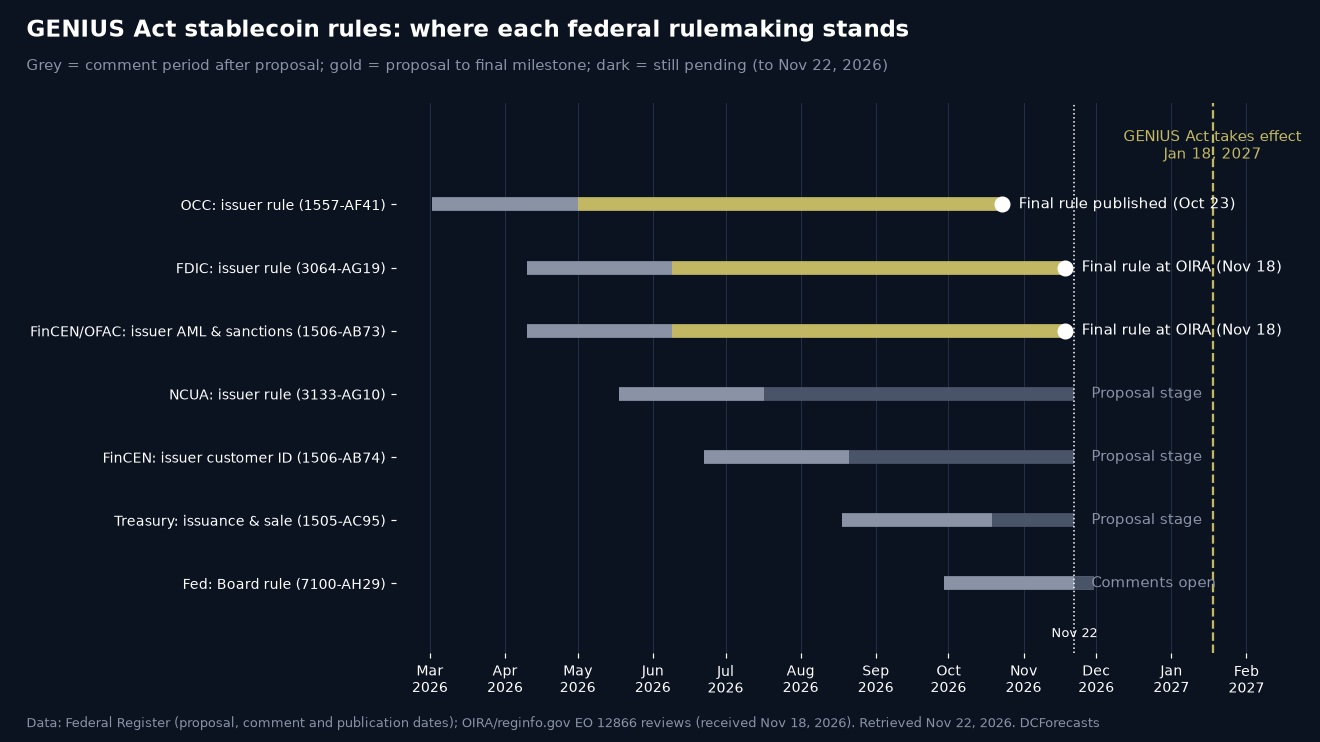
The FDIC and FinCEN rules took 222 days to go from proposal to White House review. That pace suggests the agencies are working to the statutory clock rather than drifting past it.
As we covered when MoonPay filed for a national trust bank charter, the line of firms seeking federal approval keeps growing, and these rules set the terms they will operate under.
Why Stablecoin Rules Matter While Supply Shrinks
The timing is not perfect. CoinGecko data shows combined USDT and USDC market capitalization at about $243.1 billion on November 21, 2026.
That is 9.3% below the $268.0 billion peak on May 8, and roughly $11.6 billion lower than on October 23, when the OCC’s final rule appeared.
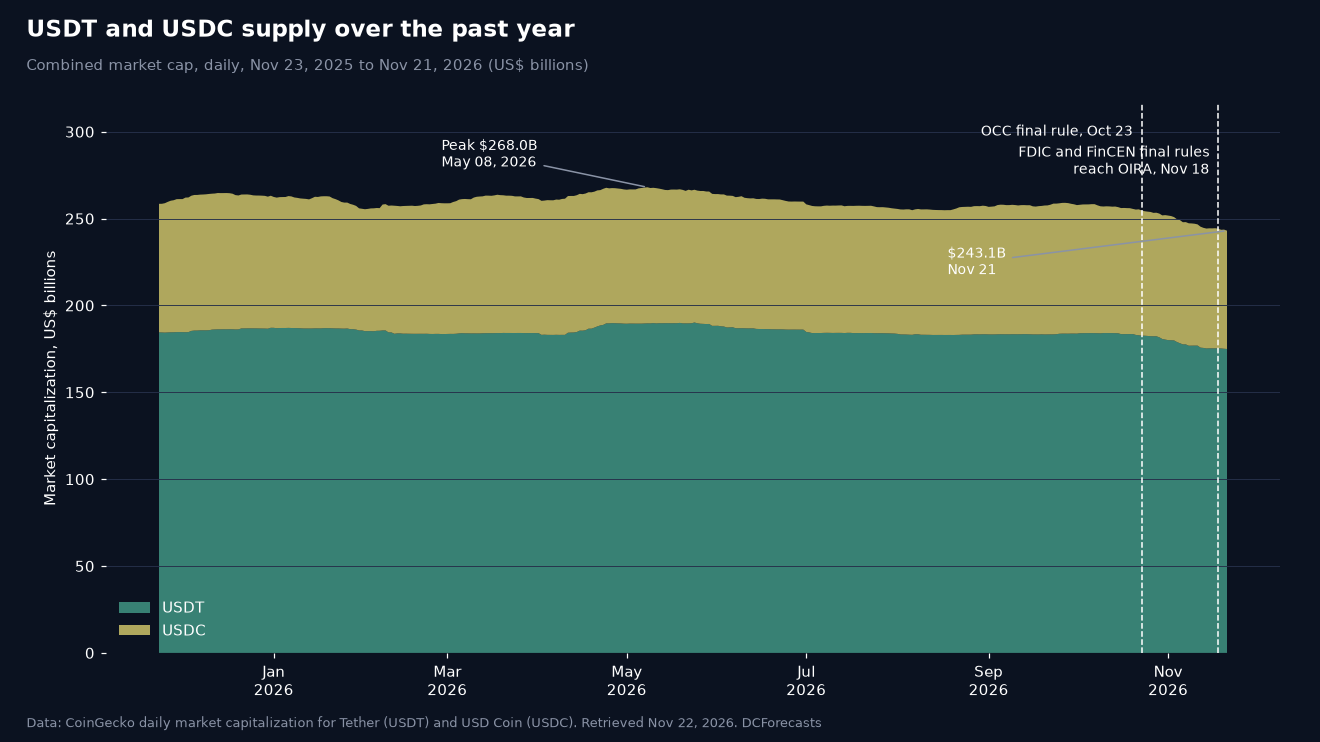
We believe that contraction is better read as a market cycle than a judgment on the rules. Stablecoin supply often shrinks when traders pull back from risk, and Bitcoin has just traded through a two-year low.
What the rules change is the plumbing. Clear reserve standards, monthly disclosures and defined AML duties are the kind of guardrails that larger institutions typically need before they move serious money through new rails.
Recent bank-charter approvals point the same way. Payoneer won conditional OCC approval for a stablecoin-focused national trust bank.
What Comes Next Before January 18?
OIRA reviews can take weeks. Once cleared, the FDIC and FinCEN rules would be published in the Federal Register, giving issuers the final text.
We would watch three things: whether the final FinCEN rule keeps the 12-month runway, how the FDIC handles reserve deposit insurance, and whether the Fed, NCUA and Treasury finish their stablecoin rules before the start date.
There is also a quieter lesson for Bitcoin holders. Stablecoins need issuers, reserves, auditors and freeze powers to earn trust. Bitcoin’s fixed 21 million supply needs none of that.
We believe both can grow together. Regulated dollar tokens can bring new users and liquidity into crypto markets, while Bitcoin remains the neutral, issuer-free asset many of them eventually buy.
The coming weeks will show whether Washington can deliver a full GENIUS Act rulebook on time. With the OCC finished and two more final rules now at the White House, the finish line is finally in sight.
DC Forecasts is a leader in many crypto news categories, striving for the highest journalistic standards and abiding by a strict set of editorial policies. If you are interested to offer your expertise or contribute to our news website, feel free to contact us at [email protected]












Discussion about this post