


Tokenized assets in Hong Kong now have a settlement home inside the city’s own bond depository, instead of on a single bank’s platform.
The Hong Kong Monetary Authority (HKMA) officially launched the CMU Digital Asset Platform on Nov. 25. It is a blockchain-based extension of the Central Moneymarkets Unit, the depository that held more than HK$6 trillion of assets at the end of September.
Ten banks signed up as direct participants from day one, including HSBC, Standard Chartered, Bank of China (Hong Kong) and DBS.
For investors following digital assets, the bigger shift is ownership of the rails. The question now is whether a public utility can bring tokenization from one-off showcase deals to everyday bond trading.
What the HKMA Switched On
The platform is built and run by CMU OmniClear, the operator the HKMA set up in October 2024 to manage the depository on its behalf.
According to the operator, it covers the full life of a bond: issuance, secondary trade settlement, coupon payments and redemption at maturity. It can host bonds that are born digital, and it can also tokenize existing paper-style securities.
Settlement is atomic delivery versus payment. In plain terms, the bond and the cash change hands in the same step, or neither moves.
The platform connects directly to Hong Kong’s real-time gross settlement systems and to central bank digital currencies. It supports 24-hour settlement in several currencies using cash tokens.
That last point matters most to us. Traditional bond settlement still follows office hours, while blockchain markets never close.

Why Tokenized Assets Needed a Public Home
Hong Kong is not new to this. The government has already sold three tokenized green bonds, and each one used a bank-run platform plugged into the depository.
The first, in February 2023, raised HK$800 million on Goldman Sachs’ GS DAP platform and settled in one day instead of the usual five. The second and third, in February 2024 and November 2025, ran on HSBC Orion.
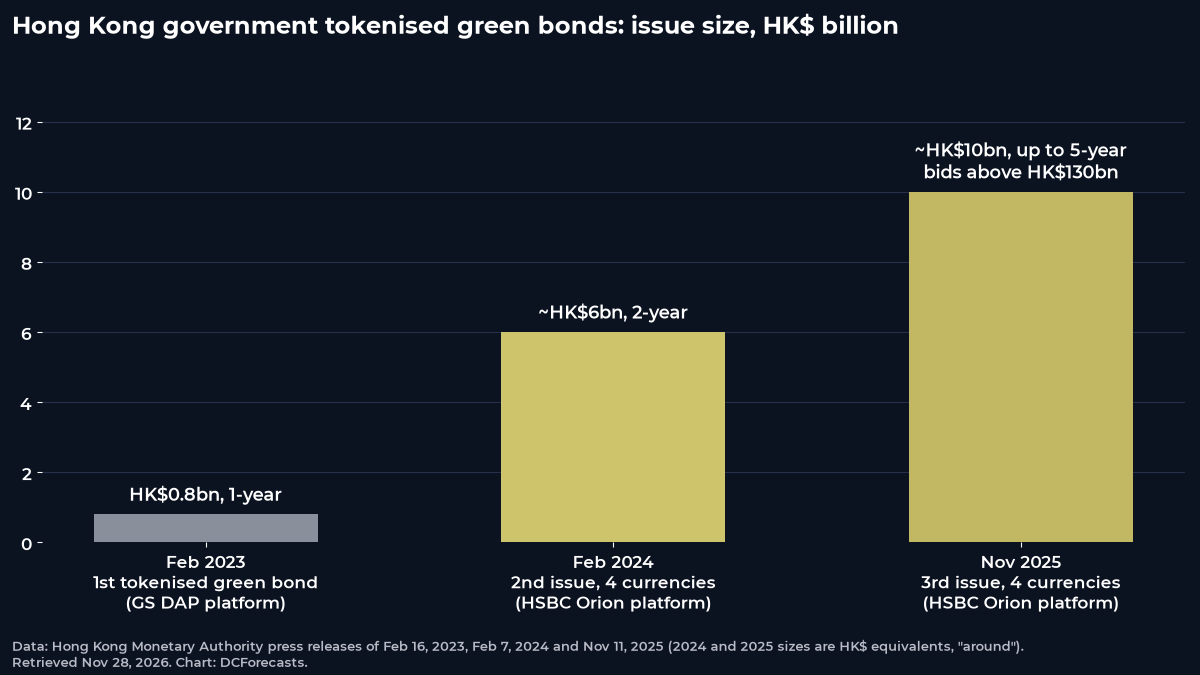
The deals grew fast. The 2024 issue reached about HK$6 billion across four currencies, and the 2025 issue about HK$10 billion, with orders above HK$130 billion, according to the HKMA.
That 2025 sale also let buyers of the Hong Kong dollar and renminbi tranches settle with tokenized central bank money, e-HKD and e-CNY, for the first time.
Those were impressive single deals. But tokenized securities that live on separate private ledgers can struggle to move between them, which limits trading after the launch day.
We believe putting the ledger inside the central depository answers that problem. It gives every member bank a neutral venue and the same legal settlement finality that the existing system already enjoys.
Ten Banks on Day One
The participant list is wider than on the last two government deals. HSBC Orion counted four direct participants in 2024 and six in 2025, according to the HKMA.
The new platform starts with 10. Four of them, Bank of China (Hong Kong), Bank of Communications (Hong Kong), Crédit Agricole CIB and HSBC, were also direct participants on the 2025 bond.
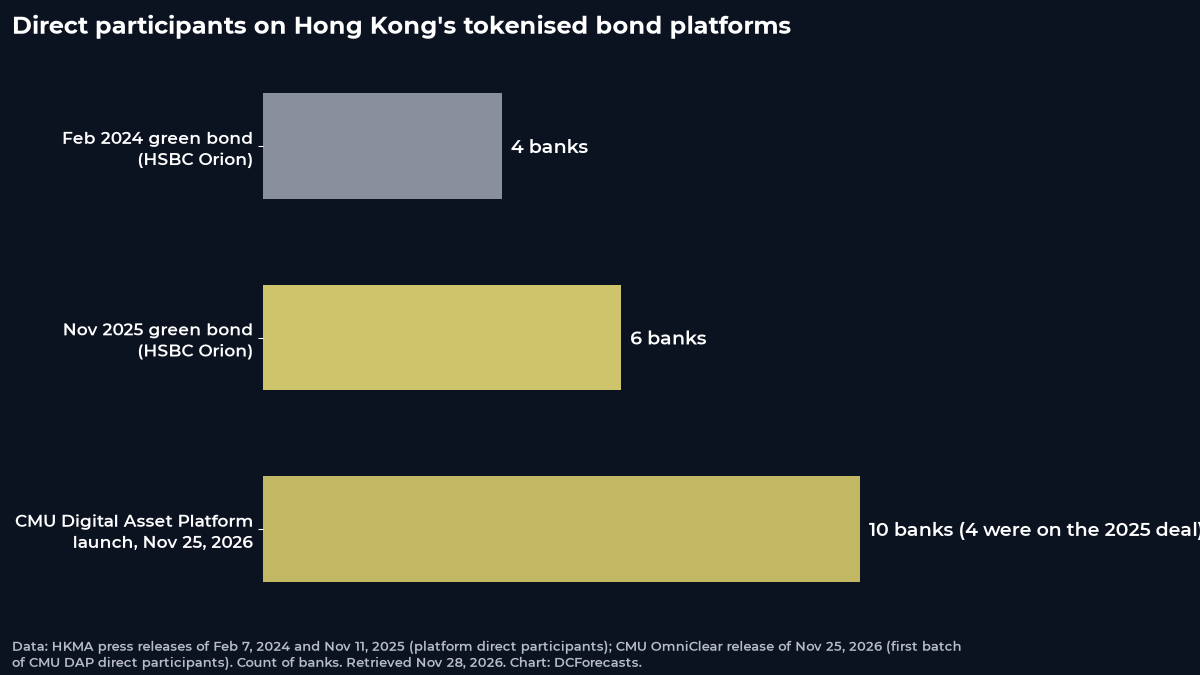
The other six are new to the list: China CITIC Bank International, China Construction Bank (Asia), CMB Wing Lung Bank, DBS’s Hong Kong branch, Industrial Bank and Standard Chartered’s Hong Kong unit.
The platform was not launched cold. The HKMA said on Nov. 2 that recognized dealers had completed secondary-market trial trades in tokenized Exchange Fund Bills, a step meant to speed up secondary and repo trading.
Bank of China (Hong Kong) said separately that its own test settled those bills against both interbank funds and e-HKD.
From Bonds to Stablecoins and Real-World Assets
Debt securities are only the starting point. CMU OmniClear said it will explore adding funds and other real-world assets, and linking the platform with other blockchain networks.
It also plans connections to wider payment tools, including tokenized deposits and regulated stablecoins. The HKMA said earlier this month it would soon extend its bill trials to regulated stablecoins.
That fits a broader push. Hong Kong recently moved its Ensemble TX pilot to 24/7 settlement of tokenized deposits, and the HKMA offers issuers up to HK$2.5 million per eligible digital bond through its grant scheme.
“Through CMU DAP, we are unlocking the transformative power of DLT to push the boundaries of financial innovation,” HKMA Chief Executive Eddie Yue said.
Globally, the trend points the same way. As we reported, the tokenized asset market reached $37 billion in IOSCO’s latest count.
What to Watch as Hong Kong Scales Up
The launch gives Hong Kong a clear framework. The test now is volume.
We would look for three signals: the first government or corporate bond issued directly on the new platform, the first live stablecoin settlement, and growth in the participant list beyond the opening 10.
Interoperability is the other open item. Bonds already issued on HSBC Orion and other bank platforms will need smooth bridges if the market is to avoid splitting into separate pools.
We think the direction is constructive for the whole digital asset space. When a major financial center rebuilds its core bond plumbing on a blockchain, it confirms that always-on, programmable settlement is becoming standard infrastructure.
Bitcoin proved that idea first, running a settlement network that has never closed for a weekend. The coming months will show how quickly Hong Kong’s bond market can match that rhythm.
DC Forecasts is a leader in many crypto news categories, striving for the highest journalistic standards and abiding by a strict set of editorial policies. If you are interested to offer your expertise or contribute to our news website, feel free to contact us at [email protected]












Discussion about this post