



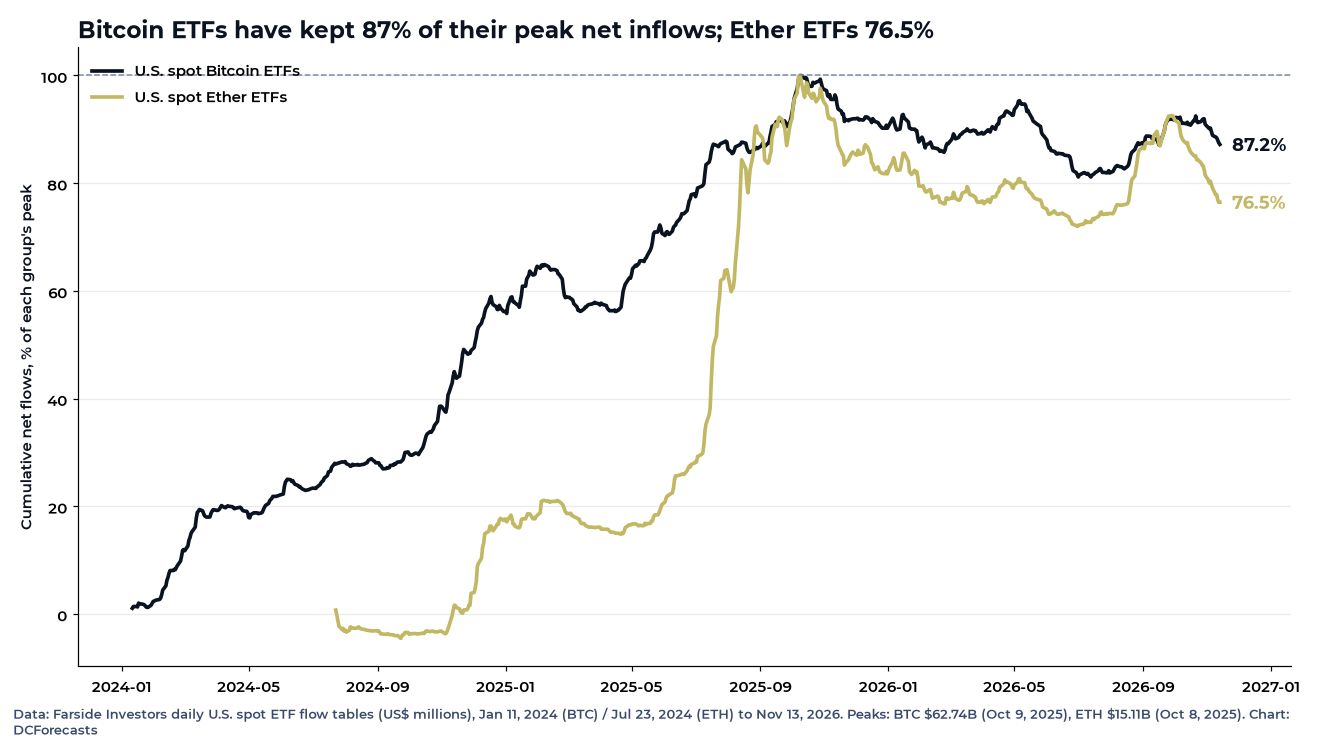
U.S. spot Ether ETFs have now handed back almost a quarter of the money they gathered at their best point. Cumulative net flows into the group stood at $11.55 billion after trading on Nov. 13, according to Farside Investors’ daily flow tables. That is down from a peak of $15.11 billion on Oct. 8, 2025.
In other words, the funds have kept 76.5% of their peak net inflows and given back 23.5%.
U.S. spot Bitcoin ETFs have had a rough autumn too, yet their base has held up far better. Their cumulative net flows reached $62.74 billion on Oct. 9, 2025, and stood at $54.70 billion on Nov. 13. That leaves 87.2% of the peak still in place.
October set a record for Ether ETF outflows
The gap opened quickly. At the end of September, Ether ETFs held $13.92 billion in cumulative net flows after a strong summer that brought in $1.85 billion in August and $831 million in September.
Then the selling started. October ended with net outflows of $1.61 billion, the worst month since the funds launched in July 2024. The previous record was November 2025, when $1.42 billion left.
November has not brought relief. Through Nov. 13, the funds have shed another $764 million, including $399 million in the week of Nov. 9 to Nov. 13 alone.
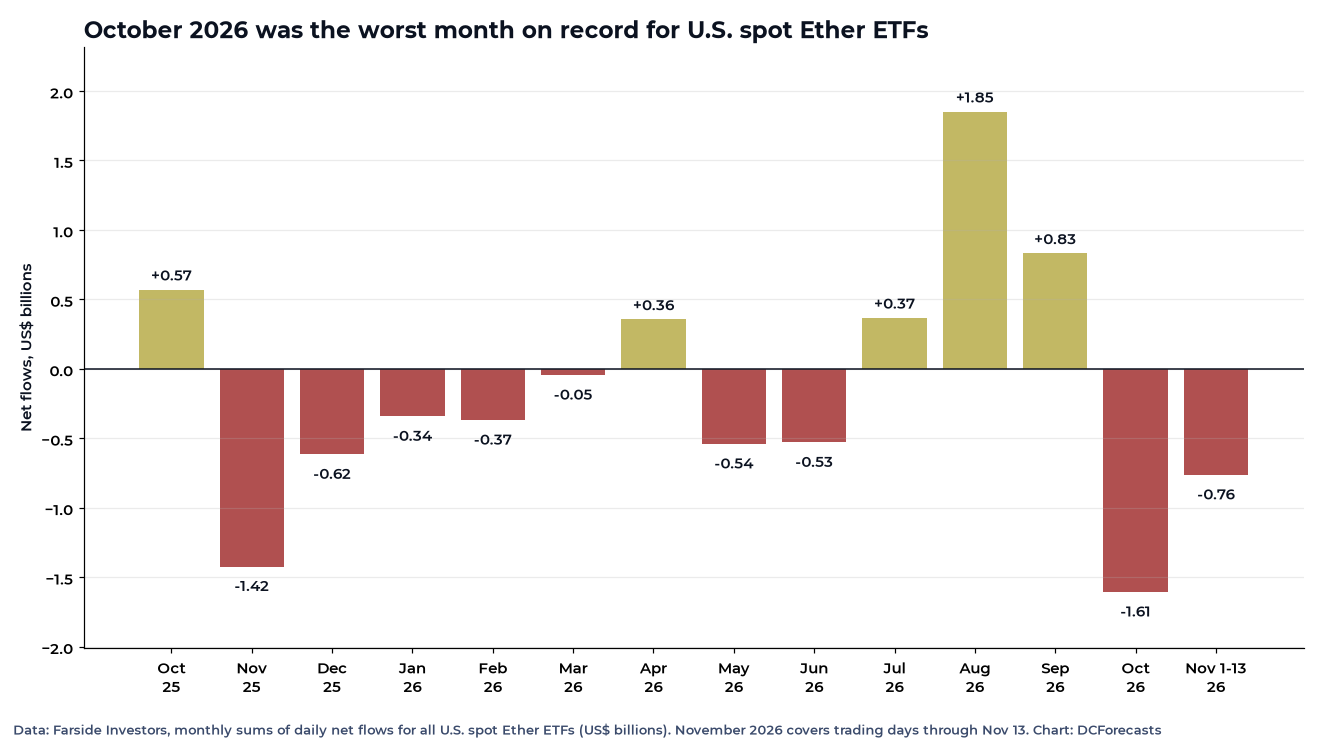
Since Oct. 1, the Ether funds have recorded net outflows on 27 of 32 trading days. Taken together, that run removed $2.37 billion, or about 17% of the cumulative total that stood at the end of September.
Bitcoin ETFs lost about 5% of their cumulative total over the same stretch. October outflows from the Bitcoin funds came to $516 million, and November so far stands at $2.35 billion.
One fund carries most of the Ether selling
The Ether outflows are heavily concentrated. BlackRock’s iShares Ethereum Trust (ETHA) accounted for $2.08 billion of the $2.37 billion that left the group since Oct. 1.

That is a split we have tracked before. Fidelity’s Ether fund has kept attracting money even as ETHA shrank, a pattern we covered in our look at Fidelity’s FETH inflows. Since Oct. 1, FETH has still taken in a net $39 million.
Grayscale’s older, higher-fee Ethereum Trust (ETHE) continues to bleed as well, with $110 million in outflows since Oct. 1. Its cumulative outflows since conversion now total $5.53 billion.
The latest session offered a small change in tone. On Nov. 13, the group posted a net inflow of $2.3 million, led by $11.6 million into FETH. It was the first positive day since Nov. 4, when the funds took in $53 million.
Why Bitcoin ETF holders have been stickier
The chart below tells a simple story. Both groups peaked within a day of each other in October 2025. Since then, Bitcoin ETF holders have mostly stayed put through a deep price drawdown, while Ether ETF holders have repeatedly sold into weakness.
Several reasons help explain the difference. Bitcoin ETFs are now a core allocation for many advisers, pensions and endowments. Recent quarterly filings showed large holders such as university endowments and trading firms keeping or adding to their Bitcoin ETF positions even as prices fell.
Bitcoin also has a simpler pitch. It is a fixed-supply monetary asset with no competing staking yield outside the fund wrapper. For many buyers, a spot ETF is the cleanest way to hold it, which may make holders less likely to switch out.
Ether’s investment case is broader and more complicated. It depends on network fees, staking returns, layer-2 growth and competition from other smart contract platforms. When sentiment weakens, investors in Ether funds appear quicker to cut exposure.
The price action reflects the same pattern. Ether traded near $1,822 late on Nov. 14, down 6.3% in 24 hours, while Bitcoin was near $65,463, down 4.9%, CoinGecko data shows. As our earlier piece on the ETH/BTC ratio showed, Ether has been losing ground to Bitcoin for weeks.
What the numbers do and do not show
Cumulative net flows measure dollars that moved into or out of the funds. They are not the same as assets under management, which also rise and fall with prices.
The figures also exclude the seed assets that Grayscale’s funds carried over at conversion. That is why ETHE’s long run of outflows weighs so heavily on the group total.
Daily flow data can be revised after issuers publish final share counts. The totals above reflect Farside’s tables as of Nov. 14.
Even so, the direction is clear. Both groups face selling in a weak market, but Bitcoin ETF holders have given back far less of their peak investment. The broader crypto sell-off has hit most large tokens harder than Bitcoin, and the ETF data points the same way.
What to watch next
The next test for the Ether funds is whether the Nov. 13 inflow starts a turn or proves to be a one-day pause. A few sessions of steady inflows into ETHA would matter more than gains at smaller funds.
For Bitcoin ETFs, the more useful marker is whether cumulative flows can hold above about $54 billion. Our tracker of Bitcoin ETF flows in November follows that trend week by week.
For now, the gap between the two groups is one of the clearest signs of how institutional demand ranks the two largest crypto assets. In a market under pressure, Bitcoin has kept far more of its institutional base.
DC Forecasts is a leader in many crypto news categories, striving for the highest journalistic standards and abiding by a strict set of editorial policies. If you are interested to offer your expertise or contribute to our news website, feel free to contact us at [email protected]












Discussion about this post