



Ethereum’s next hard fork, Glamsterdam, will not reach mainnet in 2026. Core developers said on their Nov. 19 execution-layer call that mid-January is the earliest realistic date, after an audit tied the upgrade’s gas changes to 200 findings across live applications.
The delay is not a failure of the code itself. It comes from developers choosing to give the apps already running on Ethereum time to adjust before the network changes underneath them.
The call, All Core Devs Execution #249, ended with a rough consensus to keep the current Glamsterdam specification unless a workable alternative emerges. A testnet fork on Hoodi has been penciled in for the week of Dec. 14, with a final go or no-go decision expected on an upcoming consensus-layer call.
Why Two Gas Proposals Stalled the Fork
The holdup centers on EIP-8037 and EIP-8038. Both rework how Ethereum charges gas, the fee that pays for computation and storage on the network.
EIP-8037 changes the cost of creating new state, such as new accounts and storage slots, and adds a separate state-gas reservoir. EIP-8038 reprices access to existing state. Together they are meant to price network resources more accurately as Ethereum scales.
The trouble is that some deployed contracts quietly assume today’s prices. Ethereum Foundation developer Marius van der Wijden wrote on Nov. 6 that testing had found projects that “rely on certain invariants” that the two proposals would break. Based on those findings, core developers decided not to fork the Hoodi testnet until the issues were resolved.
We covered the early stage of that debate in our look at how the repricing split developers over old contracts. Since then, the audits have landed.
What the Audit Found
The Ethereum Foundation hired security firms ChainSecurity and Dedaub to map the damage. ChainSecurity’s public assessment, completed Nov. 18, combined AI-assisted code review with a year of mainnet transaction traces, replaying candidate cases under both the current and proposed gas rules.
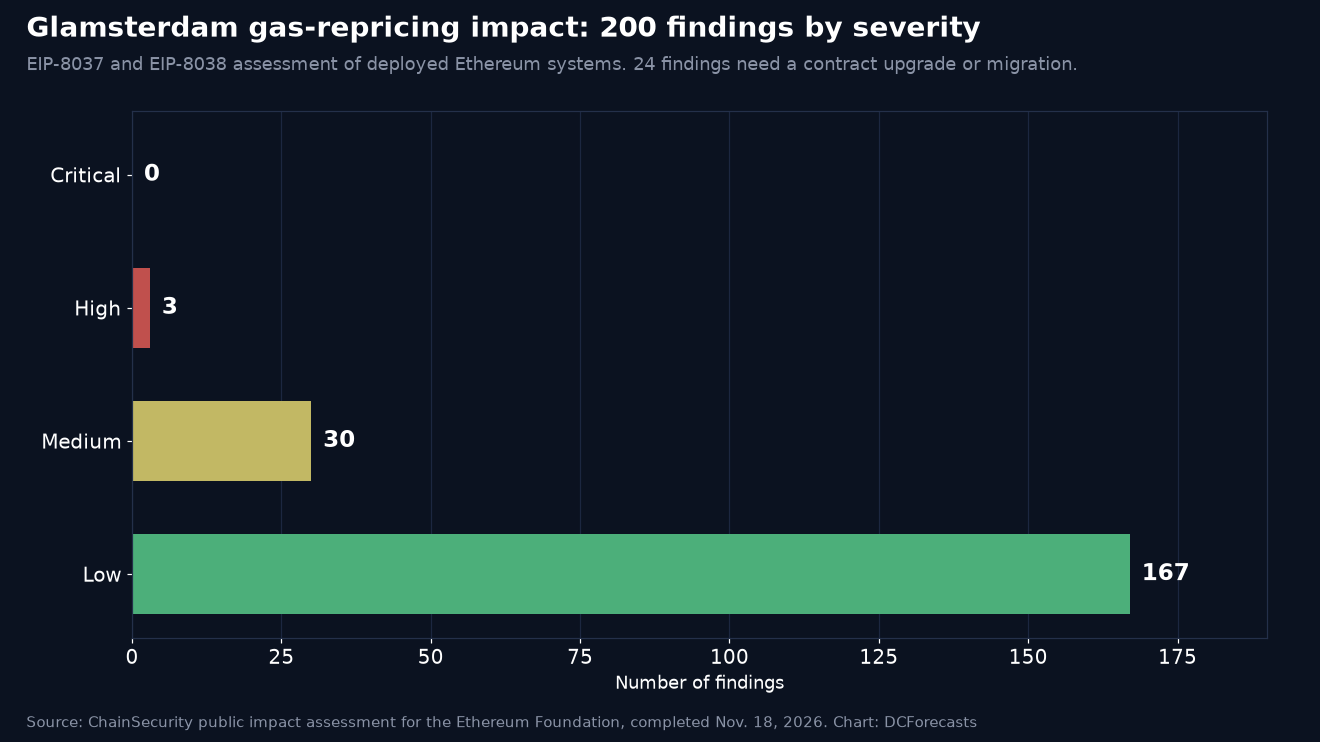
Together with the foundation’s own investigations, the assessment covers 200 findings. None are rated critical. Three are high, 30 are medium and 167 are low.

Affected systems span bridges and messaging layers, wallets, exchanges, governance tools, oracles, staking protocols and off-chain services. The possible consequences range from interrupted operations to locked funds and reward-accounting errors.
The most common cause is simple. Many contracts hardcode a fixed gas budget that would no longer be enough once the new prices apply. ChainSecurity said most findings can be fixed with configuration changes, such as raising those limits. Just 24 require a contract upgrade or migration.
The firm also cautioned that no assessment can catch everything. A system missing from the report is not proof that it is unaffected.
Fix the Apps or Change the Spec?
That left core developers with a choice on Nov. 19. They could ship the gas changes as written and give apps time to patch, or rewrite the proposals to avoid breaking old contracts.
According to the official meeting summary, the Ethereum Foundation’s Rahul reported that outreach to more than 50 affected companies pointed to mid-January as the earliest viable mainnet date if the specification stays unchanged.
Some participants, including Besu’s Justin Florentine, argued for exploring spec changes to protect existing contracts. Others, including van der Wijden, warned that late changes would bring delays and new risks. He explained that one option, moving gas refunds to the end of transactions, could itself break contracts that rely on refunds mid-transaction and sharply raise gas needs for some uses.
Several speakers called the current design “good enough.” Most client teams said they preferred to schedule the fork now and move ahead without changes, while some stayed open to more analysis.
Developers who still want an alternative have a one-week sprint to prepare one, complete with impact analysis and auditor input.
The Road From Here
If the current plan holds, the sequence looks like this:
- A short sprint for any proposed spec changes over the coming week.
- A go or no-go decision on the Hoodi date at the next consensus-layer call.
- A Hoodi testnet fork in the week of Dec. 14, possibly Dec. 16 or 17.
- Mainnet activation no earlier than mid-January 2027.
The process itself is also getting a review. Developers plan to discuss lessons from Glamsterdam on their next testing call, and several raised the need for a sturdier process for future gas changes that touch deployed contracts.
Hegota Work Continues in Parallel
The delay does not freeze Ethereum’s longer-term roadmap. Van der Wijden noted that work on Hegota, the fork after Glamsterdam, is continuing “in parallel in full force.”
On the same call, developers weighed five options for Hegota’s execution-layer scope, from a normal-sized fork to a minimal one focused on post-quantum readiness. Client teams were asked to submit short written positions by the end of next week. The debate also covered which post-quantum signature schemes to support, including hash-based Lean SPHINCS and lattice-based ML-DSA.
For users, the takeaway is reassuring. The issues were found on testnets and in audits, before activation, and most findings can be fixed with configuration changes rather than new contracts. A slower timeline is the price of an upgrade path that puts the safety of live applications first.
DC Forecasts is a leader in many crypto news categories, striving for the highest journalistic standards and abiding by a strict set of editorial policies. If you are interested to offer your expertise or contribute to our news website, feel free to contact us at [email protected]











Discussion about this post