



A single crypto tax audit in Tokyo now brings in close to three times the extra tax of a typical income tax investigation, and Japan’s tax authorities are getting ready to run more of them.
The Tokyo Regional Taxation Bureau audited more than 90 crypto users last year and flagged more than ¥3.9 billion of unreported income, Japanese public broadcaster NHK reported on Nov. 22, citing people familiar with the matter.
That is about $24.5 million at Monday’s exchange rate. NHK said the many crypto users who never file returns are why tax authorities plan to strengthen their audit setup.
For crypto investors, the timing matters. Japan is about to gain visibility into offshore exchange accounts, while a lower flat tax rate for crypto gains moves closer.
The bigger question is whether tougher enforcement and friendlier tax rules together pull more of Japan’s crypto activity into the open.
What Tokyo’s Crypto Tax Audit Numbers Show
The bureau has not yet published its official report for last year, so the NHK numbers are the first look. The official record runs through June 2025, and the trend is clear. In the year from July 2024 to June 2025, Tokyo carried out 202 special and general field audits of individual crypto traders, up from 158 a year earlier, according to the bureau’s December 2025 audit report.
Those audits found ¥8.0 billion of unreported income, up from ¥5.0 billion. Additional tax, including penalties, reached ¥2.5 billion, almost double the prior year’s ¥1.3 billion.
Irregularities turned up in 191 of the 202 cases, or about 95%.
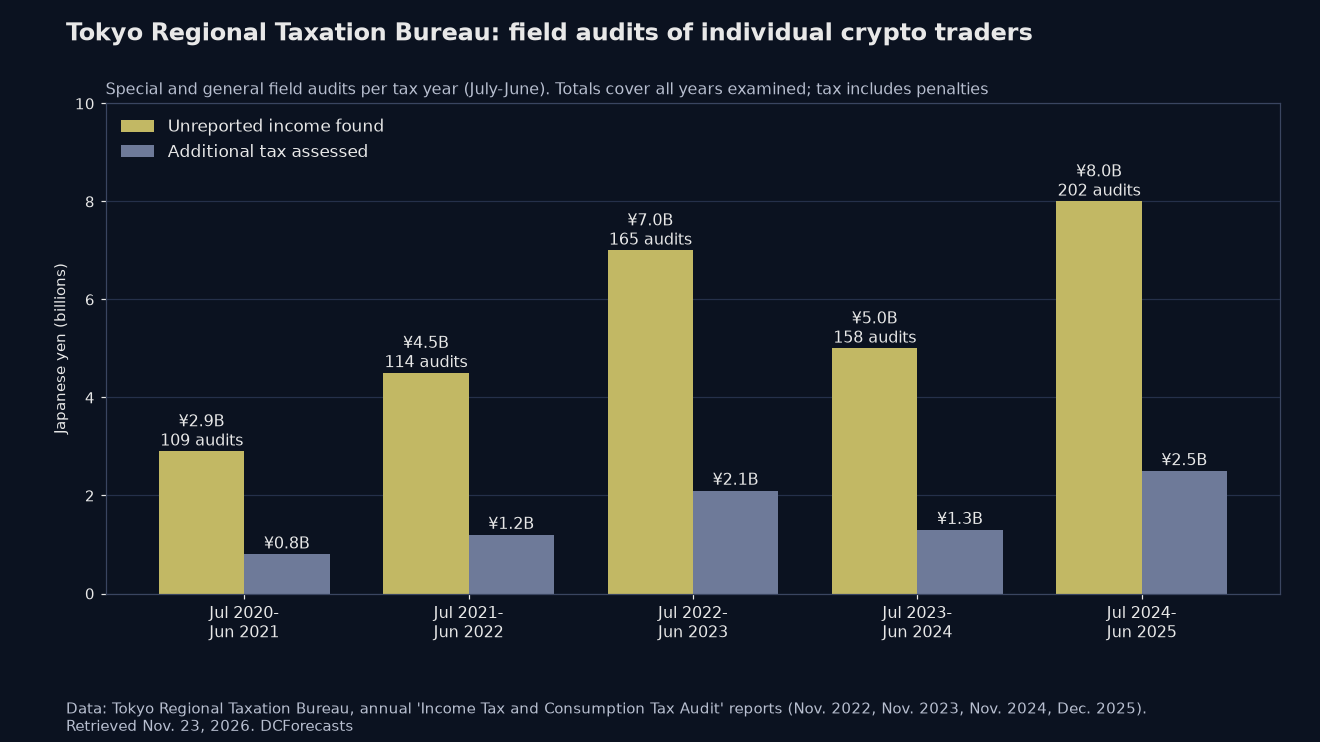
If the NHK figures hold, the newest year saw fewer audits but a similar haul per person. More than ¥3.9 billion spread across a little over 90 people works out to roughly ¥40 million each, in line with the ¥39.5 million average from the bureau’s last official year.

We read that as sharper targeting.
Why Each Crypto Case Brings In More Tax
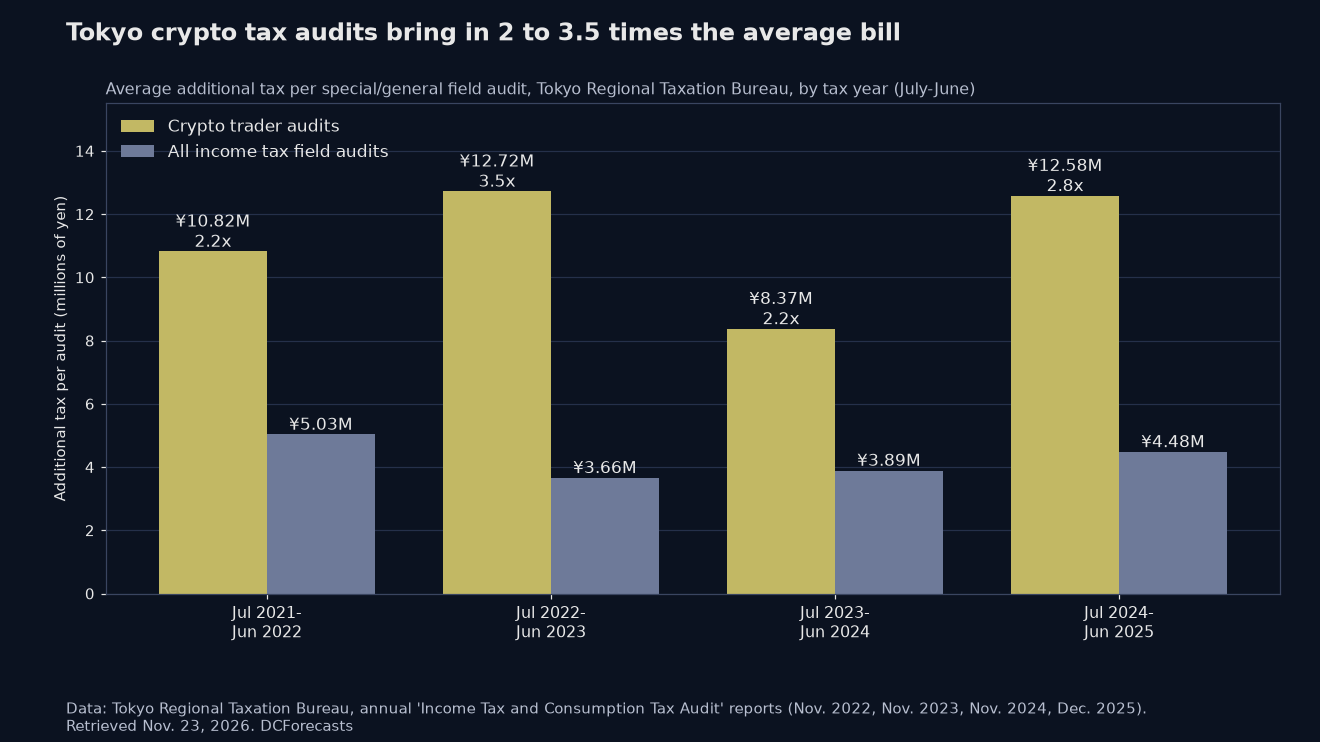
Tokyo’s average additional tax per crypto audit was ¥12.58 million in the year to June 2025. The average across all of its special and general income tax field audits was ¥4.48 million, so the crypto figure was 2.8 times higher.
The gap has held for years, ranging from 2.2 times to 3.5 times in each of the four years shown below.
The national picture tells the same story. Japan’s National Tax Agency ran 613 such audits of crypto traders nationwide in the year to June 2025, up from 535, and found ¥15.6 billion of unreported income, according to its annual income tax audit report.
The agency put the average extra tax per crypto case at ¥7.45 million, 2.5 times the ¥2.99 million average for all such audits. Tokyo alone accounted for about a third of the cases and roughly half of the unreported income.
We think the simplest explanation is size. Bitcoin and other major assets have had big multi-year runs, so unreported profits add up quickly.
Overseas Exchanges Lose Their Blind Spot in 2027
The next phase of Japan’s crypto tax enforcement reaches beyond its borders.
Under the OECD’s crypto asset reporting framework, known as CARF, Japanese crypto exchanges must report 2026 trades by foreign tax residents to the tax office by April 30, 2027, according to the National Tax Agency’s CARF guidance.
The agency says it plans its first exchange of this data with foreign tax authorities by the end of September 2027. More than 70 countries and regions have said they will start CARF exchanges by 2028.
The flow runs both ways, so data on Japanese residents trading on offshore platforms in participating countries should come back to Japan. We believe that pressure on crypto tax evasion is healthy for long-term investors who already file honestly.
A Lower Tax Rate Is Coming for Those Who File
The other half of the picture is far more encouraging.
Today, crypto gains in Japan are generally taxed as miscellaneous income at progressive rates that can reach 55% including local tax. Japan’s fiscal 2026 tax reform changes that for many investors.
According to the Ministry of Finance’s explanation of the reform, gains on “specified crypto assets” sold through registered dealers will be taxed separately at a 15% national income tax rate, or about 20% with local tax, similar to listed stocks.
The reform also lets investors carry losses forward for three years. The new rules apply from January 1 of the year after Japan’s amended Financial Instruments and Exchange Act takes effect.
For a Japan crypto tax regime with top rates of 55%, that is a major shift.
Why We See This as a Sign of a Maturing Market
Stricter audits and lower rates may seem to pull in opposite directions. We think they belong to the same plan.
Japan is treating Bitcoin and other major crypto assets as mainstream investments: taxed like stocks, reported like bank accounts and enforced like any other source of income.
The audience is already large. Japan’s crypto accounts reached a record 14.7 million this year. Neighboring South Korea is still debating its own loss carryforward rules.
We believe the investors who benefit most are long-term Bitcoin holders who keep records and file on time. They get a lower rate once the reform applies.
The next markers are the Tokyo bureau’s official figures for the year to June 2026 and the first CARF reports due on April 30, 2027.
If the reform starts as designed, Japan could move from one of crypto’s toughest tax homes to one of its clearest.
DC Forecasts is a leader in many crypto news categories, striving for the highest journalistic standards and abiding by a strict set of editorial policies. If you are interested to offer your expertise or contribute to our news website, feel free to contact us at [email protected]












Discussion about this post