



Nigeria crypto tax enforcement now has a deadline and a website: every business that provides virtual asset services in Nigeria, or to Nigerian residents, has until November 30 to register on a new tax portal.
The Nigeria Revenue Service (NRS) and the Joint Revenue Board (JRB) set out the rule in a joint public notice this week.
Registration has two steps. Firms must submit a registration form by November 30, 2026, then connect their systems to the portal by December 31, 2026.
The rule applies whether or not a provider has an office in the country. Offshore exchanges serving Nigerians are inside the net.
For Bitcoin users, the bigger question is whether this is a squeeze or a sign that Africa’s most populous country has decided to live with crypto rather than fight it.
What the Nigeria Revenue Service Is Asking For
According to the notice, the NRS deployed the VASP Tax Portal under section 71 of the Nigeria Tax Administration Act, 2025, which allows technology to be used to automate tax administration.
The portal has a dual purpose. It handles tax obligations arising from virtual asset activity, and it registers virtual asset service providers for anti-money laundering, counter-terrorist financing and counter-proliferation financing purposes, in line with Financial Action Task Force Recommendation 15.
The scope is wide. It covers exchanging crypto for naira or other tokens, transfers, custody, running a trading platform, payments and remittances, token issuance and redemption, and staking, lending and borrowing.
The registration form is already live at the NRS VASP registration page.

A provider counts as registered only after both steps are complete. Missing either deadline can bring penalties and other enforcement measures, the agencies warned.
Bitcoin Sits on the Portal’s Short List
The form itself tells us a lot about how Nigeria sees the market.
When we checked the portal on November 22, firms were asked to tick the assets they handle from a fixed list: USDC, USDT, BTC, ETH, HBAR, SOL, XRP, DAI, naira-denominated stablecoins and other stablecoins.
The networks listed are Ethereum, Solana, Hedera, Bitcoin, Polygon, Tron, Base and BNB Chain.
Business types run from exchanges, custodians and wallet providers to OTC desks, payment processors and stablecoin issuers. “Non-resident Entity” is one of the legal forms on offer, which confirms that foreign platforms are expected to sign up.
The portal says detailed API, wallet and testnet information will be collected at a later technical onboarding stage. In its privacy terms, the NRS says it will set up portal access “for the reporting, assessment and remittance of taxes on virtual asset transactions.”
We believe that line matters most. Nigeria is building the plumbing to see transaction data directly, not just collect annual returns.
No New Tax, and No Licence Either
Two clarifications in the notice should calm some nerves.
First, the agencies say the portal does not introduce new taxes or create extra tax obligations. It is the administrative machinery for duties that already exist under the Nigeria Tax Act, 2025 and the Nigeria Tax Administration Act, 2025, both of which took effect at the start of this year.
Second, registering with the tax service is not a licence to operate. Approval to run a crypto business still sits with the Securities and Exchange Commission, the Central Bank of Nigeria and other regulators. Firms can register for tax while they wait for that approval.
The notice also leaves ordinary holders out of scope. Individuals using virtual assets for their own purposes, and merchants that simply accept crypto as payment, are not covered by the registration requirement, although their existing tax duties remain.
That is a sensible line. The regime targets intermediaries, not people holding Bitcoin in their own wallets.
Nigeria is not alone in tightening the paperwork. As we covered this week, the UK crypto tax bill is also redrawing how digital assets are treated, from loans to liquidity pools.
What the Naira Price of Bitcoin Shows
The timing comes during a hard stretch for prices.
CoinGecko data show one Bitcoin cost about ₦81.6 million on November 21, down from a 12-month peak of about ₦137.8 million on January 15 and from roughly ₦123.7 million a year earlier.
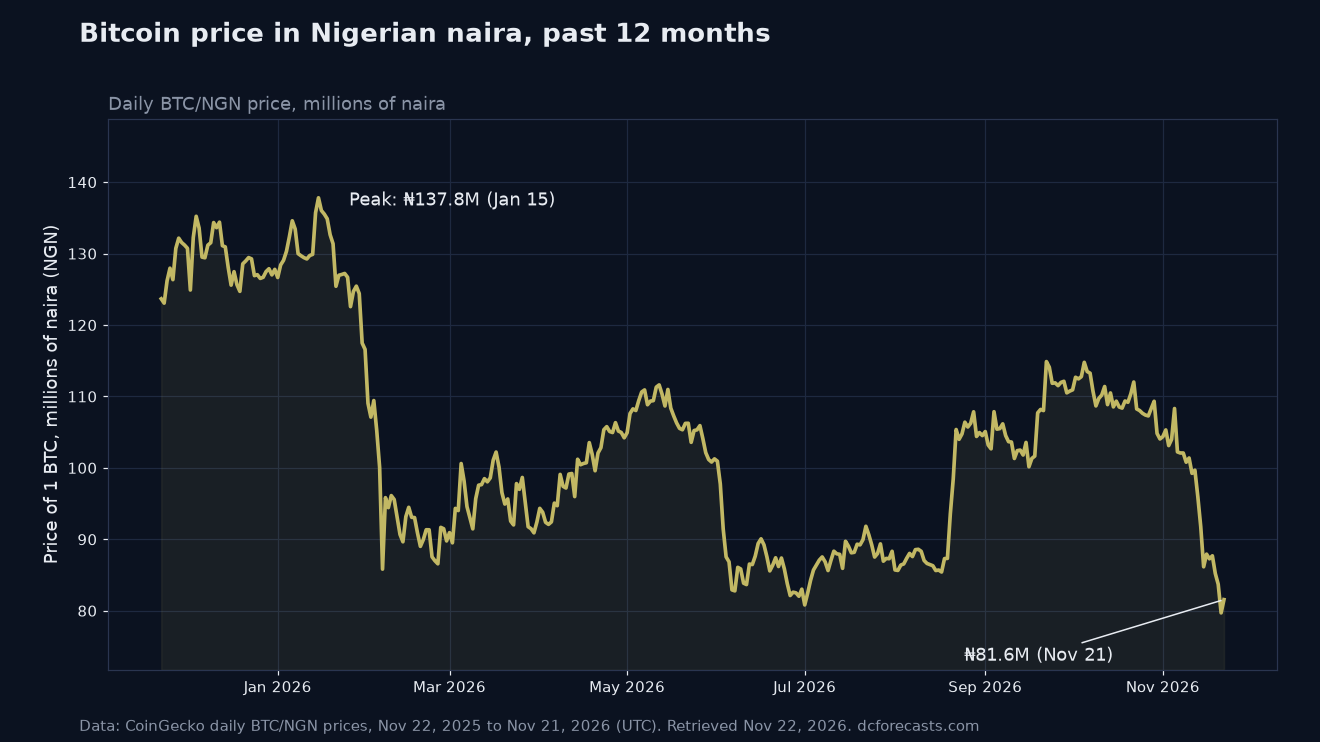
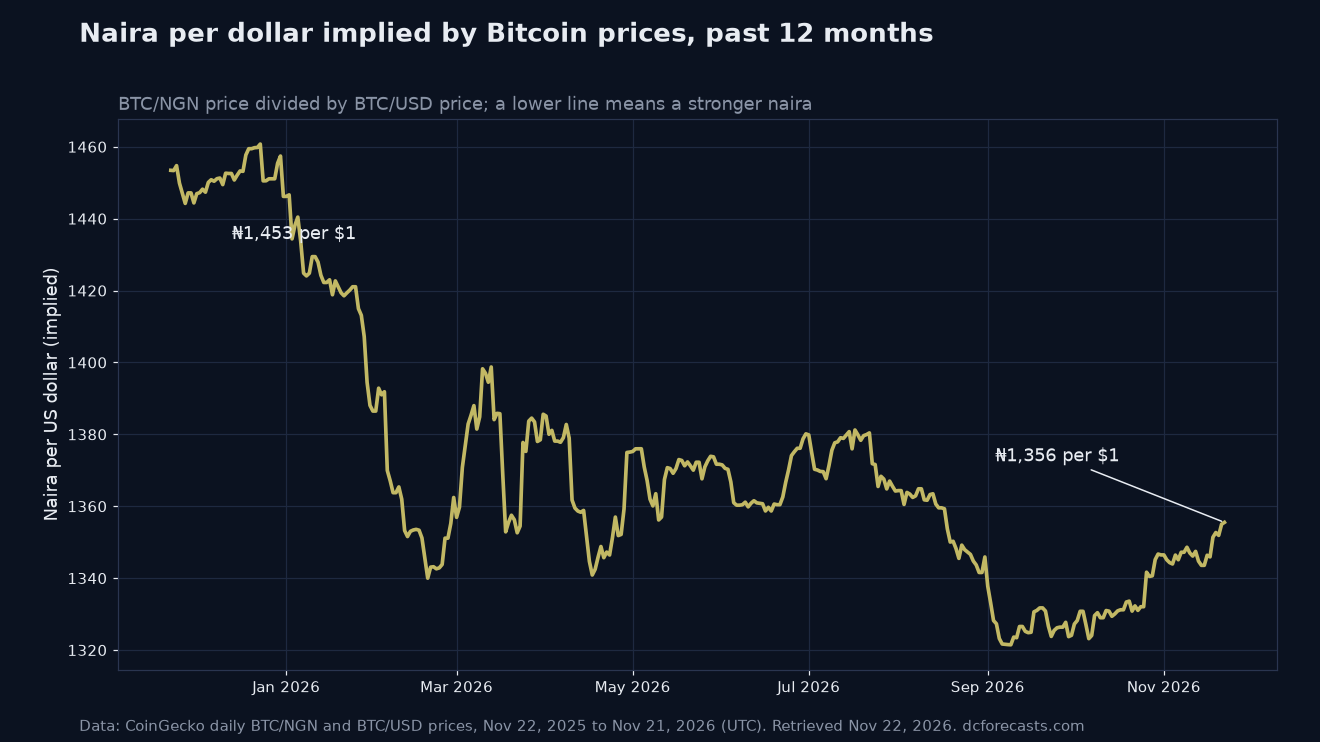
Part of that drop reflects a firmer naira, not only a weaker Bitcoin.
Dividing the BTC/NGN price by the BTC/USD price gives an implied rate of about ₦1,453 per dollar in November 2025. By November 21, 2026, it was about ₦1,356, a naira roughly 7% stronger.
In dollar terms, Bitcoin was trading near $60,150 early on November 22, according to CoinGecko, after bouncing back above $60,000 on Saturday from a slide toward $55,000.
For Nigerian buyers, that means Bitcoin is now far cheaper in naira than it was at the start of the year, just as the rules for local platforms become clearer.
Why Formal Crypto Tax Rules Can Help Adoption
Nigeria’s relationship with crypto has swung hard. The central bank barred banks from serving crypto firms in 2021 before reversing course in late 2023, and the Investments and Securities Act, 2025 brought digital assets under the securities regulator.
A tax portal is the next step in that shift from prohibition to supervision.
We believe that is constructive for Bitcoin over the long run. Exchanges with a clear tax and AML pathway are easier for banks to serve, and naira on-ramps tend to improve when regulators can see who is operating.
There are real costs. Thirty-nine days from November 22 to the integration deadline is a tight window for API work, and smaller platforms may struggle to meet it.
Privacy-minded users should also note that the NRS says it may share portal data with other competent authorities where the law requires or permits it.
Still, the structure is clear: register intermediaries, leave self-custody alone and tax activity that already exists. For a country with one of the world’s most active grassroots crypto markets, the coming weeks will show how many platforms choose to come inside the system before December 31.
DC Forecasts is a leader in many crypto news categories, striving for the highest journalistic standards and abiding by a strict set of editorial policies. If you are interested to offer your expertise or contribute to our news website, feel free to contact us at [email protected]












Discussion about this post