


Maryland can keep enforcing its sports wagering laws against Kalshi, a federal appeals court ruled on Wednesday, Nov. 18. The decision makes the Fourth Circuit the third federal appeals court to side with a state in the fight over sports event contracts.
The vote was 2-1, but the panel did not agree on much beyond the result. The published opinion in KalshiEX LLC v. Martin contains a one-line per curiam affirmance, two concurrences built on different legal theories, and a dissent that would have ruled for Kalshi.
That split matters. It leaves the core question for prediction markets unsettled, just as a federal deadline from the Commodity Futures Trading Commission approaches.
How the Kalshi Maryland Case Got Here
The dispute began on April 7, 2025, when Maryland’s gaming regulators sent Kalshi a cease-and-desist letter. They said the company was offering wagering on sporting events without the state license that sportsbooks must hold, and gave it 15 days to stop.
Kalshi sued on April 21, 2025. It argued that its contracts are swaps traded on a CFTC-designated contract market, so the Commodity Exchange Act gives the CFTC exclusive jurisdiction and pushes state gambling law aside.
A federal district judge in Baltimore denied Kalshi a preliminary injunction on Aug. 1, 2025. The Fourth Circuit heard arguments on May 7, 2026, and has now affirmed that decision. It is a ruling on a preliminary injunction, not a final judgment on the merits.
Two Judges, Two Different Reasons
Judge Roger Gregory never decided whether Kalshi’s sports contracts are swaps. Even assuming they are, he wrote, the law does not clearly push Maryland out.
“Because the regulation of gambling has long been a matter of traditional state police power, I would not infer that Congress displaced Maryland’s concurrent authority absent a clear expression of its intent to do so,” Gregory wrote.
He also warned that Kalshi’s reading would let anyone “circumvent state gambling laws by repackaging ordinary gambling as futures trading.” And he left a door open: Maryland has concurrent authority “until Congress and the CFTC are clear.”

Judge Stephanie Thacker got to the same result by another road. In her view, Kalshi’s sporting event contracts are not swaps under the act at all, so they sit outside the CFTC’s exclusive authority and Maryland can co-regulate them.
Judge DeAndrea Gist Benjamin dissented. She concluded the contracts do qualify as swaps, that Maryland’s laws are field preempted, and that the lower court’s order should be vacated. “Just because the CFTC hasn’t disapproved Kalshi’s sports-related contracts under its regulations, doesn’t mean Maryland can regulate Kalshi in its place,” she wrote.
A Growing Split Among the Courts
Gregory’s concurrence lists the rulings so far, and the tally leans toward the states. The Sixth Circuit found no preemption in April 2026, and the Ninth Circuit did the same on Aug. 28, 2026. The Third Circuit is the outlier. It upheld an injunction that blocks New Jersey from enforcing its gaming law against Kalshi.
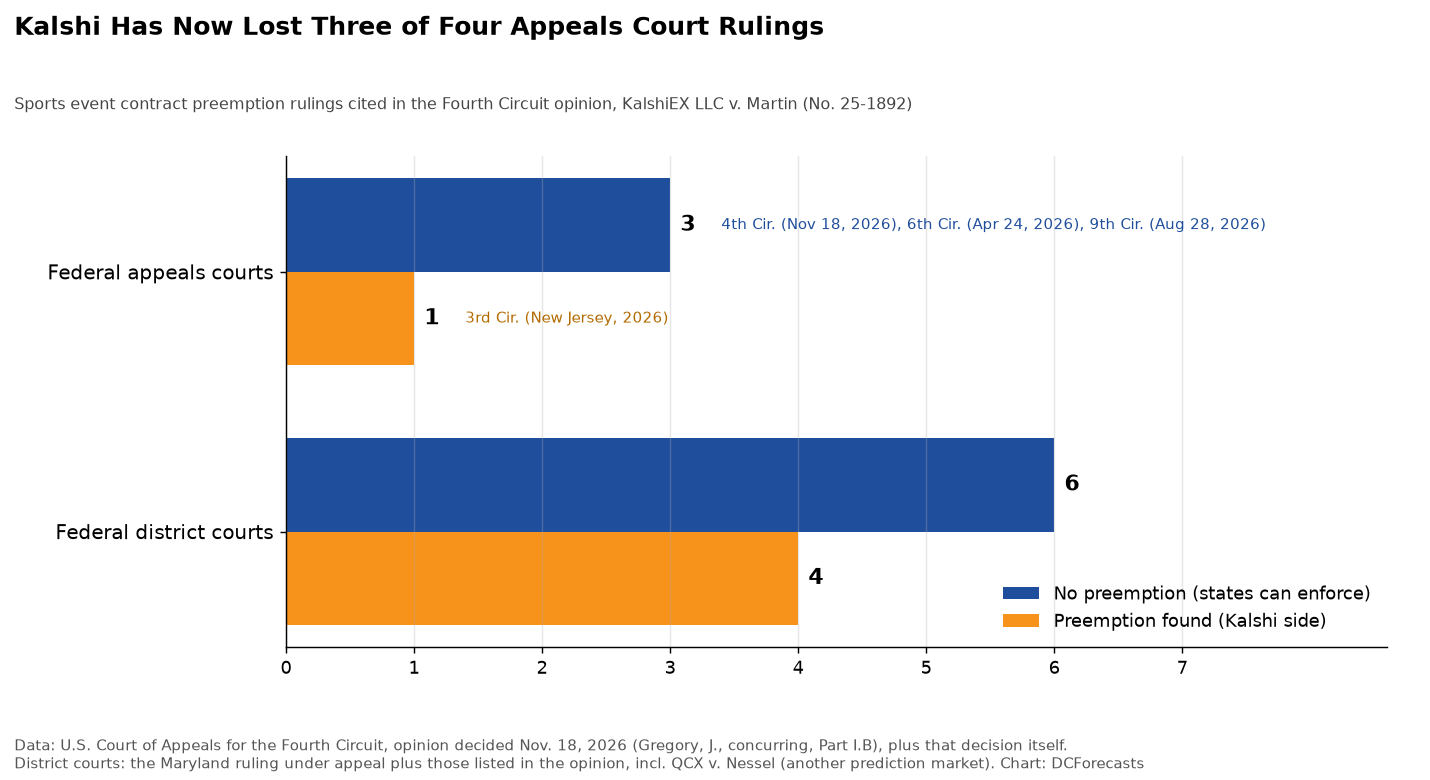
District courts are split as well. Courts in Nevada, Ohio, New York, Michigan and Utah found no preemption, along with the Maryland trial court. Judges in New Jersey, Arizona, Tennessee and Minnesota went the other way.
When federal appeals courts read the same statute in opposite ways, the Supreme Court is often the place that settles it. For now, Kalshi’s legal footing depends on which circuit a state sits in.
Maryland Had Plenty of Company
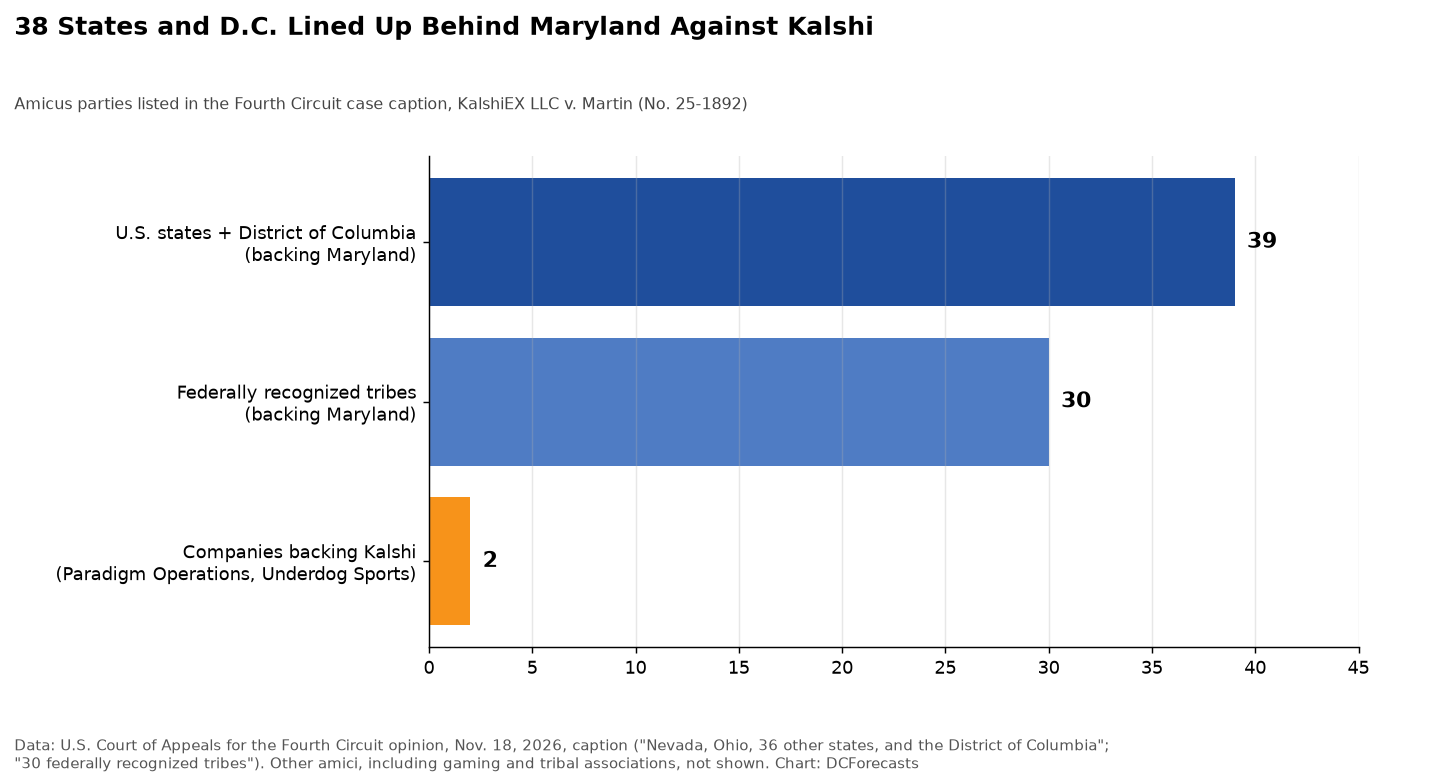
The case caption shows how much support Maryland drew. Nevada, Ohio, 36 other states and the District of Columbia filed as friends of the court on Maryland’s side. So did 30 federally recognized tribes, gaming and tribal associations, and several advocacy groups. Two companies, Paradigm Operations and Underdog Sports Holding, backed Kalshi.
Maryland Attorney General Anthony Brown welcomed the result. “Today’s ruling means Kalshi must meet the same consumer protection standards as every other sportsbook serving Maryland residents,” he said in a statement.
“Federal commodities rules were never designed to provide those safeguards,” Brown added, pointing to the state’s rules on data security, deceptive advertising and marketing to people barred from betting.
The CFTC’s December Deadline
The ruling arrives in the middle of a separate standoff in Washington. On Nov. 5, the CFTC issued an interpretation telling designated contract markets to end domestic geographic restrictions within 30 days, or explain why they cannot. That window runs to early December.
“Derivatives markets must operate on a uniform basis at a national scale,” CFTC Chairman Michael Selig said at the time. We covered the order in our report on the 30-day deadline for state geoblocks.
Courts in several states have ordered the opposite. That is why nine Democratic senators asked Selig this week to withdraw the interpretation, as we reported in our story on their letter. The agency has also sued 12 states in 2026 to defend its claim over event contracts.
Wednesday’s ruling makes that collision harder to avoid. An exchange that drops its location limits could run into court orders in states that won. One that keeps them may have to explain itself to its federal regulator.
What This Means for Crypto Markets
The Fourth Circuit’s decision is narrow. It covers sports event contracts at the preliminary injunction stage, and it does not touch the CFTC’s oversight of regulated futures markets more broadly.
Still, it is a reminder that the rules for new kinds of markets are being written in courtrooms, one circuit at a time. Gregory’s own line points to the fix: clarity from Congress and the CFTC.
We think that clarity would help the whole digital asset sector, including Bitcoin. Clear federal lines tend to attract regulated capital, and Bitcoin has already benefited from that through spot ETFs and CFTC-regulated futures. For prediction markets, the next signals are the December compliance deadline and whether Kalshi asks the full Fourth Circuit or the Supreme Court to step in.
DC Forecasts is a leader in many crypto news categories, striving for the highest journalistic standards and abiding by a strict set of editorial policies. If you are interested to offer your expertise or contribute to our news website, feel free to contact us at [email protected]











Discussion about this post