


Coinbase Derivatives runs its trades through a clearinghouse that just got a green light from the CFTC to settle with members through trust companies rather than only banks, and that clearinghouse says it is preparing to take stablecoins as margin.
The Commodity Futures Trading Commission announced the staff position on November 5, 2026. It came just seven days after the request landed.
The change sounds technical. We believe it matters because the trust companies in question are some of the main firms that hold digital assets in custody.
For anyone trading regulated crypto futures in the United States, the question is whether this quiet piece of back-office plumbing makes crypto collateral a routine part of clearing.
What the CFTC Letter Actually Says
The Division of Clearing and Risk issued CFTC Letter No. 26-30, a no-action letter signed by Acting Director Richard Haynes.
It answers an October 29 request from Nodal Clear, LLC. The issue is narrow but real.
Regulation 39.14 governs how a derivatives clearing organization, or DCO, settles with its clearing members at least once each business day. It defines a “settlement bank” as “a bank” and never mentions trust companies.
Yet the customer protection rules under Section 4d of the Commodity Exchange Act already let customer funds sit with a “bank or trust company.” The settlement rule simply never caught up.
Staff will not recommend enforcement against any DCO that uses a trust company for daily settlements, as long as it treats that trust company as if it were a settlement bank under Regulations 39.14(c) and (d).

In practice, the clearinghouse must apply the same selection criteria, ongoing monitoring, exposure limits and settlement-finality agreements it already demands of banks.
Why Nodal Clear Asked, and Where Coinbase Derivatives Fits
Nodal Clear is the registered clearing house for two CFTC-designated contract markets, Nodal Exchange and Coinbase Derivatives, according to its request letter.
It is wholly owned by Nodal Exchange, which in turn belongs to European Energy Exchange AG. It also follows the stricter “Subpart C” rules written for systemically important clearinghouses.
The request is direct about the motive. Nodal Clear writes that it “is preparing to accept stablecoins as initial margin collateral.”
It adds that state-regulated trust companies “are among the leading custodians of digital assets.” Letting them handle daily settlement would let clearinghouses fold those assets into their existing collateral workflows.
There is an important guardrail. Once the GENIUS Act takes effect, Nodal Clear says it will only accept stablecoins that comply with that law and its implementing rules.
The letter also points to earlier groundwork, including CFTC Staff Letter 25-40 from December 8, 2025, on digital assets accepted as margin collateral, and Executive Order 14405 from May 19, 2026.
What the CFTC Data Shows About Nano Bitcoin Futures
The venue this clearinghouse serves is not a sideshow. The CFTC’s own Commitments of Traders reports show how much its small-sized Bitcoin contracts have grown.
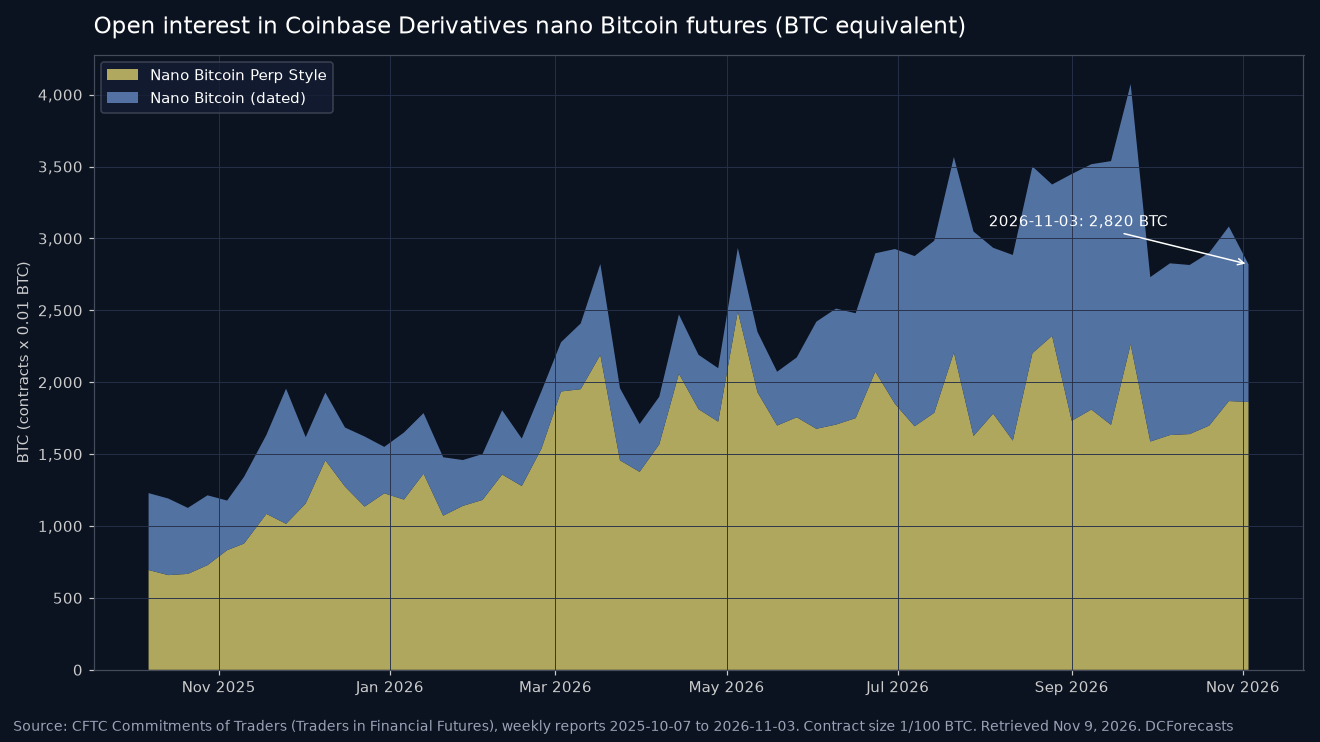
On November 3, 2026, open interest in the Nano Bitcoin Perp Style contract stood at 186,307 contracts, or about 1,863 BTC. The dated Nano Bitcoin contract held 95,678 contracts, or about 957 BTC.
That is roughly 2,820 BTC combined. On October 7, 2025, the same two contracts added up to about 1,229 BTC, so open positions are up about 129% in just over a year.
The picture is not one straight line. Combined open interest peaked near 4,074 BTC on September 22, 2026, and has since fallen about 31%.
We read that pullback as positions being cleared out during a choppy autumn, not as demand vanishing. The year-over-year base is still more than twice as large.
It mirrors what we saw on the bigger stage, where CME Bitcoin futures shorts dropped to their lowest since 2023.
Why Tokenized Collateral Needs Better Plumbing
Clearinghouses move margin every day. If a crypto custodian cannot sit inside that daily settlement loop, digital collateral stays awkward to use.
Nodal Clear’s request lists the appeal of tokenized collateral, including near-instant settlement, collateral movement around the clock and more variety in the assets backing positions.
Seen that way, the letter removes a mismatch between two parts of the rulebook rather than creating a new exemption. Regulation 39.14, the letter notes, has not been substantively revised since 2011.
It also fits a broader pattern. US regulators are moving crypto market structure through formal channels, as when SEC crypto rules on broker capital and custody reached the White House budget office.
We believe that steady, rules-based approach is exactly what institutional desks need before they commit serious balance sheet to crypto derivatives.
What This Does Not Do Yet
A no-action letter is not a rule change. The letter says it reflects the division’s view only and does not bind the full Commission.
It also rests on Nodal Clear’s own representations, and staff can modify, suspend or end it. Any clearinghouse relying on it must still meet every other requirement.
Stablecoin margin itself still depends on the GENIUS Act’s implementing framework. Nodal Clear has said it is preparing, not that it has started.
Is Regulated Crypto Clearing Ready for Bigger Volume?
We would watch three things: whether other clearinghouses lean on the letter, whether Coinbase Derivatives’ nano Bitcoin futures open interest climbs back toward its September high, and how quickly GENIUS Act rules arrive.
Each step tightens the link between Bitcoin markets and mainstream financial infrastructure.
Bitcoin’s fixed 21 million supply does not change with any rulebook. What does change is how easily regulated money can reach it, and this week that path got a little smoother.
DC Forecasts is a leader in many crypto news categories, striving for the highest journalistic standards and abiding by a strict set of editorial policies. If you are interested to offer your expertise or contribute to our news website, feel free to contact us at [email protected]











Discussion about this post