



HIVE Digital Technologies pulled more bitcoin out of the network in its latest quarter than it did a year ago, even though each coin was worth far less. The miner’s quarterly report filed with the SEC on November 9 shows it received 1,070 BTC in the three months to September 30, up about 49% from 718 BTC in the same period of 2025.
That extra output came from a much larger fleet, most of it in Paraguay. It arrived alongside a fast-growing AI hosting business that has just lined up a $128.9 million loan to buy NVIDIA GB200 GPUs.
More coins, lower prices
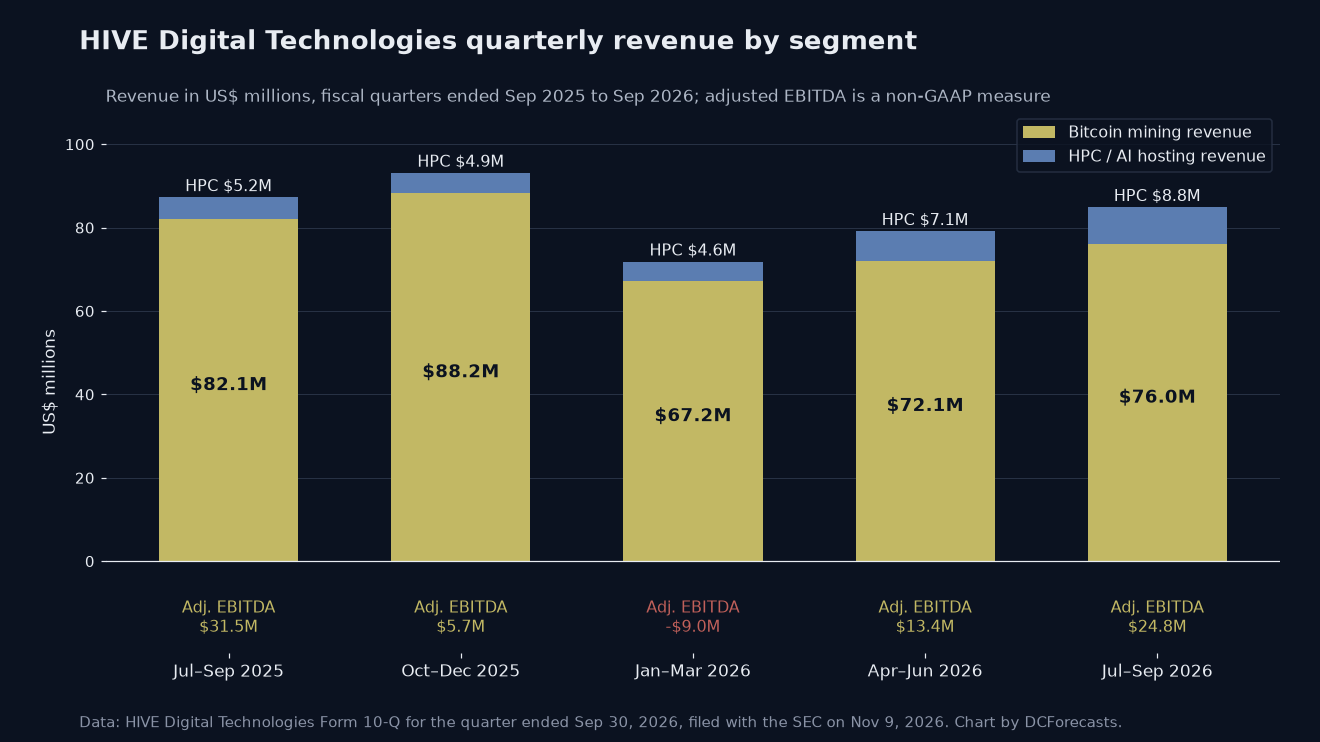
Revenue from bitcoin mining was $76.0 million, compared with $82.1 million a year earlier. The filing pins the decline on price: HIVE’s average realized bitcoin price fell to $71,003 from $114,382. Higher hashrate, plus a slight dip in average network difficulty to 128 trillion from 130 trillion, offset much of that drop.
Put simply, HIVE produced about 49% more bitcoin while the average price it received was roughly 38% lower. That is the kind of operating base that benefits most if bitcoin recovers, because every extra coin mined now is worth more in a stronger market.
Costs grew with the fleet. Operating and maintenance costs for mining rose to $50.4 million from $42.1 million, with electricity alone at $45.6 million versus $37.9 million. Depreciation climbed to $54.9 million from $38.3 million after HIVE added ASIC machines in Paraguay during fiscal 2026. As a result, the gross operating margin from mining slipped to $25.7 million from $40.0 million.
A loss on paper, but cash earnings improved
The bottom line still shows a loss. HIVE reported a net loss from continuing operations of $78.7 million, against $15.8 million a year earlier. The figure includes a $31.2 million non-cash impairment of equipment, $7.3 million from changes in the fair value of derivatives and $8.6 million of share-based compensation.
Adjusted EBITDA, a non-GAAP measure, tells a different story. It reached $24.8 million, up from $13.4 million in the April to June quarter and well above the $9.0 million loss in the January to March quarter. It remains below the $31.5 million posted a year ago, when bitcoin traded well above $100,000.
The company kept more bitcoin on its balance sheet, too. Digital currencies at September 30 mainly consisted of 269 BTC, up from 150 BTC at March 31. HIVE sold digital currencies for $70.0 million in cash during the quarter and recorded a $1.8 million realized gain on those sales.
Paraguay now does most of the work
As of October 31, HIVE said its installed fleet was about 25.8 EH/s at stock settings, with an implied efficiency of 16.7 joules per terahash. After running some machines in an optimized mode, installed hashrate was about 24.2 EH/s at 15.8 J/TH.

The site table shows how concentrated that capacity has become. The Yguazú facility in Paraguay was running 12,112 PH/s and drawing 195.9 MW of its 200 MW available. The Valenzuela site added another 7,097 PH/s. Together, the two Paraguayan sites delivered about 80% of the 23,964 PH/s HIVE had operating.
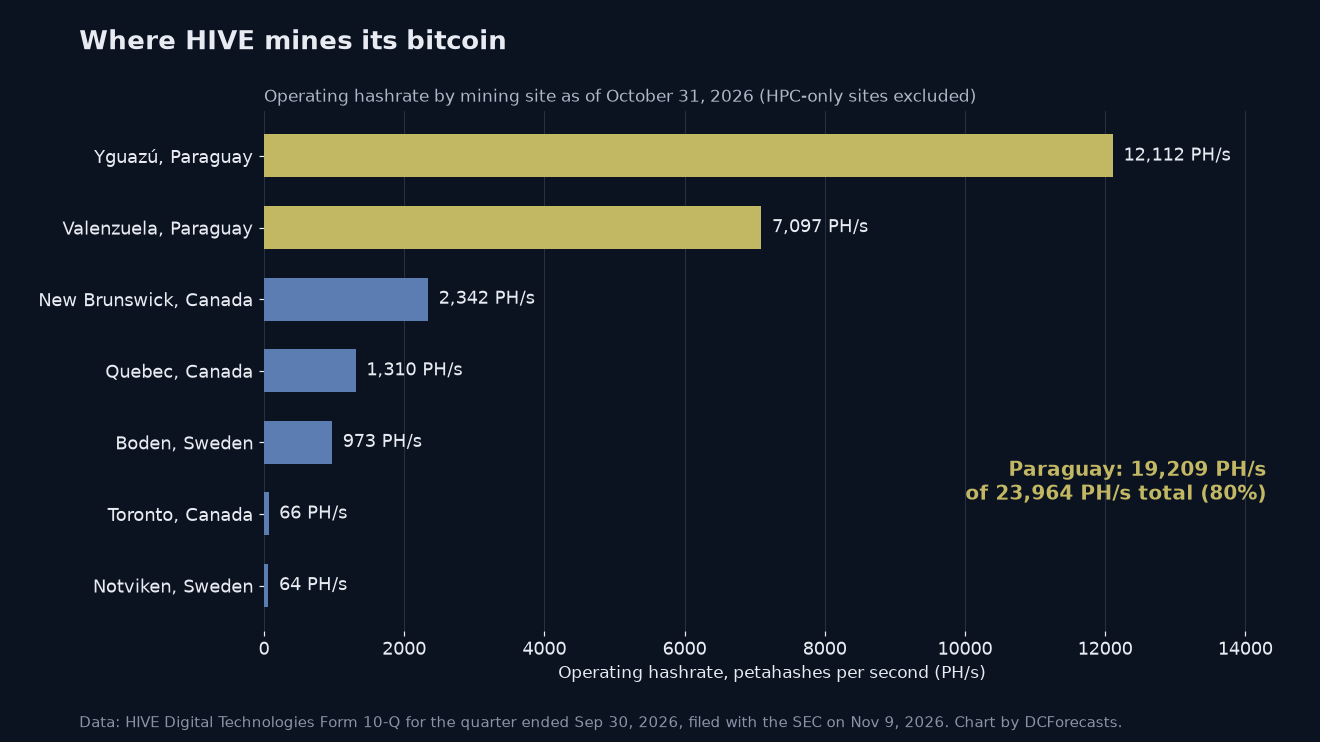
The rest of the fleet sits in Canada and Sweden, including 2,342 PH/s in New Brunswick, 1,310 PH/s in Quebec and 973 PH/s in Boden. Canada and Sweden are also home to HIVE’s HPC data centers, including hosted facilities in Montreal and Stockholm, which is where its second business is growing.
The AI hosting push gets a $128.9 million credit line
High-performance computing hosting brought in $8.8 million, up from $5.2 million a year earlier. The 10-Q credits a two-year contract announced on February 13, 2026, which pays gross monthly recurring revenue of $1.25 million. The segment’s gross operating margin nearly doubled to $4.5 million.
After quarter-end, HIVE’s BUZZ Alpha Cloud subsidiary signed a loan and security agreement for about $128.9 million with an institutional lender. The money will buy NVIDIA GB200 GPUs and related infrastructure for a three-year fixed-term customer contract. The loan carries a fixed 9.0% rate, is repaid in equal monthly payments over three years and is secured by the GPUs, which HIVE will own outright at the end of the term.
HIVE is following a path seen across the sector. Core Scientific has leaned on AI colocation revenue, while MARA sold bitcoin to repay its BTC-backed loans. HIVE, by contrast, ended the quarter holding more bitcoin than it had in March.
Why the extra hashrate matters for bitcoin miners
The filing notes that the next halving is expected in April 2028, when block rewards will be cut in half again. Miners that lock in cheap power and efficient machines before then are better placed to keep producing coins through the cut.
HIVE’s quarter shows that trade-off clearly. Margins are under pressure at current prices, and the GAAP loss is large. Still, the company is mining about half as many coins again as a year ago, holding a growing reserve and building a contracted AI revenue stream that does not depend on the bitcoin price.
Investors watching bitcoin mining stocks will be looking for two things next. First, whether the Paraguay fleet keeps output near this level. Second, how quickly the GB200 contract starts adding revenue. If bitcoin moves back above the $83,209 price HIVE used at the end of September, the extra coins it is now producing would translate directly into stronger mining revenue.
DC Forecasts is a leader in many crypto news categories, striving for the highest journalistic standards and abiding by a strict set of editorial policies. If you are interested to offer your expertise or contribute to our news website, feel free to contact us at [email protected]












Discussion about this post