


Core Scientific has sold almost all of its Bitcoin, and its latest quarterly filing shows exactly where the company is putting its power instead: AI data centers.
The miner sold 3,374 BTC for $286.8 million in the first nine months of 2026, leaving just 32 coins on its balance sheet at the end of September, down from 2,537 at the start of the year.
Over the same stretch, colocation revenue from AI and high-performance computing customers jumped to $215.4 million in the third quarter, about 14 times the year-earlier figure.
For Bitcoin investors, the most interesting part is not the sale itself but what the network did while one of its best-known miners stepped back.
The bigger question is whether the shift of public miners into AI hosting weakens Bitcoin, or simply hands block rewards to the miners who stay.
What Did Core Scientific’s 10-Q Reveal?
The numbers come from the Form 10-Q Core Scientific filed with the SEC on November 5.
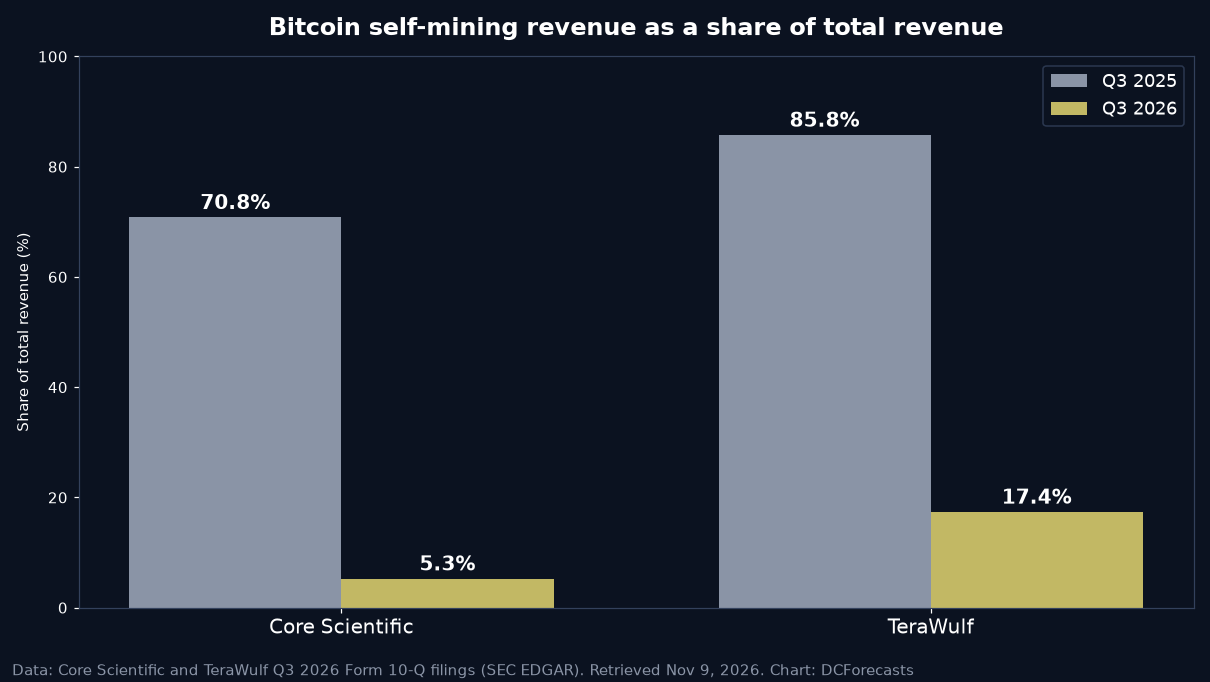
Total third-quarter revenue reached $232.9 million, up from $81.1 million a year earlier.
Almost all of that growth came from colocation, which brought in $215.4 million against $15 million in the third quarter of 2025.
Self-mining revenue went the other way, falling to $12.3 million from $57.4 million.

The company said the bitcoin it mined fell 66% year on year in the quarter, while the average Bitcoin price it realized was 38% lower.
The filing is direct about the direction of travel. Core Scientific says it is winding down self-mining, is not investing in new mining equipment and expects its hosted mining business to end by December 31, 2026.
Its consolidated gross margin rose to 53% from 5%, which helps explain why management is moving so quickly.
Why Did the Miner Sell 3,374 Bitcoin?
Core Scientific says it sold the coins to fund planned capital spending and other cash needs as it converts its sites for AI tenants.
It mined only about 869 BTC over the nine months, so the sales ran well ahead of fresh production and cleared out the reserve it built in earlier years.
The 3,374 BTC were sold over nine months, not dumped in one session, and the company says it will be “opportunistic” about selling the 32 coins it has left.
In other words, this source of supply is now almost used up.
A treasury of 32 coins can no longer weigh on the market in any real way.
TeraWulf’s Bitcoin Mining Cost Shows the Same Shift
TeraWulf, which filed its own 10-Q on November 6, is moving in the same direction.
Its high-performance computing lease revenue climbed to $63 million in the third quarter from $7.2 million, while bitcoin mining revenue fell to $13.2 million from $43.4 million.
The company mined 186 BTC in the quarter, compared with 377 a year earlier, after curtailing or repurposing parts of its Lake Mariner campus in New York.
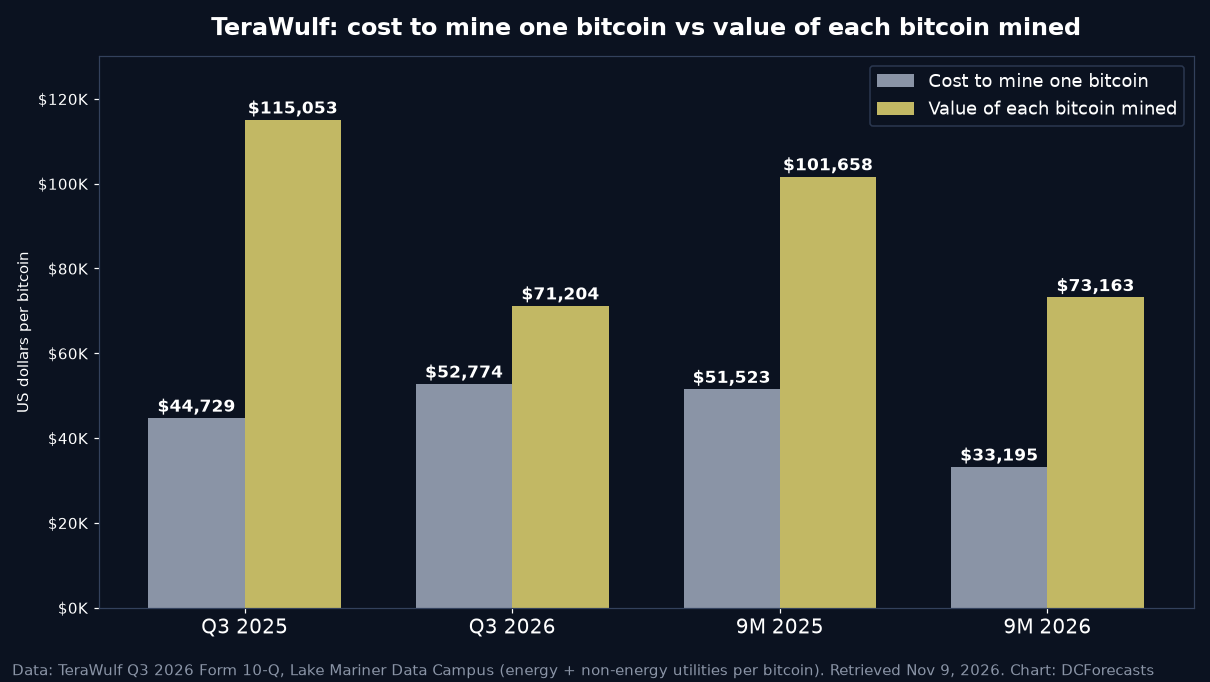
TeraWulf put the energy and utility cost of mining one coin at $52,774 in the third quarter, against an average value of $71,204 for each bitcoin it mined.
That cost equals 74.1% of each coin’s value, up from 38.9% a year earlier, as power rose to about 6 cents per kWh and Bitcoin traded lower.
Does the AI Pivot Weaken the Bitcoin Network?
The data says no.
Bitcoin’s hashrate is running at about 976 EH/s, according to mempool.space data pulled on November 9, with difficulty near 148.4 trillion.
As we covered when hashrate held near 980 EH/s ahead of a difficulty cut, the network keeps adjusting so that blocks keep coming roughly every ten minutes, whoever is mining them.
When a large miner leaves, difficulty adjusts, and the remaining miners collect a larger share of the same block rewards and fees.
We believe that makes the pivot healthy rather than worrying, because hashpower moves to operators who see mining as their core business.
The power contracts, grid connections and cooling that AI companies now want were often built for Bitcoin mining first.
Core Scientific’s July agreement with AMD, which it says could support up to 2.5 GW of leasable capacity, sits on that foundation. We first looked at that trend when Riot Platforms signed its AI deal.
What Should Bitcoin Investors Watch Next?
Bitcoin was trading near $74,700 on November 9, according to CoinGecko data, inside the nine-month range Core Scientific reported, from $57,779 to $97,877.
From here, we would watch three signals:
- Hashrate: whether it stays near 1,000 EH/s as more public miners shift capacity to AI.
- Difficulty: the size of the next adjustments, which decide how much each remaining miner earns.
- Miner treasuries: how much Bitcoin other public miners report holding in their quarterly filings.
For us, the main takeaway is simple.
Core Scientific’s selling is nearly over, and the network it is leaving behind keeps running at close to record strength.
With a fixed supply, a self-correcting difficulty and a growing base of dedicated miners, Bitcoin does not need any single company to stay secure.
The next few quarterly reports will show whether the miners staying in Bitcoin end up collecting more of the rewards that the AI converts leave behind.
DC Forecasts is a leader in many crypto news categories, striving for the highest journalistic standards and abiding by a strict set of editorial policies. If you are interested to offer your expertise or contribute to our news website, feel free to contact us at [email protected]











Discussion about this post