



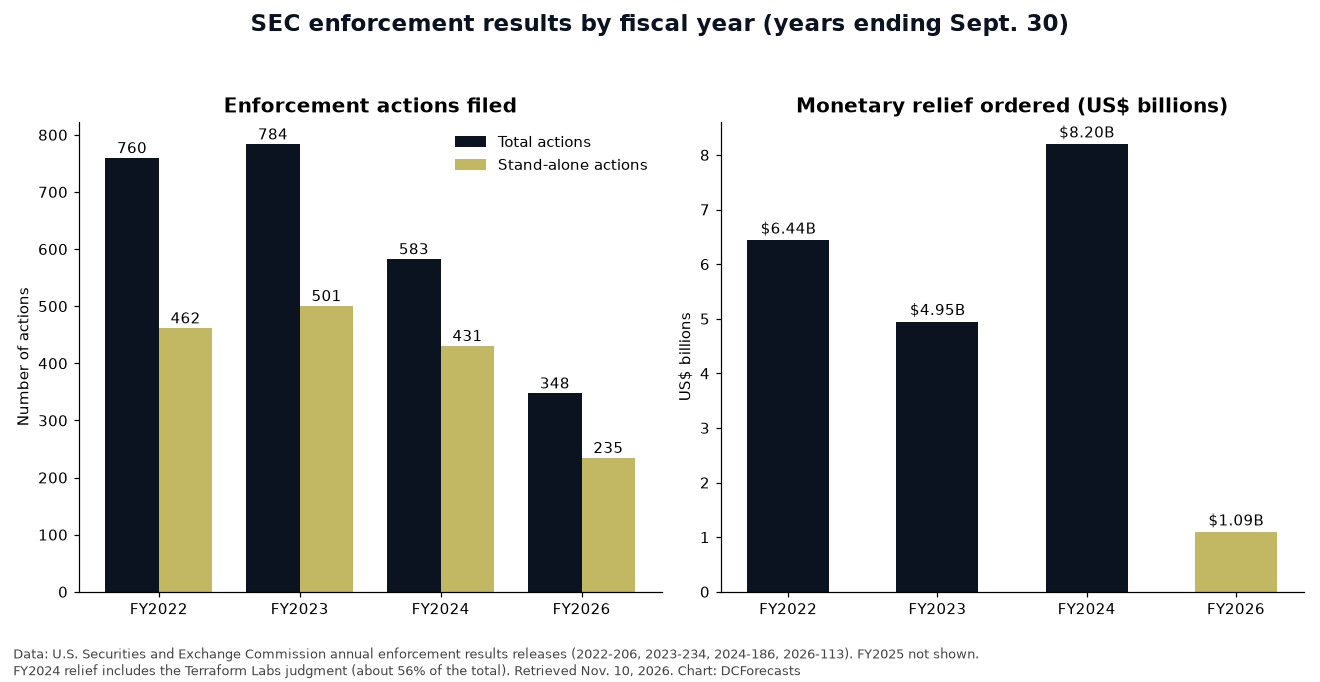
SEC enforcement actions dropped to 348 in fiscal 2026, the Securities and Exchange Commission said on Tuesday, less than half the 784 it filed three years earlier. Monetary relief fell to $1.095 billion.
The crypto cases the agency chose to spotlight tell a clear story. They were scams, Ponzi schemes and fake trading platforms that took money from ordinary investors.
We believe that is a healthier mix for the industry. A regulator chasing outright fraud protects holders, while honest builders get more room to work.
What the SEC reported for fiscal 2026
The fiscal year ended on September 30. Over those 12 months, the Commission filed 235 stand-alone actions and 113 follow-on administrative proceedings, which seek bars or suspensions after criminal convictions, injunctions or other orders.
It also put 13 trading suspensions on Asia-based issuers over suspected manipulation, much of it pushed through social media.
Of the $1.095 billion in ordered relief, $752 million was disgorgement and prejudgment interest and $343 million was civil penalties. The SEC said $235 million of that disgorgement was deemed satisfied by a court in a separate non-SEC action.
The agency returned about $731 million to more than 250,000 harmed investors during the year. Two-thirds of stand-alone cases charged at least one individual.
How SEC enforcement actions compare with earlier years
The drop is steep, and it is worth stating plainly. The SEC filed 760 actions in fiscal 2022, 784 in fiscal 2023 and 583 in fiscal 2024, according to its own annual releases.
Stand-alone cases, the cleanest measure of new work, went from 501 in fiscal 2023 to 431 in fiscal 2024 and 235 this year.

Money tells a similar story, with one caveat. Fiscal 2024’s record $8.2 billion was heavily shaped by a single case: about 56% came from the jury win against Terraform Labs and Do Kwon.
Chairman Paul S. Atkins pushed back on reading too much into raw totals. “Enforcement actions and financial remedies are important measures of activity, but they are not the only or most telling measures,” he said.
Which crypto cases made the list?
Crypto appears in the release mostly where fraud is involved. The SEC said it charged three purported crypto asset trading platforms and four investment clubs that allegedly took at least $14 million from retail investors and moved the money overseas.
Those schemes recruited victims on social media with investment tips supposedly generated by what the agency calls super intelligence, or SI.
The Commission also charged the founder and CEO of a bitcoin mining business for allegedly raising more than $95.6 million from about 6,400 investors and misappropriating $48.5 million.
In February 2026, a jury found Ismael Sanchez liable for securities fraud and registration violations tied to CryptoFX, a $300 million Ponzi scheme that the SEC says targeted more than 40,000 mostly Latino investors.
Older files also closed out. A court ordered a BitConnect promoter to pay $731,281 in disgorgement plus interest and a $50,000 penalty, and the SEC settled with an audit partner over negligent audits of FTX.
Why fraud-focused enforcement is good news for Bitcoin holders
None of these cases go after Bitcoin itself, and none of them go after people simply using a blockchain. They go after people allegedly lying to investors and taking their money.
That matters because fraud is the thing that hurts newcomers most. Fake platforms and promised returns do real damage, both to victims and to the reputation of honest projects.
We have seen how much trust matters in this market, from the ex-FBI agent who admitted taking crypto from bureau cases to the hardware wallet security debates of recent weeks.
A regulator that spends its time on scams, rather than on whether every token is a security, gives the market a clearer set of rules. In our view, that clarity is what brings in cautious capital over time.
New tools aimed at blockchain fraud
The Division of Enforcement also set up an Office of Super Intelligence and Analytics during the year. The SEC said its work includes anomaly detection, faster document review and “improved blockchain and financial-flow analysis.”
A new Retail Fraud Working Group has already produced more than a dozen investigations, the agency said, and a Financial Reporting and Accounting Unit now handles complex accounting cases.
The SEC also signed a memorandum of understanding with the Commodity Futures Trading Commission on joint enforcement matters. That fits a wider pattern of the two agencies working together, which we covered when Coinbase and Kalshi backed the CFTC in its stock perps fight.
What to watch next
Lower case counts do not mean bad actors get a free pass. The SEC said it updated its Enforcement Manual for the first time since 2017, standardized the Wells process and plans to review the manual every year.
It also rescinded Rule 202.5(e), the long-running policy that barred defendants who settle from publicly denying the allegations.
For crypto, the key test is whether this approach holds: firm action against fraud and steady rules for everyone else. The full figures are in the SEC’s fiscal 2026 enforcement results release.
We believe a market that sees scammers charged and honest players left to build is a market with a stronger base for Bitcoin’s next leg of adoption.
DC Forecasts is a leader in many crypto news categories, striving for the highest journalistic standards and abiding by a strict set of editorial policies. If you are interested to offer your expertise or contribute to our news website, feel free to contact us at [email protected]












Discussion about this post