



The Trump Bitcoin reserve has not bought a single coin on the open market, and the reason is legal authority, not a lack of interest, according to the man who ran the White House crypto council until October.
Patrick Witt, the council’s former executive director, said in a What Bitcoin Did podcast interview released this week that President Donald Trump still wants the government to add bitcoin.
“I can tell you the president’s interested in it. I can tell you that there has been a lot of discussion about how we might be able to do that,” Witt said.
For Bitcoin holders, that is the headline worth keeping. The appetite at the top has not faded.
The harder question is who gets to sign off on the purchases, and how they would be paid for.
Why the Strategic Bitcoin Reserve Has Not Bought Yet
Trump created the Strategic Bitcoin Reserve by executive order in March 2025. It was seeded with bitcoin the government already held through completed forfeiture cases.
The order told the Treasury and Commerce departments to develop budget-neutral ways to acquire more, meaning strategies that would not add costs for taxpayers. No such plan has been published.
Witt was direct about the obstacle. “It’s of questionable legality whether or not there could be outright open market purchases,” he said.
Congress controls federal spending, and an administration that buys an asset without clear authority invites a fight it may not win.

“We didn’t necessarily want to do something that then had a boomerang effect and led Congress to actually put a rider in the NDAA that says you cannot do this,” he said, referring to the annual defense authorization bill.
“We’re trying to get to the place where it is permitted and where the authority is granted,” Witt added.
We believe that caution is a sign of seriousness. A rushed purchase that triggered a legal ban would have set the policy back for years.
Gold Revaluation and Other Budget-Neutral Ideas
The most discussed budget-neutral idea involves the government’s gold, and the numbers explain why it keeps coming up.
The Treasury held about 261.5 million fine troy ounces of gold on October 31, according to its monthly gold reserve report. It books that metal at a statutory price of $42.2222 an ounce, for a total of roughly $11.04 billion.
At a gold price near $4,036 an ounce on Wednesday, the same holdings would be worth about $1.06 trillion. The book value is roughly 1% of that figure.
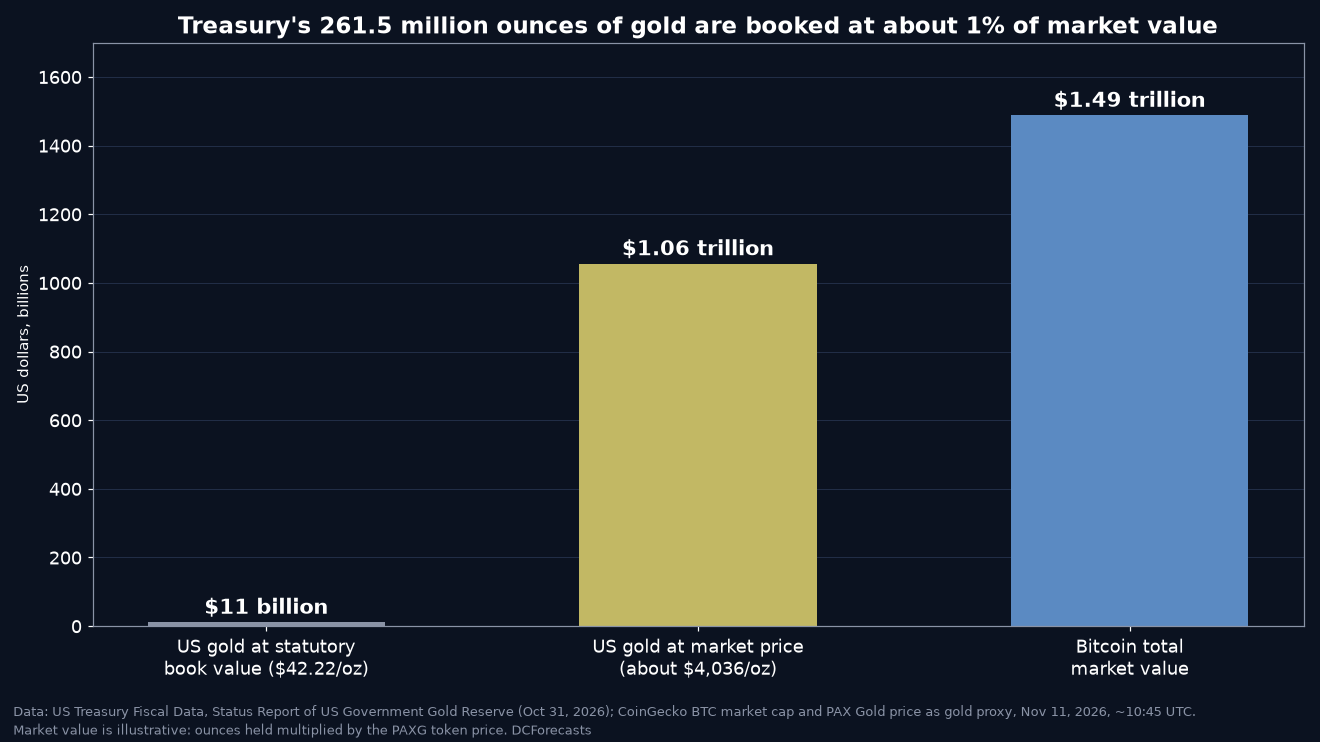
Proposals backed by bitcoin advocates in Congress would tap part of that accounting gap. Senator Cynthia Lummis’s BITCOIN Act, for example, envisions the government accumulating up to one million BTC over five years.
Other ideas include swapping some government-held digital assets into bitcoin or using funds the Treasury already controls. None of these routes is automatic. Each would need legal backing.
The scale comparison is still striking. Bitcoin’s whole market value sat near $1.49 trillion on Wednesday, with BTC trading around $74,000.
Custody Problems in Washington’s Bitcoin Pile
Witt also described a messier issue: knowing exactly what the government already holds.
He said the audit of federal bitcoin holdings was unfinished, with agency records of varying quality. Some agencies kept cold wallets in desk drawers, while others relied on outside custodians.
That matches a pattern we have tracked. A former FBI agent recently admitted taking $2.47 million in crypto from 35 bureau investigations.
The stakes are rising as seizures grow. The government is still waiting on a final ruling over 127,271 bitcoin seized in the Prince Group case.
For us, fixing custody is a precondition for a credible US Bitcoin reserve. A nation that holds bitcoin should hold it at least as carefully as a regulated fund does.
Can a Divided Congress Make the Reserve Permanent?
Witt was blunt about writing the reserve into law. “It’s going to be hard. It’s going to be really hard,” he said.
Parts could ride on a larger bill, he suggested, but “passing a standalone bill around that is going to be incredibly difficult with a divided Congress.”
The interview was recorded before the November 3 midterm elections. The results since then have made the math tougher, as we covered when Tom Emmer won the House minority whip race and crypto bills began to need Democratic votes.
Without legislation, the reserve rests on an executive order that a future president could change. Witt noted that unwinding a predecessor’s orders is often among the first things a new administration does.
What Bitcoin Holders Should Watch Next
Other governments are not standing still. Kazakhstan has already invested $190 million of its crypto reserve, a reminder that state-level crypto reserves are spreading beyond the United States.
In Washington, we would watch three signals: any Treasury statement on a budget-neutral acquisition route, the next defense authorization bill’s text, and a public tally of federal bitcoin holdings.
The reserve already stops the government from dumping forfeited coins on the market. That alone removed a recurring source of supply.
And with a president who still wants to buy, the debate has shifted from whether the United States should own bitcoin to how it can legally own more.
DC Forecasts is a leader in many crypto news categories, striving for the highest journalistic standards and abiding by a strict set of editorial policies. If you are interested to offer your expertise or contribute to our news website, feel free to contact us at [email protected]












Discussion about this post