



A former FBI agent has admitted to quietly draining about $2.47 million in cryptocurrency from wallets the bureau itself had uncovered during its own investigations.
Patrick Steven Yaroch, 37, of Ashburn, Virginia, pleaded guilty on November 5 to wire fraud and money laundering in federal court in Alexandria, according to the U.S. Attorney’s Office for the Eastern District of Virginia.
Prosecutors say he made roughly 100 fraudulent transfers using wallet credentials tied to 35 separate FBI cases.
For Bitcoin holders, the most striking detail is not the size of the theft. It is how it happened: nobody broke a blockchain, they simply walked off with stored keys.
The bigger question now is whether Washington’s growing pile of seized crypto is guarded as carefully as the assets deserve.
How Did an FBI Agent Get Access to Seized Crypto Keys?
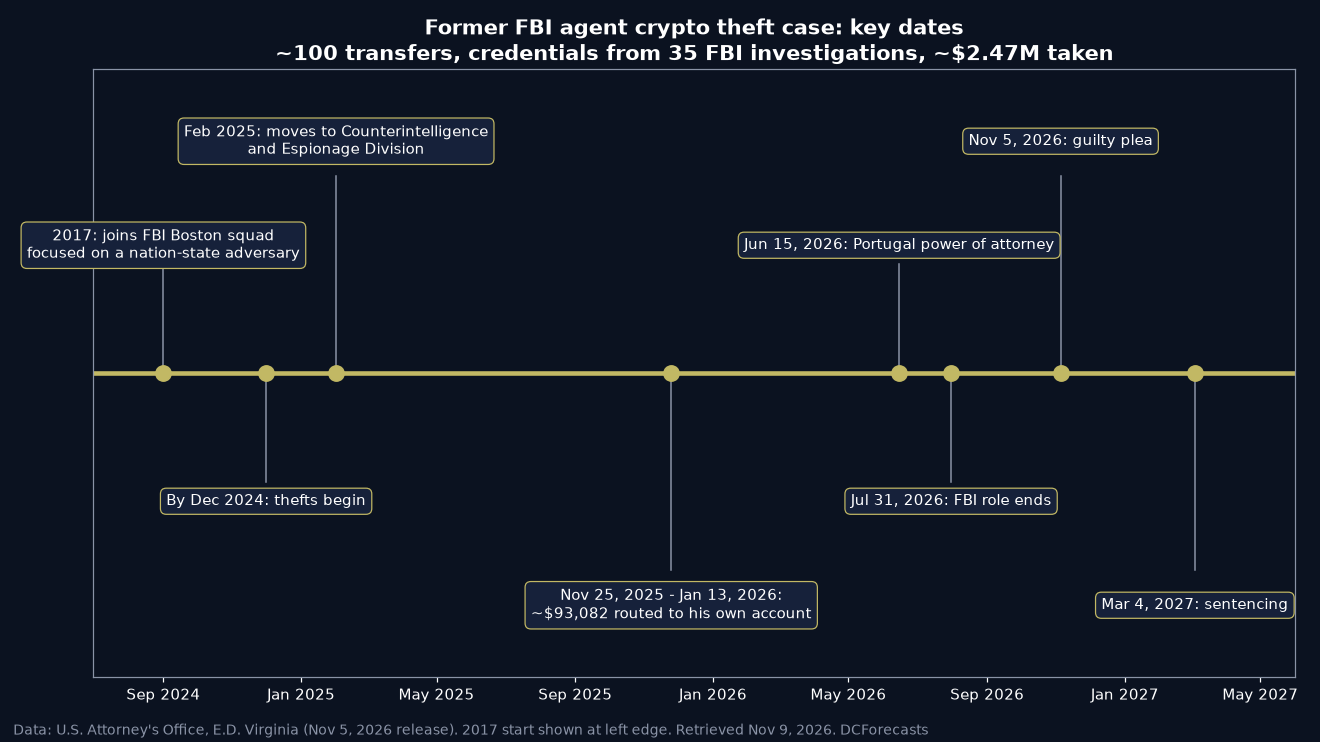
According to the plea documents summarised by prosecutors, Yaroch joined an FBI Boston squad focused on an adversarial nation state in 2017.
From February 2025 until July 31, 2026, he worked in the bureau’s Counterintelligence and Espionage Division.
That role gave him access to FBI systems holding cryptocurrency credentials gathered during investigations.
Beginning no later than December 2024, he used those credentials to move funds out of wallets controlled by investigation subjects, by nation-state actors and from at least one wallet the FBI had created for an operation.

The total, as stated by the Justice Department, came to $2,474,380.66.
After each move, he swapped the coins into a different cryptocurrency and pushed them through further transactions to hide their origin.
A Vineyard in Portugal and a Paper Trail That Never Disappears
The money did not stay hidden for long.
Between November 25, 2025, and January 13, 2026, prosecutors say about $93,082 landed in one of Yaroch’s own accounts and went toward credit cards, car payments and other loans.
He also planned a new life abroad. The release says he asked ChatGPT where to live in the European Union and how to maximise investment profits.
After the chatbot suggested a Portuguese vineyard, he gave lawyers in Portugal a power of attorney on June 15, 2026, and arranged travel there for September.
His FBI tenure ended on July 31, 2026. He now faces up to 20 years in prison at sentencing on March 4, 2027.
We believe the lesson is simple. Value moved on public ledgers leaves a record that does not fade, and investigators can rebuild the path step by step.
Why This FBI Agent Case Is Really About Key Custody
The theft did not exploit any weakness in Bitcoin’s code or in any other network’s consensus rules.
It exploited a person with access to secrets stored in a database.
In crypto, whoever controls the private key controls the coins. That is the rule that makes self-custody so powerful for ordinary holders.
It also means institutions that hold other people’s keys need strict controls: split signing authority, multi-person approval and constant audits.
Prosecutors said Yaroch’s actions compromised investigations into criminal groups and nation-state adversaries, as well as FBI sources and methods.
For us, the key takeaway is that strong cryptography works best when the human process around it is just as strong.
We have seen the same pattern elsewhere. As we covered when a crypto insider received five years for minting 1 billion HLG tokens, insider access remains one of the hardest risks to manage in this industry.
What Does It Mean for the Strategic Bitcoin Reserve?
The timing matters because the U.S. government is now a long-term Bitcoin holder by policy.
The March 6, 2025 executive order told the Treasury to set up a Strategic Bitcoin Reserve funded with Bitcoin that was finally forfeited in criminal or civil cases.
The order says Bitcoin deposited into the reserve shall not be sold and must be held as a reserve asset of the United States.
It also required every agency to give the Treasury a full accounting of its digital assets, including the custodial accounts holding them, within 30 days.
A case like this one shows why that accounting step is so important.
We believe clear custody standards for government-held coins would strengthen confidence in the reserve, not weaken it.
Enforcement against bad actors around crypto also keeps building. Treasury recently moved to cut MEXC off from the U.S. financial system, another sign that illicit flows are being traced and acted on.
How Is Bitcoin Holding Up Through the Noise?
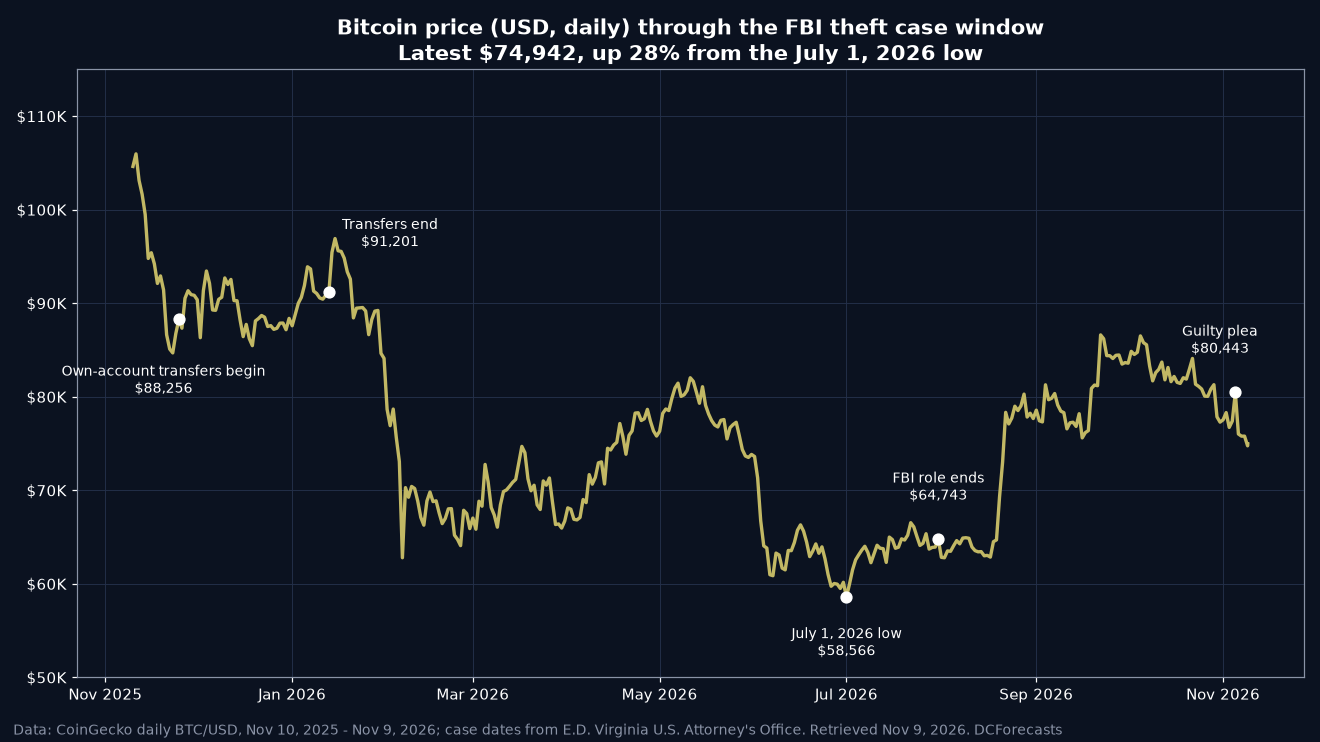
Bitcoin traded near $74,942 early on November 9, according to CoinGecko data, down about 1% over 24 hours.
That is lower than the $80,443 level on the day of the plea, as the wider market cooled after the midterm elections.
Yet the bigger picture is far more constructive. Bitcoin is still up about 28% from its July 1 low of $58,566.
A return to $80,000 would require a gain of roughly 6.7% from current levels, well within the swings Bitcoin has posted over a few weeks this year.
We would watch spot ETF flows, Tuesday’s inflation data and the $75,000 area as the near-term guide.
None of that changes Bitcoin’s core design. Its supply is capped at 21 million coins, a point the executive order itself highlights.
Cases like this one do not weaken that thesis. They show that the network keeps a permanent public record while the people around it are held to account.
The coming months, including the March sentencing, will show how seriously agencies take custody. If that discipline improves, a stronger Strategic Bitcoin Reserve may be one of the quiet winners.
DC Forecasts is a leader in many crypto news categories, striving for the highest journalistic standards and abiding by a strict set of editorial policies. If you are interested to offer your expertise or contribute to our news website, feel free to contact us at [email protected]












Discussion about this post