


Square bitcoin payments have reached their deadline. Back in March, Block’s bitcoin product lead Miles Suter said Bitcoin acceptance was expected to be available to all Square merchants by November 10, 2026. That date passed on Monday. Square’s Support Center now says bitcoin payments settled in dollars are switched on by default for eligible U.S. business locations.
A café or barber shop that already runs Square can now take a Lightning payment from a customer’s phone and still see dollars land in its account, without touching a wallet or an exchange.
How a Square Bitcoin payment works
Square describes two ways to take a payment. In the first, the seller picks Bitcoin at checkout and the screen shows a QR code. The buyer scans it with a Lightning-enabled wallet, and Square says the payment settles in seconds.
The second is newer. On the Square Register (2nd generation), the buyer can choose Bitcoin on the customer-facing display and tap a phone to pay over NFC, the same short-range radio used for contactless cards. Square says tap-to-pay bitcoin is not available on Square Terminal, Square Stand or mobile devices.
By default, every bitcoin sale is converted and settled in U.S. dollars. Sellers who would rather keep the coins can choose to receive bitcoin instead. Separately, Square’s Bitcoin Conversions feature lets a business route a set percentage of its daily card sales into bitcoin, a kind of automatic savings plan run from the same dashboard.
The fee math: zero until 2027
The headline term is the price. Square says bitcoin payments carry a 0% processing fee until December 31, 2026. From January 1, 2027, the fee becomes a flat 1% per transaction. That is the same whether the seller takes the payment as bitcoin or as dollars.
The promotional window means the next seven weeks of holiday trade run at no processing cost. Conversions are priced differently. Square charges 1% on the converted amount, so a seller converting 10% of $1,000 in daily sales would receive $99 of bitcoin and pay a $1 fee, according to Square’s own example.
Limits, refunds and who is left out
The rollout comes with guardrails worth knowing:
- Transaction cap: the maximum single payment is the bitcoin equivalent of $600, with a $20,000 total daily limit. At a price near $73,400 on November 11, that cap works out to roughly 0.0082 BTC per sale.
- No chargebacks: Square does not handle disputes or chargebacks on bitcoin payments. Issues must be settled between the seller and the customer, and refunds are issued as Square e-gift cards.
- New York excluded: businesses and locations in New York cannot use the feature.
- Eligibility checks: Square decides automatically which accounts qualify and re-evaluates them periodically. Sellers must be 18 or older and pass Square’s business verification.
The no-chargeback rule cuts both ways. Customers lose a safety net they are used to with cards. Merchants, though, are protected from one of the most expensive forms of fraud in retail, the “friendly” chargeback filed after goods have been delivered. Bitcoin payments are final once they settle.

The tax detail sellers should not skip
Square says it does not withhold anything for capital gains or losses at the time of a bitcoin sale. A merchant who keeps the bitcoin is responsible for tax on any rise in value between receiving it and selling it later. Square says that information will be reported on Form 1099-DA, the new broker form for digital assets. The IRS explains how those rules work on its digital assets page.
What Block’s filing shows
Square sits inside Block, which also runs Cash App. In its quarterly report filed with the SEC on November 3, Block reported bitcoin ecosystem revenue of $1.80 billion for the third quarter of 2026, down from $2.02 billion a year earlier. That line mostly reflects the gross value of bitcoin Cash App customers buy, so it moves with the price and with demand.
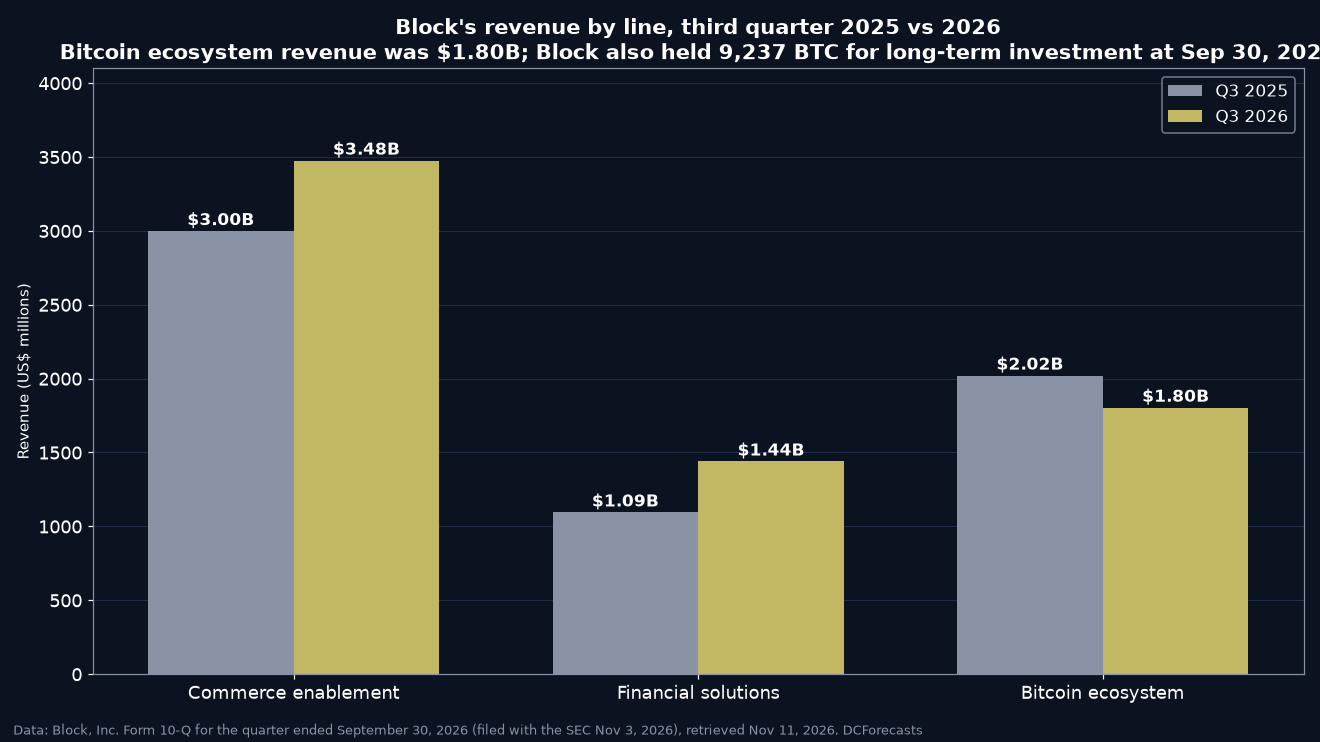
The bigger story in the filing is the commerce engine. Commerce enablement revenue rose 16% to $3.48 billion, helped by $230.4 million of growth in Square processing. That is the merchant network bitcoin payments now plug into. Block is also a long-term holder itself: as of September 30, it held about 9,237 bitcoins for investment, valued at $771.9 million.
Why this matters for Bitcoin as money
Most debates about Bitcoin adoption focus on ETFs and treasuries. This one is about the checkout line. Square’s network spans millions of businesses, though the share that are eligible and actually take bitcoin is not public, and that figure will be the real test of the rollout.
The cost side is already favorable. Lightning payments ride on top of the base chain, and on-chain conditions are calm: as we found this week, Bitcoin blocks are nearly full while fees barely top 1 satoshi per vByte.
Square is also not alone in bringing bitcoin into everyday bills. Florida’s largest county just started accepting it for Miami-Dade property taxes. Block’s own legal path was cleared earlier this month, as covered in our report on Block’s DOJ settlement.
What to watch next
Three things will show whether this sticks. The first is any usage data Block shares. The second is how many merchants stay on once the 1% fee starts in January. The third is whether the $600 cap rises, which would open the door to larger purchases like electronics or repairs.
For now, the barrier for a U.S. shop to accept bitcoin has rarely been lower: no setup for eligible sellers, dollars by default, and no processing fee for the rest of the year.
DC Forecasts is a leader in many crypto news categories, striving for the highest journalistic standards and abiding by a strict set of editorial policies. If you are interested to offer your expertise or contribute to our news website, feel free to contact us at [email protected]












Discussion about this post