



Blockstream co-founder and CEO Adam Back is sticking with one of the boldest targets in the market. Speaking on CNBC’s “Closing Bell Overtime” on Nov. 11, the cypherpunk whose Hashcash proof-of-work system is cited in the Bitcoin white paper said he personally bets Bitcoin will reach $1 million by 2028.
The timing is notable. Bitcoin closed Nov. 11 at $73,927.63 on Coinbase, after a slide that followed hotter U.S. inflation data. Back’s case is that the short-term noise hides how early adoption still is. He said roughly 95% of Bitcoin’s potential adoption remains untapped, and that large pools of capital such as pension funds and mutual funds have yet to allocate to it in a meaningful way.
Will Bitcoin Reach $1 Million? The Math Behind Back’s Call
So will Bitcoin reach $1 million on Back’s timeline? The arithmetic is straightforward even if the outcome is not. From the Nov. 11 close, $1 million by Dec. 31, 2028 requires a gain of about 13.5 times in 781 days. That works out to compound growth of roughly 238% a year.
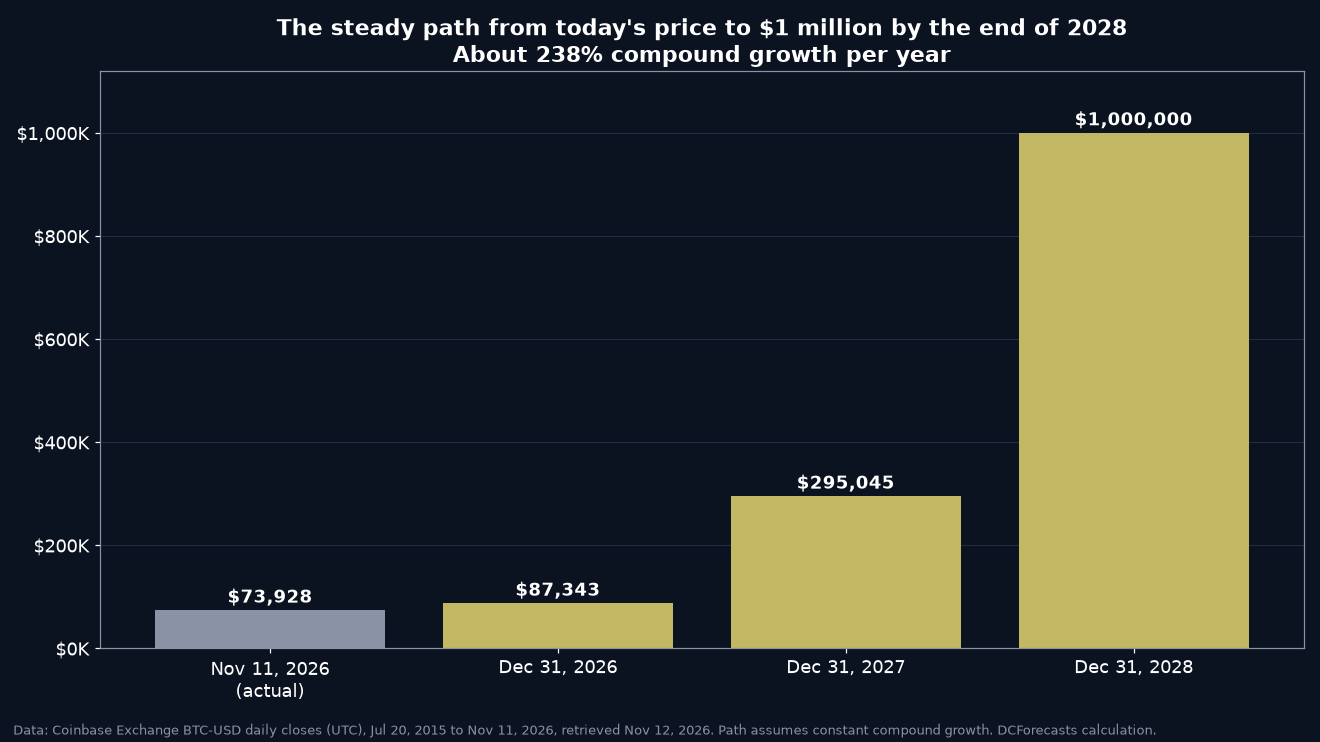
On a smooth path, Bitcoin would sit near $87,343 at the end of this year and around $295,045 by the end of 2027. Real markets never move that evenly, of course. Bitcoin’s biggest gains have tended to arrive in short, sharp bursts rather than steady steps, so the path is a yardstick, not a forecast.
At $1 million per coin, the roughly 20.1 million BTC issued so far, based on the block subsidy schedule through block 975,525, would be worth about $20.1 trillion. Bitcoin’s supply grows only slowly, and that fixed issuance is central to Back’s view. If new demand from large institutions arrives, the coins available to meet it are limited.
Since the April 2024 halving, miners receive 3.125 BTC per block. With about 144 blocks a day, that is roughly 450 new coins daily, or around $33 million at the Nov. 11 close. A single large allocator moving even a small share of its portfolio would dwarf that daily flow, which is why supporters see institutional demand as the main lever for price.
Has Bitcoin Ever Moved This Fast?
It has. A DCForecasts review of Coinbase daily closes since July 2015 checked every possible 781-day window. Bitcoin gained 13.5 times or more in about 11.5% of them, with qualifying start dates in 2015, 2016, 2018 and 2019.
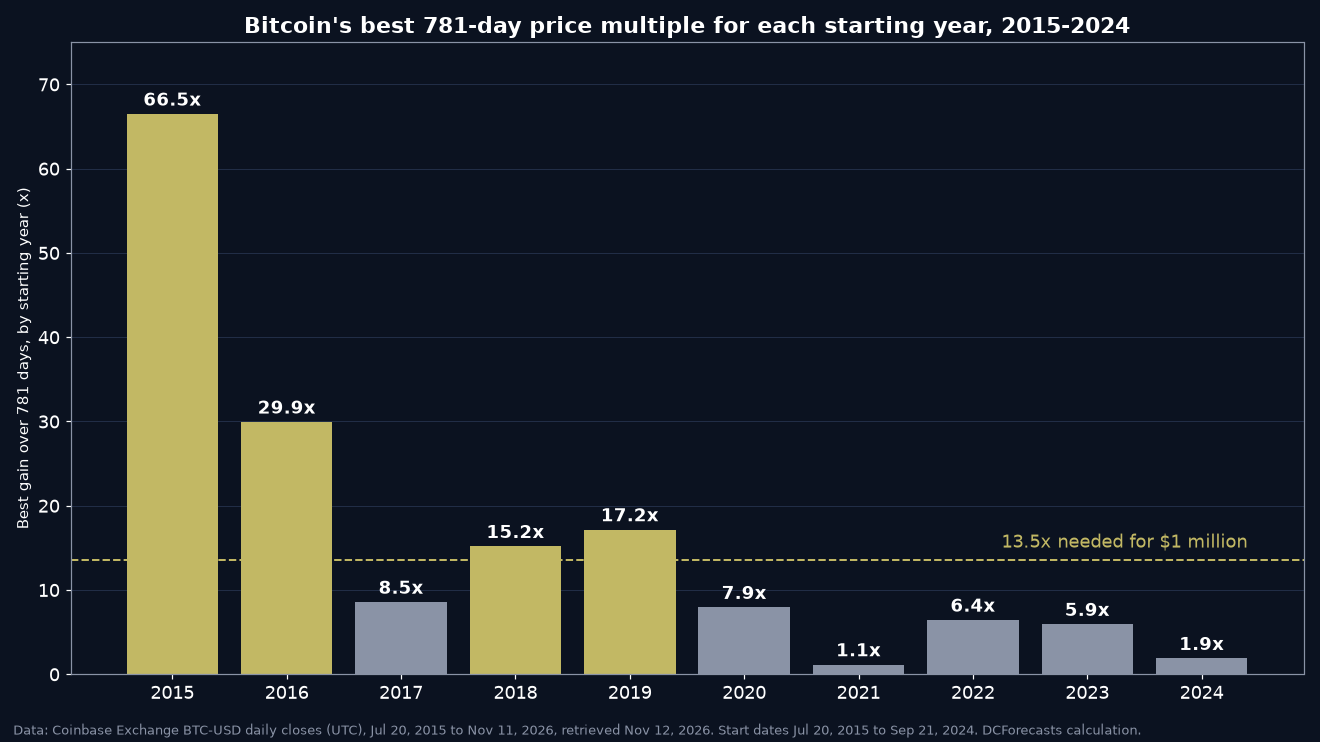
The most recent examples came out of the 2018 bear market. Buying at $3,691.86 on Dec. 31, 2018 would have returned 15.2 times by Feb. 19, 2021. A purchase at $3,359 on Feb. 7, 2019 grew 17.2 times by March 29, 2021.
Gains have come in larger dollar amounts but smaller multiples as Bitcoin has grown. The best 781-day run from a 2022 starting point was 6.4 times, from $16,206.30 on Nov. 28, 2022 to $104,107 on Jan. 17, 2025. A 13.5x move from today would therefore need a demand shock bigger than anything in the last cycle. Back argues that the arrival of pensions and mutual funds could supply exactly that.

The Institutional Case
There are signs that the institutional pipeline Back describes is widening. Deutsche Bank has launched digital asset custody covering Bitcoin and Ether for institutional clients. In Israel, Discount Bank plans to let retail customers buy Bitcoin inside its app from Nov. 26. Third-quarter filings also showed Barclays and Citi building positions in spot Bitcoin ETFs.
Still, these are early moves. Pension funds and large mutual fund complexes often take a long time to add a new asset class, with internal reviews, consultant input and board sign-off along the way. That is why Back frames the bulk of adoption as still ahead.
Back also argued that rising institutional ownership tends to lift Bitcoin’s price floor over time. One long-term measure supports that view. Bitcoin’s 200 week moving average hit a record $67,754 this week and has not fallen in a single week since 2019, even through this month’s pullback.
A Personal Bet, Not a Promise
Back was clear that $1 million is his personal expectation, not a guaranteed outcome. The same historical data shows that some two-year stretches delivered almost nothing. The best 781-day run from a 2021 start was just 1.1 times, after buyers paid cycle-top prices. Timing and starting price matter a great deal.
What makes Back’s call worth tracking is who is making it. His Hashcash work predates Bitcoin itself, and he co-founded Blockstream in 2014. The company builds the Liquid sidechain, the Jade hardware wallet and mining operations, and Back has held a consistently long-term view through several market cycles.
For long-term holders, the takeaway is that Back is not betting on a quick bounce. He is betting that the large pools of money that have barely touched Bitcoin will eventually arrive. If even part of that capital moves in over the next two years, Bitcoin’s capped supply would have to meet that demand, and that is the core of the bull case he laid out on Wednesday.
DC Forecasts is a leader in many crypto news categories, striving for the highest journalistic standards and abiding by a strict set of editorial policies. If you are interested to offer your expertise or contribute to our news website, feel free to contact us at [email protected]











Discussion about this post