



Tom Emmer won the House minority whip race on Tuesday, keeping one of Congress’s most outspoken crypto supporters in the second-highest job in House Republican leadership.
The Minnesota Republican beat back a challenge from Texas Rep. August Pfluger in a secret-ballot vote of the GOP conference on November 10. He has served as majority whip since 2023.
The title changes because the chamber does. Democrats won control of the House in the November 3 midterms, so Emmer will lead the Republican vote count from the minority when the new Congress meets in January.
For crypto, that shift matters more than the name on the door. The industry’s next federal wins will need Democratic votes, and the record shows those votes have been there before.
Who Is the New House Minority Whip?
Emmer represents Minnesota’s 6th Congressional District, which he held on November 3 by about 12 percentage points.
He will serve as the No. 2 Republican under Ohio Rep. Jim Jordan, the House Judiciary Committee chairman, who won the race for Republican leader over outgoing Majority Leader Steve Scalise on the same day. Speaker Mike Johnson did not run for the post.
After the vote, Emmer struck a combative tone at a news conference. “House Republicans will hold each and every Democrat accountable for every vote cast, every committee hearing held,” he said.
In crypto circles he is known for something else. Emmer co-chairs the Congressional Crypto Caucus and has spent years arguing that unclear rules push blockchain builders offshore.
Emmer’s Anti-CBDC Bill Still Waits on the Senate
His signature measure is the Anti-CBDC Surveillance State Act, H.R. 1919, which would bar the Federal Reserve from issuing a central bank digital currency without approval from Congress.

According to the official bill record on Congress.gov, Emmer introduced it on March 6, 2025. The Financial Services Committee advanced it 27-22, and the full House passed it 219-210 on July 17, 2025.
That was the bill’s last recorded action. It has passed the House but has not passed the Senate.
We believe the argument behind it has aged well for Bitcoin holders. A state-issued digital dollar and a fixed-supply, permissionless asset sit at opposite ends of the money debate, and Emmer has made privacy the center of his case.
Crypto Bill Votes Show Where Democrats Already Stand
The more useful signal for the next Congress is how the House voted on crypto’s busiest day, July 17, 2025, when three bills cleared the chamber within hours.
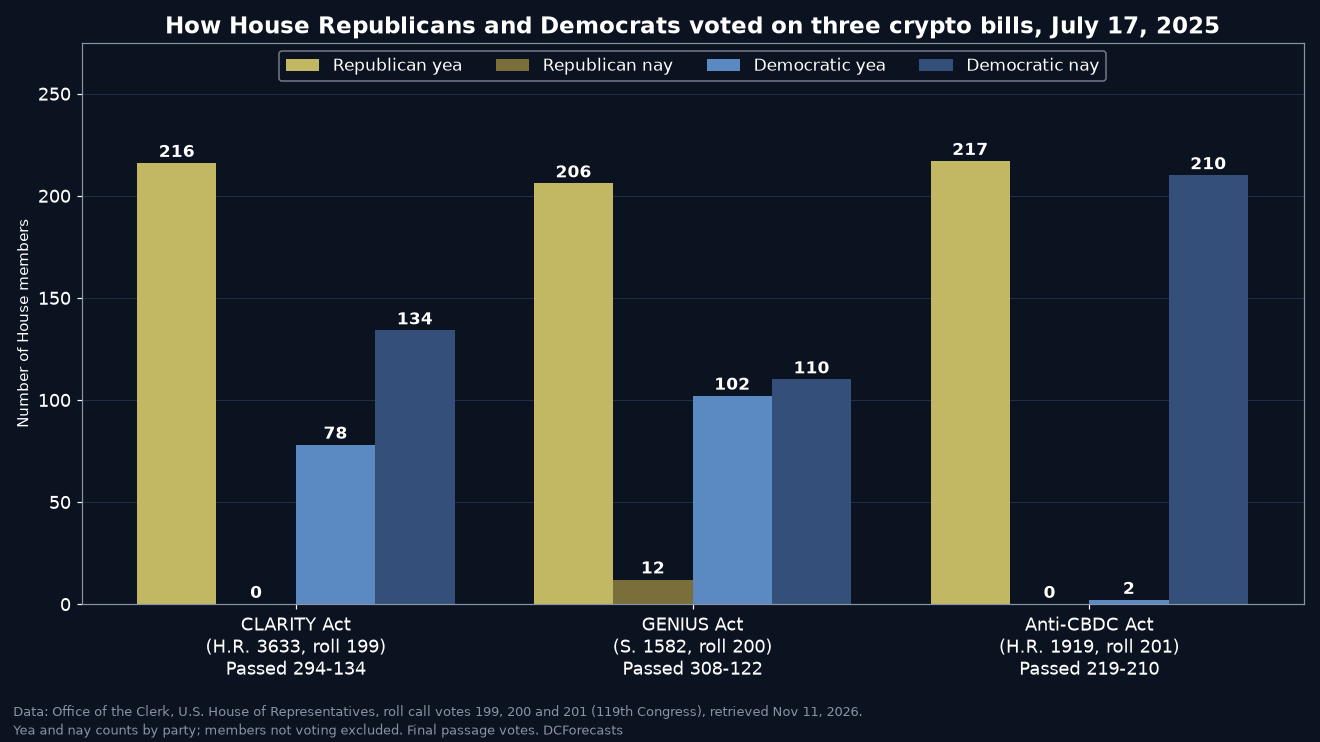
The GENIUS Act, the stablecoin law, passed 308-122 with 102 Democrats voting yes. It became Public Law 119-27 the next day.
The CLARITY Act, the market structure bill, passed 294-134. Republicans voted 216-0 in favor, and 78 Democrats joined them, according to House Clerk roll call 199.
The anti-CBDC bill was a different story. Only two Democrats voted yes, which is why it passed by just nine votes.
In short, crypto bills that focus on clear market rules have drawn real Democratic support, while the CBDC fight has been almost purely partisan.
Where the CLARITY Act Vote Leaves Market Structure
The market structure bill is the industry’s biggest unfinished job. The Congress.gov record for H.R. 3633 shows the Senate Banking Committee reported an amended version on June 1, 2026.
On September 15, a CLARITY Act vote on cloture for the motion to proceed failed 49-50 in the Senate, well short of the 60 votes needed. Sen. Thom Tillis entered a motion to reconsider the same day, which keeps the bill alive on the calendar.
No later action is listed. Any Senate-passed text would still have to match the House version before it could reach the president.
With Democrats taking both chambers in January, sponsors will need to rebuild that coalition rather than lean on a Republican majority. The 78 House Democrats who backed CLARITY in 2025 are the obvious starting point.
Why This Leadership Vote Matters for Bitcoin
A whip’s job is counting votes and holding the conference together. On crypto bills, that means Emmer’s influence now depends on finding common ground across the aisle, not on setting the floor schedule.
The industry spent heavily to shape this election, as we covered in our look at Fairshake’s midterm spending. The results show that money alone does not decide chamber control, but it has kept crypto a live issue for members of both parties.
Regulators are also still moving. The CFTC’s decision to allow single-stock perpetual futures, now facing a court challenge from Wall Street groups, shows that policy is being made outside Congress as well.
For Bitcoin, the network itself needs no new crypto bill to keep producing blocks. BTC traded near $73,980 on Wednesday morning, according to CoinGecko data, down about 1% in 24 hours as markets digest the new balance of power in Washington.
We see a split Washington as a test of how broad crypto’s support really is. If the bipartisan votes behind GENIUS and CLARITY hold, clearer rules could still arrive, and that would make it easier for more institutions to hold Bitcoin with confidence.
What to Watch as the New Congress Forms
Three markers stand out. First, whether Senate leaders revisit the motion to reconsider on the market structure bill before this Congress ends.
Second, who takes the gavel at the House Financial Services Committee in January, since that panel writes most digital asset legislation.
Third, whether Emmer reaches for Democratic co-sponsors on privacy and CBDC limits, an area where the 2025 roll call showed almost no overlap.
For now, crypto keeps a familiar ally in the House minority whip’s office. The question is whether he can turn that seat into votes from across the aisle.
DC Forecasts is a leader in many crypto news categories, striving for the highest journalistic standards and abiding by a strict set of editorial policies. If you are interested to offer your expertise or contribute to our news website, feel free to contact us at [email protected]












Discussion about this post