


Ledger chief executive Pascal Gauthier did not try to sell perfection on Tuesday. “Everybody will be hacked at some point. Perfect security doesn’t exist,” he said in a Bloomberg Crypto interview published on November 10, adding that “that rule applies to Ledger as well as others.”
The line drew criticism from parts of the crypto community, coming from the head of the best-known hardware wallet maker. But the rest of the interview was a defence of self-custody, and the numbers he leaned on mostly support his case.
Gauthier said about $90 million had been drained from Ledger devices sold through a single reseller. “$90 million seems like a big number. It’s far less than $6 billion,” he said, referring to the theft from Binance two weeks earlier.
What Happened to the Ledger Devices
The losses trace back to CryptoBilis, a reseller covering Indonesia, Malaysia and the Philippines. In its published response, Ledger said a criminal group “bought genuine Ledger devices, opened them, fitted custom-built hidden components designed to capture the recovery phrase during setup, and put them back into distribution.”
Ledger’s Donjon security lab found that the implant read the 24-word recovery phrase from the device screen and sent it out over a mobile network using an eSIM. It did not change the Secure Element chip, the operating system or any transaction the device signed.
“There was no flaw in Ledger’s chip, operating system or servers,” the company said. It described the incident as an attack on the distribution channel after the devices left its control.
Ledger has not confirmed a final loss figure, and the $90 million is Gauthier’s own estimate. He put it at about 0.01% of the value Ledger devices protect, a ratio the interview did not give enough detail to check.
How Ledger Is Closing the Gap
Ledger asked authorized resellers and distributors in Southeast Asia and Hong Kong to suspend sales while it investigated. It said spot checks of devices bought from stores, including in Germany, and samples from warehouses all came back clean.
The company has also tightened its retail rules. Returned devices can never be resold, even if they look unopened, and products must now stay off shelves and displays until they are handed to a buyer at the time of purchase.

Trezor, whose devices were also sold through the same reseller, issued a precautionary warning on October 30 about a suspected implant in one Safe 5 unit. The problem is the route into the buyer’s hands, not the wallet design.
Why Gauthier Still Argues Self-Custody Wins
Gauthier’s central point is about concentration. A single breach at a centralized platform exposes pooled customer funds, while a compromised hardware wallet usually exposes one holder at a time. Attacking millions of separate devices is far harder than attacking one hot wallet.
Binance said its hot wallets were compromised at around 20:05 UTC on October 29. Its November 3 post-mortem put the affected amount at about $6.34 billion, said about $2.85 billion had been frozen or intercepted, and said users would not bear the losses. We covered the recovery in our report on Binance restoring HYPE and APT after the hack.
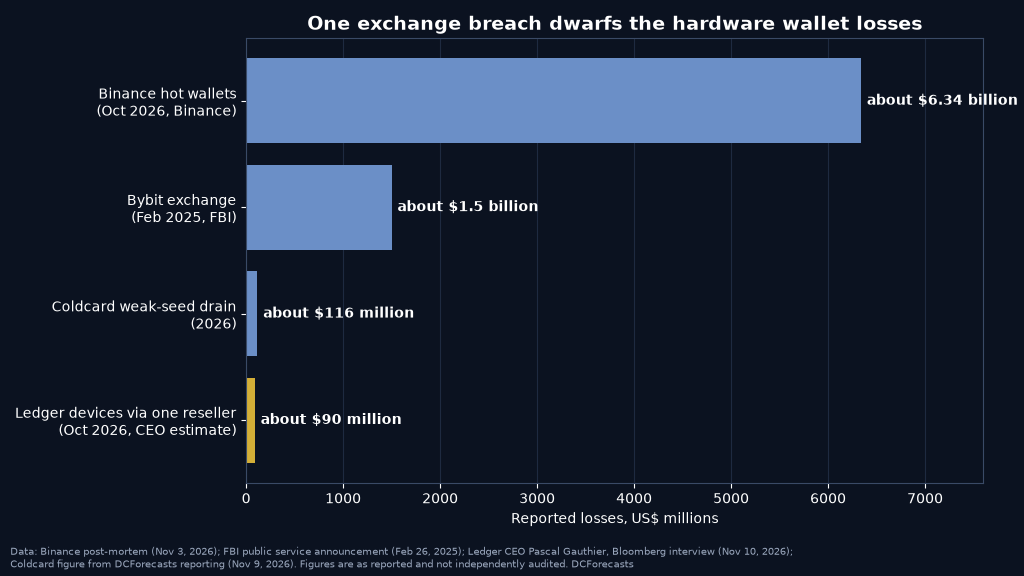
The FBI attributed the Binance theft to North Korean hackers it tracks as TraderTraitor, the same label it used in its public service announcement on the $1.5 billion Bybit theft in February 2025. As we reported, the launderers have since been minting memecoins to move the stolen funds.
Even so, Gauthier refused to pile on. “Binance is not the criminal. The attackers are the criminals,” he said. “We all are together in this.”
The Threat Is Shifting to People and Supply Chains
Gauthier said roughly $9 billion was stolen from the crypto industry last year and an estimated $12 billion so far in 2026, and that artificial intelligence is speeding up attackers. “We are entering a world where every year is going to get worse,” he said.
The recent incidents share a pattern. None broke Bitcoin’s cryptography. Attackers went after a distribution channel, a weak seed generator in the Coldcard case, or the people and internal tools around an exchange.
That is a useful reminder for anyone holding bitcoin in self-custody. The recovery phrase is the real asset, and recent warnings, including Binance’s alert that an iOS flaw could expose seed phrases, all point to the same place.
What Bitcoin Holders Can Do Now
Ledger’s own advice is direct. Anyone who bought a device from the affected reseller and has not set it up should not initialize it. Anyone who already did should move their assets to a new device with a newly generated recovery phrase.
More broadly, buying hardware directly from the manufacturer or an authorized seller, generating a fresh recovery phrase on the device and never typing it into a phone or computer remove most of the risk these cases exposed.
Gauthier’s message, stripped of the headline, is that no single defence is perfect. For bitcoin holders, the practical answer is the one self-custody has always offered: spreading risk across many independent wallets rather than trusting one large target to hold everything.
DC Forecasts is a leader in many crypto news categories, striving for the highest journalistic standards and abiding by a strict set of editorial policies. If you are interested to offer your expertise or contribute to our news website, feel free to contact us at [email protected]












Discussion about this post