



MSCI is due to publish its November 2026 index review today, Wednesday, November 11, and the list will settle a question that has followed Strategy for more than a year: does the world’s largest corporate bitcoin holder stay in MSCI’s global benchmarks?
The announcement is scheduled for 5:00 p.m. ET. Any deletions take effect at the close of trading on November 30, and funds that track the affected indexes would have to sell the shares by then.
That selling would land on Strategy’s stock, MSTR. Nothing in MSCI’s rules requires Strategy, or any other company, to sell a single bitcoin.
What MSCI Decided in October
On October 15, MSCI said it would make “non-operating companies” ineligible for its Global Investable Market Indexes, a family that includes the widely tracked ACWI and its sub-indexes. The change applies from the November review.
The test has two stages. A company passes outright if operating assets make up more than half of its total assets. Companies that fail that core screen face five financial ratios, covering operating assets, operating expenses, operating cash flow, fair-value changes and reliance on outside financing. Being flagged on four or more makes a security ineligible.
Existing members get a buffer. MSCI said current constituents “will be removed only if they fail the ineligibility screen in each of the two most recent annual filing periods.” A company that fails only once can stay, and MSCI may also use the latest interim filing.
MSCI also scrapped the interim measures it introduced in October 2025 for companies whose digital assets were at least half of total assets. Those measures had frozen share-count increases and deferred additions for bitcoin treasury firms.
Who Is on the Line
MSCI’s list of current constituents that could be affected names five possible deletions, according to reports of the list: Strategy, Metaplanet, Yellow Cake, Skel Fjárfestingafélag and Upexi. Strategy is by far the largest of them.
The test is not crypto-specific on paper. It applies to any issuer whose operating assets fall below half of its total assets, which is why a uranium holder and an Icelandic investment company sit alongside two bitcoin treasury companies.

The two-filing rule is the live issue for Strategy. The company adopted fair-value accounting for bitcoin from January 1, 2025, which means its fiscal 2024 accounts carried bitcoin at cost less impairment rather than at market value. MSCI has not said publicly how it treated that earlier year.
How Much Selling Is Really at Stake?
Strategy put its own number on the exposure. In an August 31 letter to MSCI signed by executive chairman Michael Saylor and CEO Phong Le, it said funds tracking these indexes held about 13 million MSTR shares, or 3.1% of basic shares outstanding. That equals roughly 60% of one average trading day over the prior 30 days.
JPMorgan analysts had earlier estimated that an exclusion could trigger about $2.8 billion of passive selling, although that figure was calculated against MSCI’s earlier digital asset proposal rather than the final rules.
By Strategy’s own count, the index-linked stake amounts to less than one average day of MSTR trading, and the rebalance is a one-off event with a fixed date. In its letter, Strategy said the proposal “would have no meaningful impact on Strategy’s business.”
The company also argued that it is an operating business, pointing to an enterprise-analytics software arm with more than 1,500 employees and close to half a billion dollars in annual revenue. It called the test “discriminatory, arbitrary, and misguided.”
Strategy’s Bitcoin Stack Is Not Part of the Trade
Whatever the list says, Strategy’s balance sheet is unchanged by it. The company holds 850,364 BTC after buying another 1,036 coins between November 2 and November 8, according to its latest Form 8-K filed with the SEC. We broke down that filing in our report on Strategy’s 850,364 BTC position and STRC buybacks.
Its average cost is $75,456 per coin. Bitcoin traded near $74,000 on Wednesday, slightly below that level after a strong run through September and October.
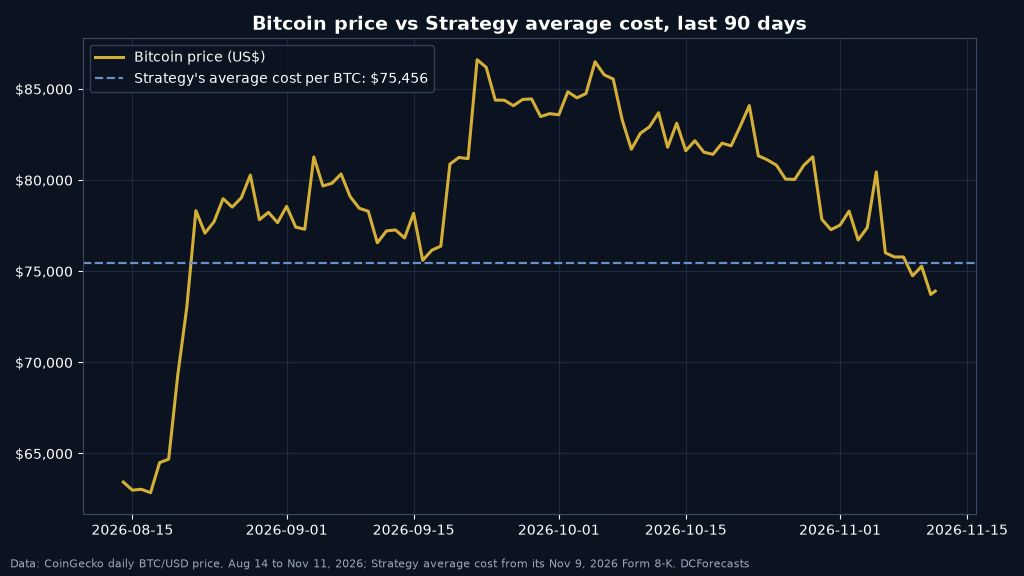
The chart shows how quickly that gap has opened and closed this year. Bitcoin climbed from about $63,000 in mid-August to above $86,000 in late September before easing back.
The more lasting effect of an exclusion, if one comes, would be on funding. Strategy pays for bitcoin and preferred stock buybacks partly by selling MSTR shares through its at-the-market program, and fewer index buyers could make that issuance a little more expensive.
Why a Final Answer Helps
MSCI first proposed excluding bitcoin treasury companies in October 2025. It dropped that plan in January 2026 after more than 250 organizations and 1,500 signatories opposed it, then opened the broader non-operating company consultation in August.
A year of open-ended review has been an overhang on MSTR. Today’s list removes that uncertainty either way. If Strategy stays, the overhang is gone. If it is removed, the selling has a fixed date and a known size, and the company keeps every one of its 850,364 bitcoin.
For bitcoin itself, index committees decide only which stocks sit in a benchmark. Demand for BTC comes from the buyers who hold it directly, and Strategy has kept buying through every stage of this debate.
DC Forecasts is a leader in many crypto news categories, striving for the highest journalistic standards and abiding by a strict set of editorial policies. If you are interested to offer your expertise or contribute to our news website, feel free to contact us at [email protected]












Discussion about this post