


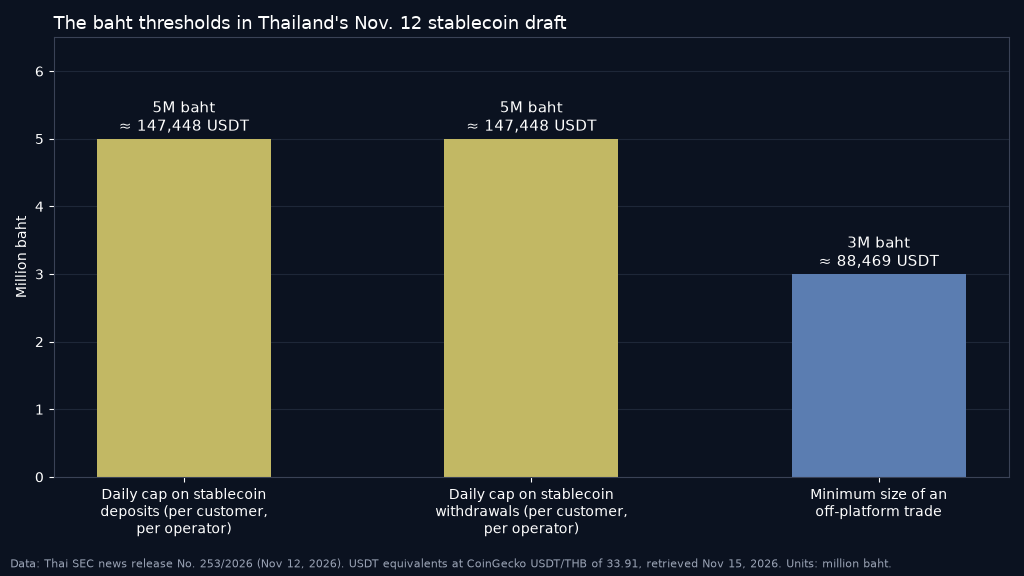
Thailand has put a hard number on its stablecoin regulation plans. A draft from the country’s Securities and Exchange Commission would cap stablecoin transfers into and out of each customer’s account at 5 million baht a day per licensed operator.
The same draft would also end payments to strangers through those platforms. Stablecoins could only come from, or go to, a wallet or account verified as the customer’s own.
The Thai SEC published the proposal on Nov. 12, after a September hearing on the principles. It says the aim is to stop digital assets being used for money laundering, cybercrime or dodging international money transfer rules.
For Bitcoin investors, the detail that stands out is the scope. The cap is written for stablecoins, the dollar-linked tokens that move most like cash.
The bigger question is whether tighter rails for stablecoins push Thailand’s crypto market toward cleaner, better-documented flows.
What the Draft Stablecoin Regulation Would Change
The core rule is ownership. Any account or wallet sending stablecoins to a customer at a digital asset operator, or receiving them, must be verified as belonging to that same customer.
Transfers to or from another person’s wallet would be prohibited.
Operators would also have to apply the Travel Rule, screen out mule accounts and use blockchain analytics to flag links to high-risk or watchlisted wallets.
On top of that, the value a customer moves has to fit their income and financial position. The 5 million baht limit applies separately to inbound and outbound transfers, per customer, per day, at each operator.

Who Is Exempt From the 5 Million Baht Cap?
The draft carves out the flows that keep the market working.
- Moves between a customer’s own accounts at two SEC-supervised operators, if both follow the Travel Rule.
- Digital asset operators moving stablecoins through accounts in their own names for business purposes.
- Businesses supervised by the Bank of Thailand that win case-by-case approval to use stablecoins under a set model.
- Market makers for stablecoin-baht trading pairs, when they move coins through supervised operators to provide liquidity.
- Subscriptions, refunds and investor payouts tied to digital tokens the SEC has approved for sale through token portals.
We believe those exemptions matter as much as the cap. They suggest the target is anonymous, high-value transfers rather than ordinary trading or approved token offerings.
What 5 Million Baht Buys in Dollar Terms
At CoinGecko’s USDT/THB rate of 33.91 on Nov. 15, 5 million baht equals about 147,450 USDT. That is the lowest level of the past year, because one USDT now costs more baht than at any point in that period.
The same amount bought about 162,320 USDT on Jan. 25, 2026, when the baht was strongest. In other words, the cap is worth roughly 9% fewer dollars today than it would have been at the start of the year.
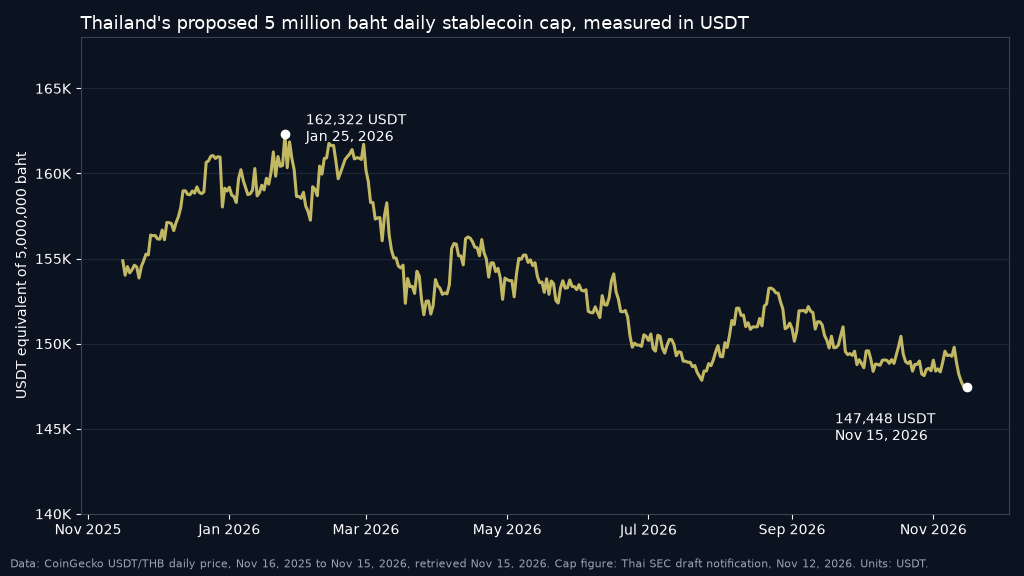
For most retail users, that still leaves plenty of room: about 147,000 USDT in and the same out, every day, at each licensed platform.
Measured in Bitcoin, 5 million baht was worth about 2.25 BTC at CoinGecko’s price of 2,221,888 baht on Sunday, when BTC traded near $65,500.
Tighter Checks for Market Makers and Brokers
Exchanges would have to publish the names of their market makers and the assets each one supports, and monitor where those firms’ coins come from.
Brokers would be barred from using outside liquidity providers for stablecoin-baht pairs. Any liquidity provider they do use could not be based in a jurisdiction that fails to apply Financial Action Task Force standards, and it would need its own anti-money laundering controls and a regulator.
Brokers would also have to name those providers to customers and disclose conflicts of interest.
Off-platform deals get a floor as well. Brokers and dealers offering them would need a minimum ticket of 3 million baht, about 88,500 USDT at Sunday’s rate, and would have to publish their prices. Brokers could not match off-platform trades between their own customers.
Why Thailand’s Crackdown Can Strengthen Its Crypto Market
This is not Thailand turning against digital assets.
As we reported, Thailand now lets tourists pay with crypto at shops through PromptPay, with stablecoins at the center of that launch. Its central bank also took part in Project Meridian FX, a cross-border settlement test with the Bank of England and the Monetary Authority of Singapore.
At the same time, regulators have been tough on unlicensed players, as seen in the action against Bitget earlier this month.
We read the draft as part of that pattern. Thailand wants crypto activity inside licensed, traceable channels, where every stablecoin transfer has a verified owner on both ends.
It also highlights a contrast worth noting. Stablecoins depend on issuers, banks and permissioned platforms, which is why regulators can cap them this precisely. Bitcoin’s own network has no issuer and no central operator, even when investors choose to buy it through a regulated exchange.
Can Feedback Still Shape the Final Rules?
Yes. The SEC is taking comments until Nov. 26, 2026. Submissions can be made through the SEC’s website, by email, or through the government’s Legal Hub portal.
We will watch whether the 5 million baht figure survives and how quickly the Bank of Thailand approves business stablecoin use.
For Bitcoin holders in Thailand, the message is fairly reassuring. The heaviest new limits fall on stablecoin transfers, while the wider effort points toward a more transparent, better-regulated market that could attract larger players over time.
The coming two weeks will show how hard the industry pushes back before the final notification takes shape.
DC Forecasts is a leader in many crypto news categories, striving for the highest journalistic standards and abiding by a strict set of editorial policies. If you are interested to offer your expertise or contribute to our news website, feel free to contact us at [email protected]











Discussion about this post