


Foreign visitors in Thailand can now turn digital assets into Thai baht inside a phone app and pay at shops, restaurants and malls by scanning the same QR codes locals use every day. It is one of the clearest tests yet of crypto payments in a major tourism economy.
The app, called WORPT, runs under TouristDigiPay, a regulatory sandbox set up by Thailand’s Securities and Exchange Commission. Its backers hope it will bring in about 15 billion baht, roughly $440 million, in spending over an 18-month trial.
The timing is not an accident. Thailand’s foreign arrivals are running almost 5% behind last year, and the country is looking for new kinds of visitors who are ready to spend.
How the WORPT App Works
WORPT was built by Waan Exchange, a licensed Thai digital asset business, together with Wipay, an e-money provider regulated by the Bank of Thailand. Tether, The Mall Group and Visa are also involved in the launch.
A visitor downloads the app and verifies their identity with a face scan and the chip in an electronic passport. They then link an outside crypto wallet and deposit supported assets. At launch these include the stablecoins USDT and USDC.
Before any conversion, the app screens the incoming funds to check that the wallet is not tied to money laundering or other crime. The assets are then sold for baht, and the balance sits in an e-wallet ready to spend.
To pay, the tourist scans a Thai QR PromptPay code. The merchant receives baht through its normal payment channel. It never touches crypto, needs no new equipment and carries no price risk.
What Thailand’s SEC Sandbox Allows
TouristDigiPay is a controlled experiment. According to the Thai SEC’s published TouristDigiPay rules, it lets foreign tourists convert digital assets into baht to pay for goods and services through e-money systems. It does not make crypto legal tender, and merchants are not paid in digital assets.
Only licensed digital asset exchanges, brokers or dealers can take part. Each must have an agreement with an e-money provider, consult the SEC and the Bank of Thailand on system design before applying, and keep the tourist payment service separate from its trading business.

Operators must also run identity checks and apply the country’s anti-money laundering rules. Approved firms get a testing period of up to 18 months, which the SEC may extend if the service works well.
This is the same regulator that has been tightening rules on unlicensed platforms, a push we covered in our report on Thailand’s crypto exchange license crackdown. The message is consistent: crypto is welcome in Thailand, as long as it runs through licensed and supervised channels.
Why Thailand Wants Crypto-Holding Tourists
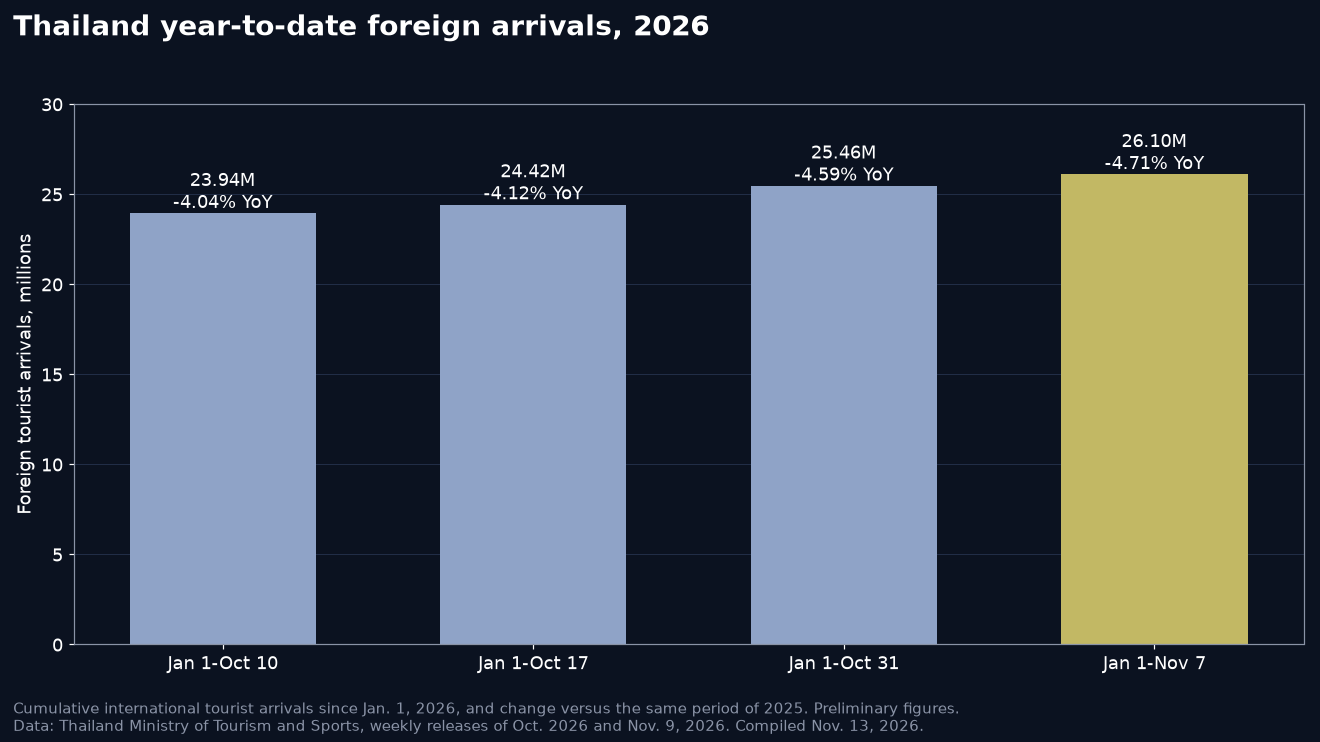
Tourism is one of Thailand’s biggest economic engines, and 2026 has been a difficult year. Preliminary figures from the Ministry of Tourism and Sports show 26.10 million foreign arrivals from Jan. 1 to Nov. 7, down 4.71% from the same period of 2025.
The gap has widened through the autumn. Year-to-date arrivals were 4.04% lower by Oct. 10, 4.59% lower by the end of October and 4.71% lower by Nov. 7.
Foreign visitors spent 1,272.4 billion baht between Jan. 1 and Nov. 7. That is still a vast sum, but spending in the first ten months was 2.85% lower than a year earlier, according to the ministry’s figures.
There are some bright spots. Arrivals in the first week of November rose 18.15% from the week before, to 636,432, as the winter season began. China, the largest market, has grown this year.
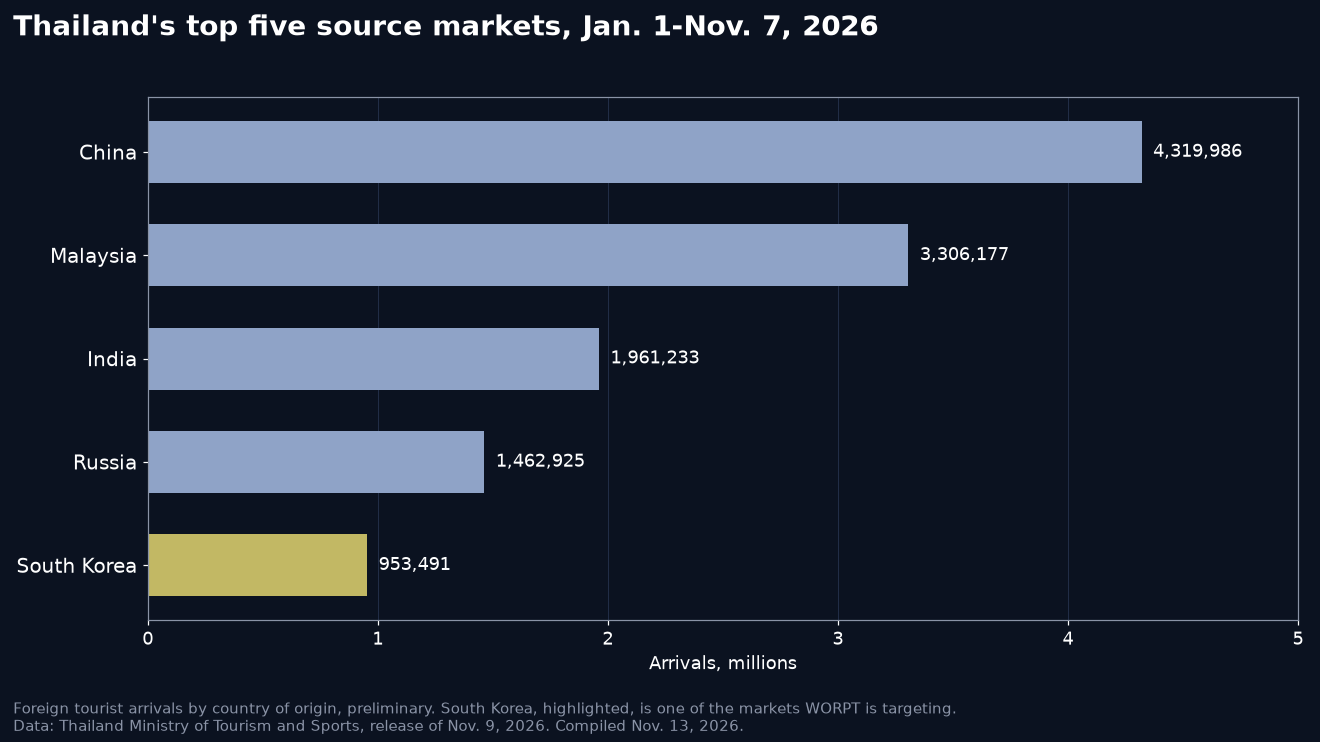
WORPT is aimed at travelers from South Korea, Japan, the Middle East and Southeast Asia. South Korea is a telling choice. It is Thailand’s fifth-largest source market this year, with 953,491 arrivals, but it has also posted one of the steepest declines among the top ten. South Korea is also one of the most active crypto trading markets in the world.
The Targets Behind the Trial
The project’s backers have set ambitious goals. Local reports put the user target at roughly 150,000 to 200,000 people, depending on whether active users or total sign-ups are counted. Spending is expected to reach about 15 billion baht over the 18-month trial.
The app initially charges a 1.5% conversion fee, according to Thai media reports. A physical Visa prepaid card is planned for mid-November, with a virtual card to follow in early 2027. That would let users spend the same baht balance online and at card terminals, not just at QR codes.
A Real-World Test for Crypto Payments
For years, the main obstacle to spending digital assets abroad has been the last step. A traveler holding crypto often had to use an exchange, find an over-the-counter dealer or withdraw cash before paying for dinner. Each extra step added cost, friction and the risk of meeting a scammer.
WORPT removes most of those steps inside a licensed, supervised app. If it works, it gives regulators elsewhere a practical model: let tourists bring digital wealth, convert it under strict checks and pay local businesses in local money.
The launch currently centers on stablecoins. Still, every new legal route from a crypto wallet to everyday spending widens the practical use of the whole asset class, and we expect Bitcoin holders to watch closely whether support grows as the trial matures.
We believe this is the more important story behind the headline numbers. Bitcoin and the wider crypto market were built to move value across borders. Thailand is now testing whether that value can also be spent on the street, in a country that welcomes tens of millions of visitors a year.
The first results will come from the operators’ regular reports to the SEC. If tourists sign up in the numbers the backers expect, TouristDigiPay could move from a sandbox to a permanent part of how Thailand welcomes the world.
DC Forecasts is a leader in many crypto news categories, striving for the highest journalistic standards and abiding by a strict set of editorial policies. If you are interested to offer your expertise or contribute to our news website, feel free to contact us at [email protected]












Discussion about this post