


CNCK stock closed at $0.98 on Friday, its first finish below $1 in at least a year, on the same day Coincheck filed quarterly results showing revenue down 43%.
Yet the same filing holds a number that points the other way. Japan’s Coincheck added 243,686 net new verified users between July and September, by far its biggest quarter in the monthly data it publishes back to April 2024.
The figures come from the company’s Form 6-K, filed with the U.S. Securities and Exchange Commission on Nov. 13.
For Bitcoin investors, the split is the story. Japanese savers kept opening accounts even as the people already on the platform traded far less.
The bigger question is whether those new accounts turn into active buyers when the market picks up again.
What Coincheck Reported for the September Quarter
Total revenue fell 43% to ¥75.5 billion in the three months to Sept. 30, from ¥133.1 billion a year earlier.
Retail transaction revenue, the core of the business, nearly halved to ¥67.6 billion. The company said 89.5% of its revenue still comes from trades on its Marketplace platform, where Coincheck itself buys from and sells to customers.
A new line helped. Institutional transaction revenue brought in ¥6.6 billion, and investment management fees from 3iQ, the Canadian fund manager Coincheck took over on March 1, added ¥542 million.
The bottom line swung to a net loss of ¥4.1 billion, against a ¥355 million profit a year ago. About ¥3 billion of that came from writing down Aplo, the French institutional brokerage Coincheck bought in October 2025.

Coincheck said demand for Aplo’s altcoin-heavy brokerage “has declined significantly.” It is winding down that client business and moving Aplo’s trading and custody technology to 3iQ, which plans to launch separately managed digital asset accounts in the first half of 2027.
Why Did Sign-Ups Jump While Trading Cooled?
Verified users reached 2,868,544 at the end of September, up 18.5% in a year. September alone added 120,944, the largest single month in the series.
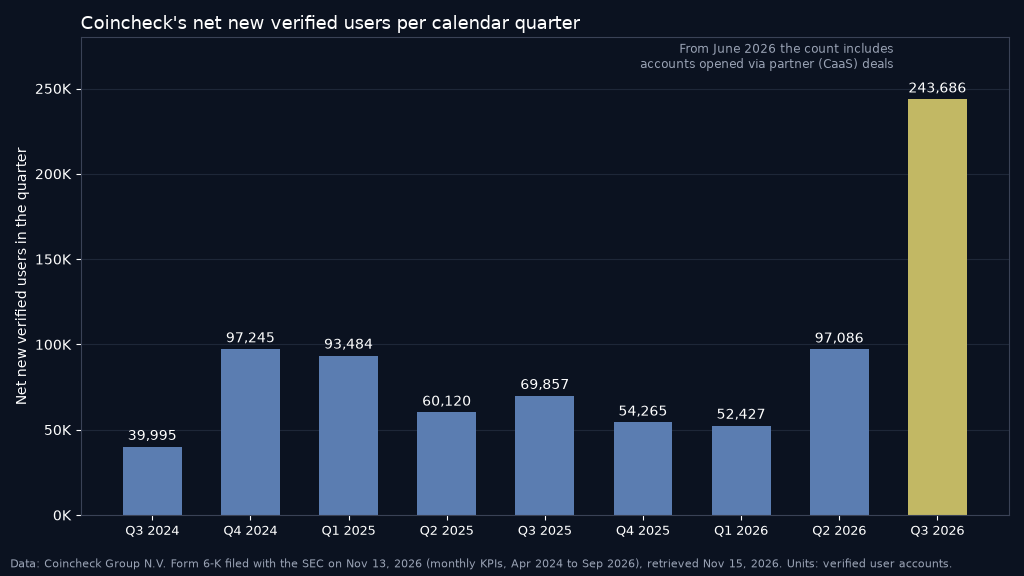
There is an important footnote. Starting in June 2026, the count includes accounts opened through crypto-as-a-service deals, where partner firms offer Coincheck’s trading and custody to their own customers.
Coincheck credits the growth to new products, rising interest in BTC, ETH and XRP in Japan, and “our recent partnership with Mercari,” the country’s big online marketplace.
Activity tells a different story. Monthly trading users fell 17.5% to 89,880 in September, from 108,988 a year earlier. Marketplace trading volume dropped 56% to ¥41.5 billion for the quarter, and Bitcoin trading on it fell 59% to ¥13.7 billion.
We read that as a market in waiting mode rather than retreat. Accounts are being opened at the fastest pace in the data, while existing users mostly hold.
Bitcoin’s Price Still Drives Customer Assets
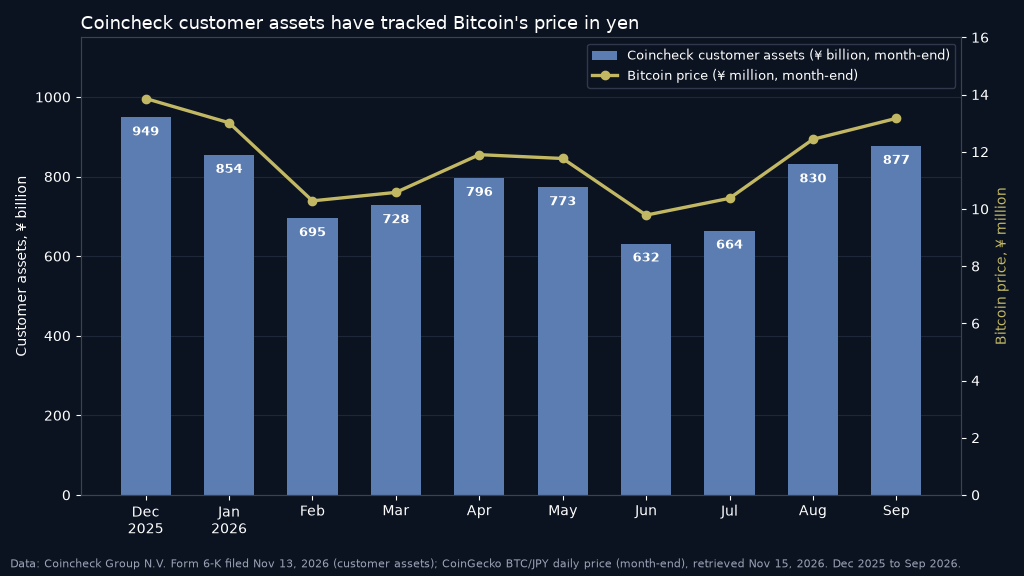
Customer assets, the crypto and cash Coincheck holds for clients, climbed 39% in the quarter to ¥876.9 billion in September, from ¥631.6 billion in June.
That tracked Bitcoin closely. CoinGecko data shows BTC rising about 35% in yen over the same stretch, from roughly ¥9.78 million on June 30 to ¥13.17 million on Sept. 30.
Exchange platform volume also rose each month of the quarter, from ¥156.3 billion in July to ¥217.8 billion in September, a 39% gain. The quarter’s total of ¥577.6 billion was still 39% below a year earlier.
Bitcoin has since pulled back. It trades near ¥10.44 million, or about $65,360, according to CoinGecko on Sunday, roughly 21% below its Sept. 30 level in yen. That suggests customer assets for October and November may come in lower when the next report lands.
For long-term holders, the more useful signal is the base. Nearly 2.9 million verified Japanese accounts can now buy Bitcoin with a few taps, up from just over 2 million in April 2024.
What CNCK Stock Is Pricing In
The share price has been hit hard. Nasdaq data shows CNCK closed at $7.88 on Dec. 1, 2025, its high for the past year, so Friday’s $0.98 close marks a fall of about 88%.
Friday’s close was also 10.9% lower on the day, on volume of 35,738 shares.
Nasdaq’s listing rules require a minimum bid price of $1. A company usually gets a deficiency notice only after 30 consecutive business days below that level, and then has time to recover, so one close under $1 does not trigger anything yet.
The pressure is not unique to Coincheck. Retail-focused exchanges have struggled across the market, as we saw when Gemini’s credit card out-earned its own exchange after a steep volume drop. Kraken’s parent Payward, by contrast, kept adding client assets through a weaker profit quarter.
Japan’s wider market is still drawing serious players, too, as Nomura’s crypto unit Laser Digital showed by winning a Japanese license.
Can New Accounts Become Bitcoin Buyers?
We believe that is the question that matters most for Coincheck and for Bitcoin demand in Japan.
The company’s own filing says trading users have historically risen with crypto prices and volatility. If that pattern holds, the biggest wave of sign-ups in its published data gives it a much larger pool to draw from once momentum returns.
We would watch three things in the next report: monthly trading users, Bitcoin’s share of Marketplace volume, and how many of the new partner accounts actually place a first trade.
Bitcoin’s fixed supply, growing access through mainstream apps like Mercari and steadily rising account numbers form a strong long-term backdrop. The coming quarters will show how quickly Japan’s new crypto savers put that access to work.
DC Forecasts is a leader in many crypto news categories, striving for the highest journalistic standards and abiding by a strict set of editorial policies. If you are interested to offer your expertise or contribute to our news website, feel free to contact us at [email protected]












Discussion about this post