



Payward, the parent company of the Kraken exchange, has posted a third quarter that looks very different depending on where you stand.
Against a year ago, profit fell hard. Against the spring, it nearly tripled. And underneath both numbers sits a detail that matters more for crypto’s long game: Kraken clients added assets in every one of the last 12 months, even as prices fell.
The figures come from Payward’s Q3 2026 financial highlights, published on Nov. 13. The company is private, so these are its own unaudited, non-GAAP measures rather than a full set of public accounts.
Payward Profit: Down 66% on the Year, Up From Q2
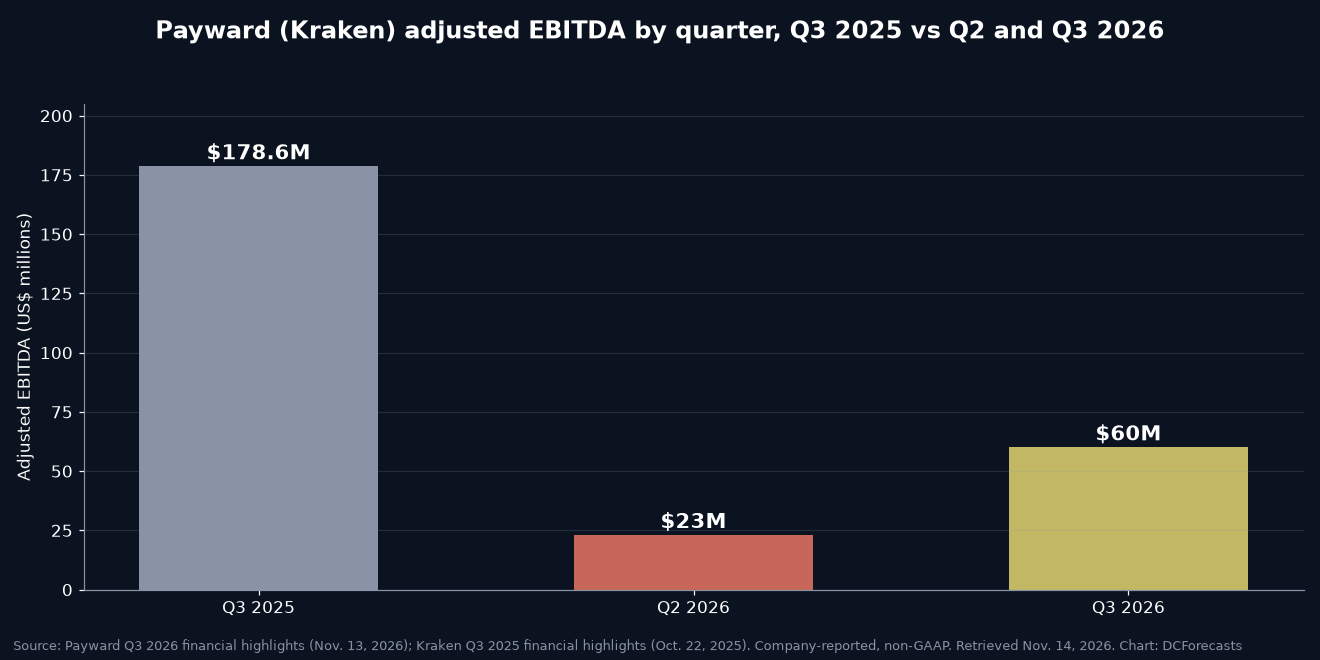
Adjusted EBITDA came in at $60 million for the July to September quarter. That is up from $23 million in Q2 2026.
It is also about 66% below the $178.6 million Kraken reported for Q3 2025, when it said revenue had hit a record.
The company also changed how it reports. It dropped adjusted revenue as its headline measure and now uses Total Platform Margin, or TPM, which also deducts the staking rewards it pays to clients.
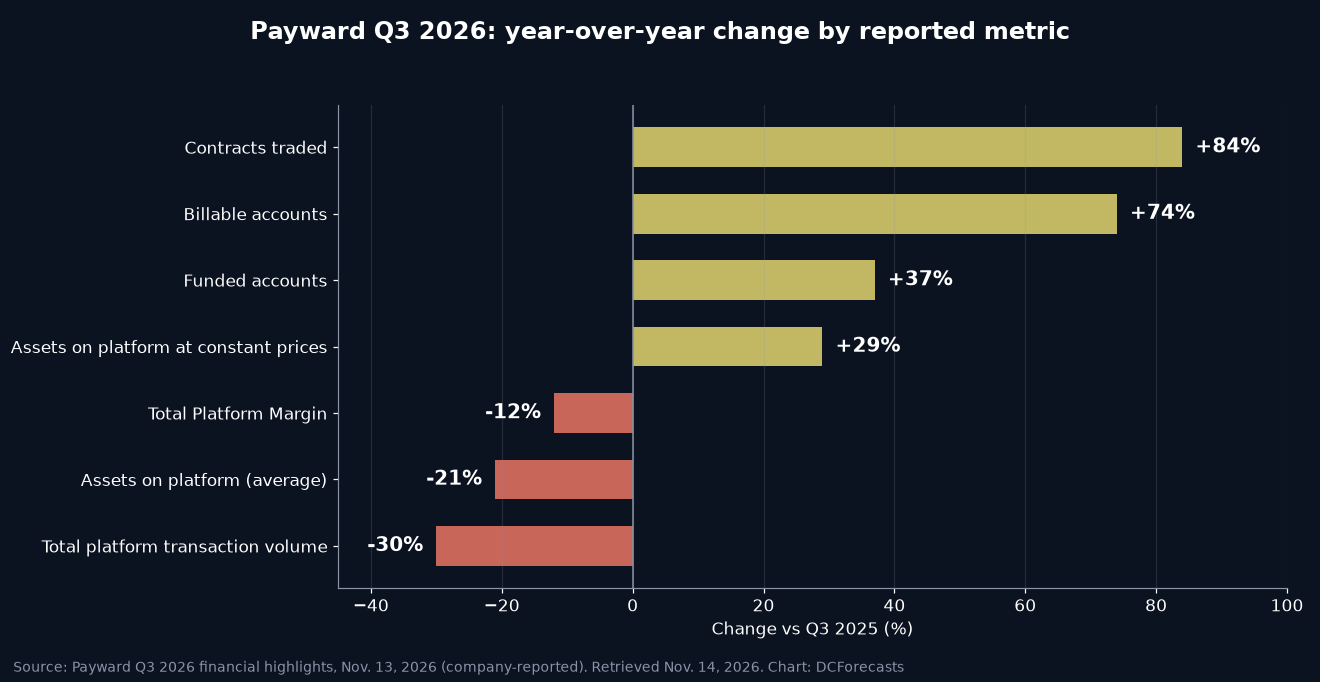
TPM was $487 million, up 12% from $436 million in Q2 but down 12% from a year earlier. The adjusted EBITDA margin rose to 12% of TPM from 5% the quarter before.
Because the yardstick changed, the 12% margin should not be compared directly with the 27.6% margin Kraken quoted a year ago, which was measured against adjusted revenue.
Trading Volume Fell, but Kraken Took Market Share
Total platform transaction volume reached $353 billion. That was 22% higher than in Q2 and 30% lower than in Q3 2025.

The year-on-year drop reflects a quieter market. Payward said industry spot volume fell 7% from Q2, citing CoinMarketCap data.
Even so, the Kraken exchange gained ground. Its share of industry spot volume rose to 6.5% in September 2026, from 3.3% in September 2025, the company said.
Derivatives grew faster still. Contracts traded rose to 66 million, up 10% on the quarter and 84% on the year, as more clients traded futures.
Clients Kept Adding Crypto as Prices Slid
The most telling numbers sit in the asset base. Assets on platform averaged $43 billion, up 4% from Q2 and down 21% from a year earlier.
That headline decline is mostly about prices. Measured at constant prices, which strips out market moves, assets on platform rose 29% year over year to $71 billion.
Payward also said clients have added assets in each of the last 12 months. In plain terms, people kept moving coins and cash onto the platform through a weaker market rather than pulling out.
We read that as a healthy sign for Bitcoin and the wider market. Holders who keep depositing while prices drop tend to be building positions for the long term, not chasing a quick trade.
Funded accounts reached 7.1 million, up 37% on the year. Payward notes this counts accounts, not unique people, since one client can hold several.
Less Reliance on Trading Fees
For the first time, Payward split TPM into three buckets. All three grew from Q2.
- Transaction based: $234 million, up 7%, earned when clients trade.
- Asset based: $128 million, up 26%, earned on assets clients hold.
- Access based: $125 million, up 7%, from subscriptions, trader evaluations, listings and index licenses.
Asset- and access-based income made up 52% of TPM, up from 46% in Q3 2025. Access-based TPM grew 59% from a year ago and now accounts for about a quarter of the total.
Billable accounts, which pay for products such as subscriptions, rose 74% to 1.5 million.
That shift matters for an exchange. Fees tied to trading volume swing with the market, while income from held assets and paid access tends to be steadier.
xStocks, Prediction Markets and an AI Agent
Payward used the update to name AI as its fifth business pillar, next to trading, banking, asset management and Payward Services.
Next, it plans a personal finance agent. The company says the agent will act only within limits set by the client, require approval before a trade runs and log every action it takes.
For trading, it lists prediction markets for U.S. clients and equity perpetual futures as next steps. Rivals are already there: Robinhood recently reported 5.9 billion prediction market contracts.
Tokenization is already scaling. Payward said xStocks passed $1 billion in assets under management in October and now offers more than 700 tokenized equities, after the recent expansion into DAX 40 and FTSE 100 names.
In banking, the company said it plans to move U.S. dollar wires onto its own Federal Reserve master account. It also agreed in October to buy Saldo Bank, an EU-licensed digital bank, subject to regulatory approval.
Reap, which joined Payward in July, launched a Virtual Asset Ledger that lets clients of its card-issuing platform spend Bitcoin and other virtual assets from their existing balances.
What Comes Next for the Kraken Exchange
Payward also completed its latest quarterly Proof of Reserves as of Sept. 30, 2026, validated by The Network Firm. Regular, checkable reserves remain one of the clearest trust signals an exchange can offer.
The quarter’s message is mixed but readable. Profit is well below last year’s peak, and trading volume is lower. Yet market share, derivatives activity, paid accounts and client deposits all moved up.
We believe that combination is what matters for crypto’s next phase. Platforms that hold client assets through a downturn and earn steadier income are better placed when activity returns.
The test now is execution. Watch whether the Q4 update shows the AI agent, U.S. prediction markets and the Fed account moving from plans to live products.
DC Forecasts is a leader in many crypto news categories, striving for the highest journalistic standards and abiding by a strict set of editorial policies. If you are interested to offer your expertise or contribute to our news website, feel free to contact us at [email protected]












Discussion about this post