



Situational Awareness LP, the hedge fund founded by former OpenAI researcher Leopold Aschenbrenner, walked away from most of its bitcoin miner stocks in the third quarter. The fund’s latest Form 13F, filed with the SEC on Nov. 16, shows it fully exited Core Scientific, Riot Platforms and HIVE Digital, and cut IREN by 94%.
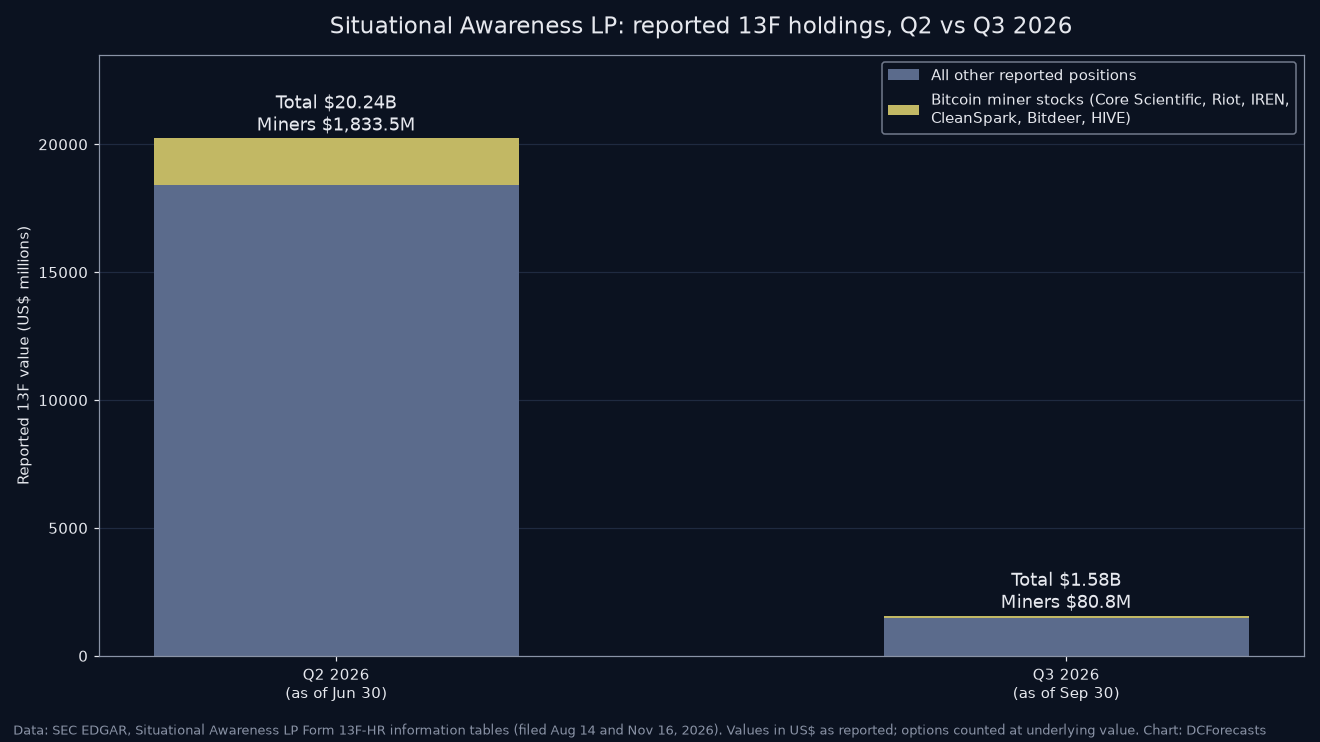
The miner exits were part of a much larger shift. The reported value of the fund’s U.S.-listed positions fell from $20.24 billion on June 30 to $1.58 billion on Sept. 30, and the number of positions shrank from 26 to nine.
Six Miners, Three Exits and Three Deep Cuts
At the end of June, the fund held six bitcoin mining stocks worth a combined $1.83 billion. By the end of September, the figure was $80.8 million, a drop of about 96%.
- Core Scientific: 26,008,473 shares worth $665.6 million in Q2, sold in full.
- Riot Platforms: 17,100,000 shares worth $468.2 million, sold in full.
- HIVE Digital: 9,133,726 shares worth $33.2 million, sold in full.
- IREN: cut from 9,474,099 shares to 527,864, worth $21.6 million at quarter end.
- CleanSpark: cut 75%, from 12,276,139 shares to 3,019,029, worth $38.9 million.
- Bitdeer: cut 44%, from 3,439,450 shares to 1,934,618, worth $20.3 million.
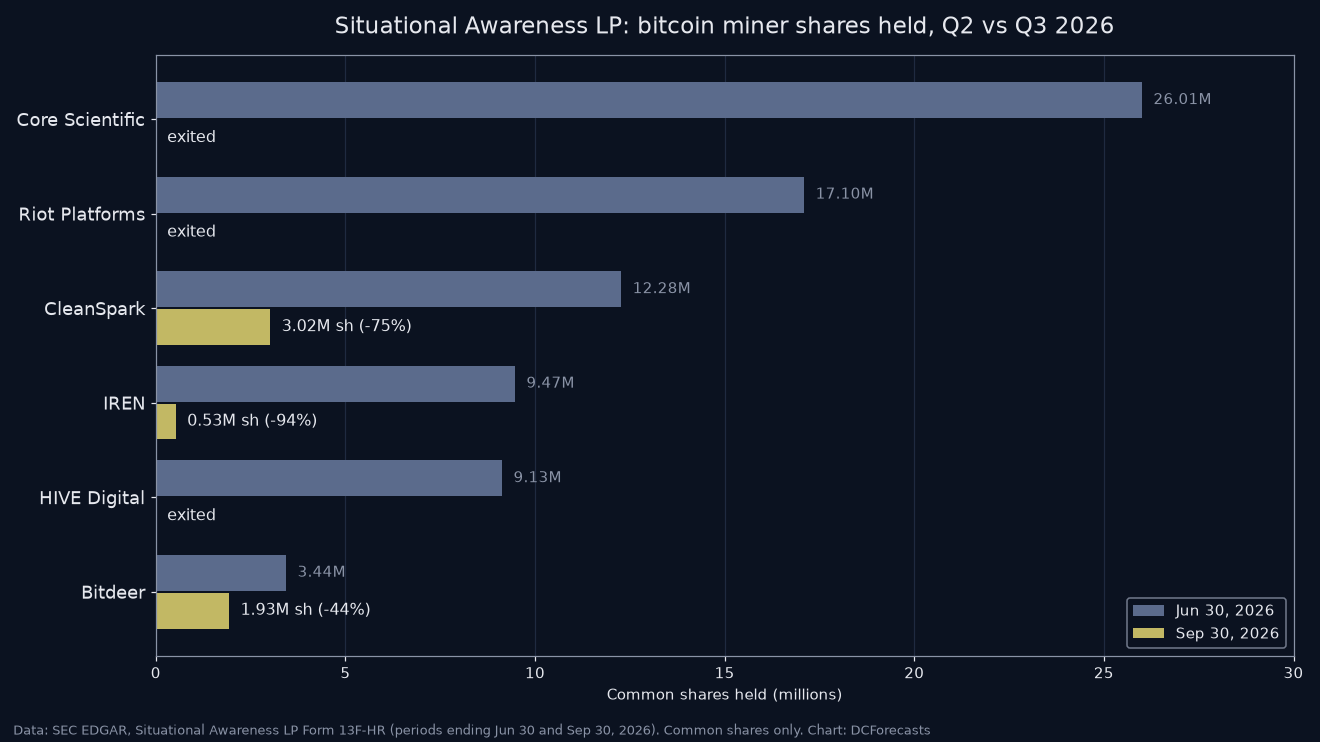
The fund did not leave the miner sector entirely. The trimmed IREN, CleanSpark and Bitdeer stakes are still on the books, and the filing gives no reason for any of the trades. Funds do not explain their moves in a 13F, so the filing shows what changed, not why.
Miners Were Never the Fund’s Main Bet
The miner stakes made up only about 9% of the fund’s reported book in June. The much bigger positions were in chips, memory, power and data centers, and the fund cleared out almost all of them in common stock form:
- Sandisk, $5.67 billion.
- Micron Technology, $5.57 billion.
- Bloom Energy, $1.90 billion.
- Taiwan Semiconductor, $1.27 billion.
- Nebius Group, $1.23 billion.
- CoreWeave, $744.5 million.
- Applied Digital, $469 million.
Some of that exposure moved into options rather than disappearing. At Sept. 30, the fund reported call options on Bloom Energy ($389.2 million of underlying value), Nebius ($332.6 million), Sandisk ($182.7 million) and the Roundhill memory ETF ($140.3 million). Together the calls account for about $1.04 billion of the $1.58 billion total.
Its largest stock holding is now SharonAI Holdings, with 8,070,950 shares valued at $440.7 million. A Schedule 13D/A filed in September lists Aschenbrenner among the reporting persons and puts that stake at 21.1% of SharonAI’s Class A shares. The fund also opened a small new position in Fermi Inc., with 2,671,898 shares worth $11.2 million.
What a 13F Leaves Out
A 92% fall in reported value does not mean the fund lost 92% of its money. A 13F covers only long positions in U.S.-listed stocks and certain options. Cash, short positions, private deals and foreign holdings are not included. A fund can sell its listed stocks and hold the proceeds elsewhere, and the filing would look the same.
The filing does show a clear change in how much listed exposure the fund carried into the fourth quarter. It is especially relevant for bitcoin miners, which had become popular with AI-focused investors because their power contracts and data-center sites can be rented to AI customers.

Why Miners Drew AI Money in the First Place
Aschenbrenner’s 2024 essay series, which gave the fund its name, argued that electricity and data-center capacity would become the bottleneck for AI. Bitcoin miners already own large grid connections and cooling infrastructure, so several of them have signed AI hosting deals over the past two years. That made miner stocks a convenient way to bet on AI power demand.
When an AI-focused fund cuts those stakes, it says more about its view of AI infrastructure trades than about Bitcoin itself. The fund sold its biggest chip and memory positions in the same quarter, which fits that reading.
The Bitcoin Network Did Not Notice
The equity sales had no visible effect on the network those companies help secure. Mempool.space put Bitcoin’s daily average hashrate at about 1,148 EH/s on Nov. 16, close to the top of its three-month range. The peak in that window was about 1,228 EH/s on Oct. 24. DCForecasts covered the hashrate rebound after the latest difficulty cut earlier today.
Miners keep running their machines whoever owns their shares, and the network’s security budget depends on block rewards and fees, not on which funds hold mining stocks. Hashrate staying near record levels while the price has pulled back shows how committed operators remain.
Bitcoin traded at about $64,890 on Coinbase on Nov. 17. Grayscale recently described that zone as an attractive entry point after the latest sell-off. None of that guarantees a rebound, but it puts one fund’s exit from miner stocks in context.
Other Funds Are Moving the Other Way
Situational Awareness was not typical of the latest round of filings. Several large managers added Bitcoin exposure in Q3. D. E. Shaw opened a $90 million IBIT stake and increased its Strategy position, even as it trimmed some miners.
For investors who own bitcoin mining stocks, the main point is that the AI trade can bring buyers to miners and can also take them away. Bitcoin’s own fundamentals, including hashrate, the issuance schedule and network security, do not depend on whether one fund holds those shares. The full filings can be checked on the SEC’s EDGAR page for Situational Awareness LP.
DC Forecasts is a leader in many crypto news categories, striving for the highest journalistic standards and abiding by a strict set of editorial policies. If you are interested to offer your expertise or contribute to our news website, feel free to contact us at [email protected]












Discussion about this post