



Bitcoin mining difficulty has fallen sharply, giving miners some relief after weeks of declining profitability. However, new network data from November 18 suggests the adjustment may be temporary, with Bitcoin’s next difficulty reset already projected to move higher.
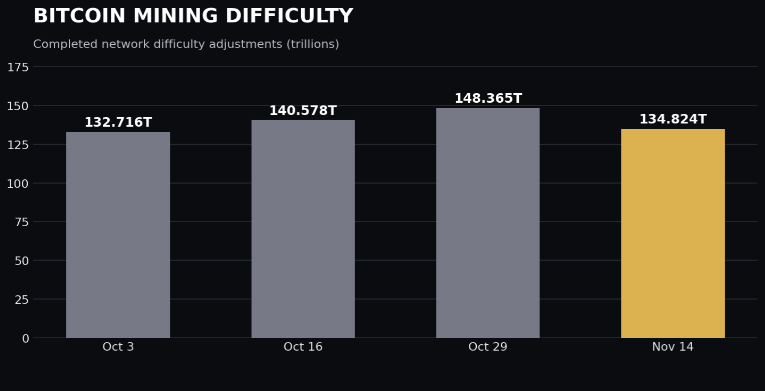
Bitcoin’s mining difficulty dropped 9.1% on November 14, falling from 148.36 trillion to 134.82 trillion. The adjustment reduced the computational competition faced by active miners following October’s consecutive increases.
According to the latest Bitcoin network statistics, the seven-day average hashrate stood at approximately 982.8 exahashes per second (EH/s) on November 18.
Meanwhile, the next difficulty adjustment was projected at an increase of 10.26%, potentially reversing much of the recent decline.
Bitcoin Mining Difficulty Sees a Major Reset
The November 14 adjustment was one of Bitcoin’s largest difficulty reductions of 2026.
Earlier in October, mining difficulty increased twice, reaching approximately 140.58 trillion on October 16 before climbing to 148.36 trillion on October 29.
The latest reduction brought difficulty back to 134.82 trillion, removing most of those increases.
Bitcoin automatically adjusts mining difficulty approximately every 2,016 blocks to maintain an average block interval of ten minutes.

When network computing power declines, blocks can take longer to produce, eventually triggering a downward difficulty adjustment.
This mechanism helps Bitcoin maintain predictable issuance even when mining conditions change.
The adjustment also highlights an important difference between Bitcoin’s network fundamentals and its market price.
As discussed in our previous Bitcoin market outlook, broader market conditions can affect investor confidence, but the network continues operating according to its established rules.
Bitcoin Mining Profitability Remains Under Pressure
Although difficulty has declined, mining profitability has not experienced an equivalent recovery.
Hashprice, which measures expected mining revenue per unit of computing power, remains under pressure.
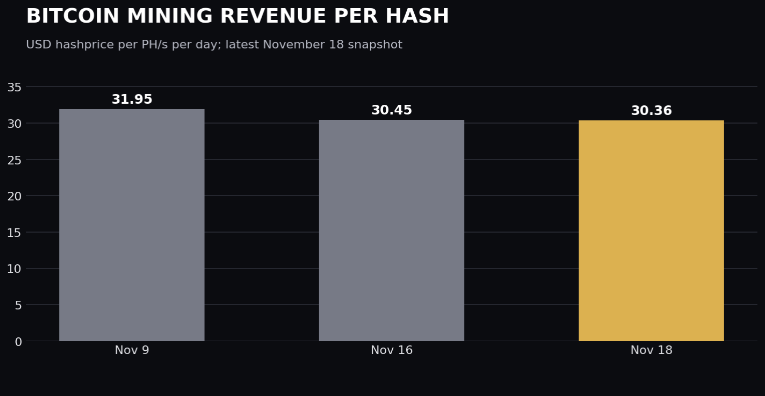
On November 9, Bitcoin’s dollar-denominated hashprice stood at approximately $31.95 per petahash per second per day.
By November 16, it had declined to $30.45, representing a weekly decrease of approximately 4.7%.
The November 18 reading was approximately $30.36.
The figures reveal an important development.
While the difficulty reduction increases the expected BTC earned per unit of computing power, Bitcoin’s lower market price continues limiting miners’ dollar-denominated revenue.
Electricity costs, equipment efficiency, and transaction fees also determine whether individual operations remain profitable.
For miners operating newer equipment with access to inexpensive electricity, lower difficulty can provide meaningful relief.
However, older mining machines may continue struggling despite the adjustment.
November 26 Could Bring Another Difficulty Increase
The next important date for Bitcoin miners is November 26, when the network’s next difficulty adjustment is estimated to occur.
As of the November 18 snapshot, the projected increase stood at approximately 10.26%.
That estimate is not guaranteed.
Difficulty projections change as additional blocks are produced, and the final adjustment depends on actual block production during the current period.
Nevertheless, the projection suggests that network competition could increase again if computing power remains elevated.
This development comes as investors continue monitoring Bitcoin’s broader market performance, including the technical conditions examined in our Bitcoin moving average analysis.
What Does This Mean for Bitcoin’s Recovery?
Bitcoin’s mining difficulty adjustment does not directly predict the cryptocurrency’s next price movement.
However, it provides useful information about the economics supporting the network.
A lower difficulty level can improve miners’ expected BTC production per unit of computing power, potentially reducing financial pressure on some operations.
That does not automatically mean miners will sell fewer coins. Treasury decisions, operating costs, and financing arrangements remain important factors.
The network’s ability to adjust to changing conditions is nevertheless an important part of Bitcoin’s long-term design.
We previously explored how institutional demand could influence Bitcoin, but mining fundamentals offer another perspective on the cryptocurrency’s resilience.
For now, investors should monitor whether hashprice begins recovering, whether network hashrate stabilizes, and how the next difficulty adjustment develops.
Bitcoin’s latest difficulty reduction provides temporary relief for miners, but the November 26 adjustment could become another important test of network competition.
A sustained improvement in mining economics, combined with stronger Bitcoin demand, would offer a more constructive foundation for the market’s longer-term recovery.
DC Forecasts is a leader in many crypto news categories, striving for the highest journalistic standards and abiding by a strict set of editorial policies. If you are interested to offer your expertise or contribute to our news website, feel free to contact us at [email protected]












Discussion about this post