


Two Ledger Flex owners, one in Berlin and one in Dubai, were drained 22 minutes apart on the evening of Nov. 14, according to transaction records we checked on the Bitcoin and Solana blockchains.
Both owners said they bought their devices at stores that sell Ledger hardware, MediaMarkt in Berlin and Virgin Megastore in Dubai.
A third owner says a Ledger Stax from the same Dubai chain lost 507,000 USDT on the same day.
That matters because the implant attack Ledger confirmed in October ran through resellers in Southeast Asia.
The bigger question for anyone holding Bitcoin in self-custody is simple: how do you know the device in your hand is the device that left the factory?
What the Ledger Flex Owners Reported
Of the three new cases, only the Dubai Flex is confirmed so far.
The owner, who posts on X as Rewinsky, said on Nov. 15 that about 1,300 SOL had been drained from his Ledger. A day later he opened the device and posted photos of the inside.
The Ledger Implant OSINT registry, run by former Mt. Gox chief Mark Karpelès, classified it as “implant confirmed.” The photos show an extra board and an antenna stuck inside the back cover, marked V1.3. It is the first V1.3 antenna the registry has recorded on a Ledger, and its first case from the Middle East.
The Berlin owner said on Nov. 18 that more than $320,000 had been taken from a Ledger Flex bought at MediaMarkt Tech Village in Berlin, and posted two Bitcoin transactions and one USDT transaction.

The Stax owner said the device was bought new at Virgin Megastore Dubai on Oct. 11 and that its recovery phrase was never typed anywhere else. No photos of either device’s inside have been published, so the registry lists both as “implant suspected.”
As of Wednesday, Ledger and the two retailers had not commented publicly on these cases.
What the Blockchain Shows About Nov. 14
We traced the hashes the owners posted.
The two Bitcoin transactions from the Berlin owner’s post moved 4.72 BTC into a single address. Both were confirmed in block 975,836 at 19:53 UTC, when one bitcoin traded near $65,670 on Coinbase, for a value of about $310,000.
The same address took in seven more deposits in that block, worth 1.55 BTC. The chain alone cannot tell us whose coins those were.
At 20:15 UTC, the Solana transaction Rewinsky posted moved 1,299.998 SOL out of his wallet, worth roughly $93,000 at Coinbase prices at the time.
By 21:22 UTC, the Bitcoin address had forwarded everything it received, 6.27 BTC in its final sweep, and its balance was back to zero.
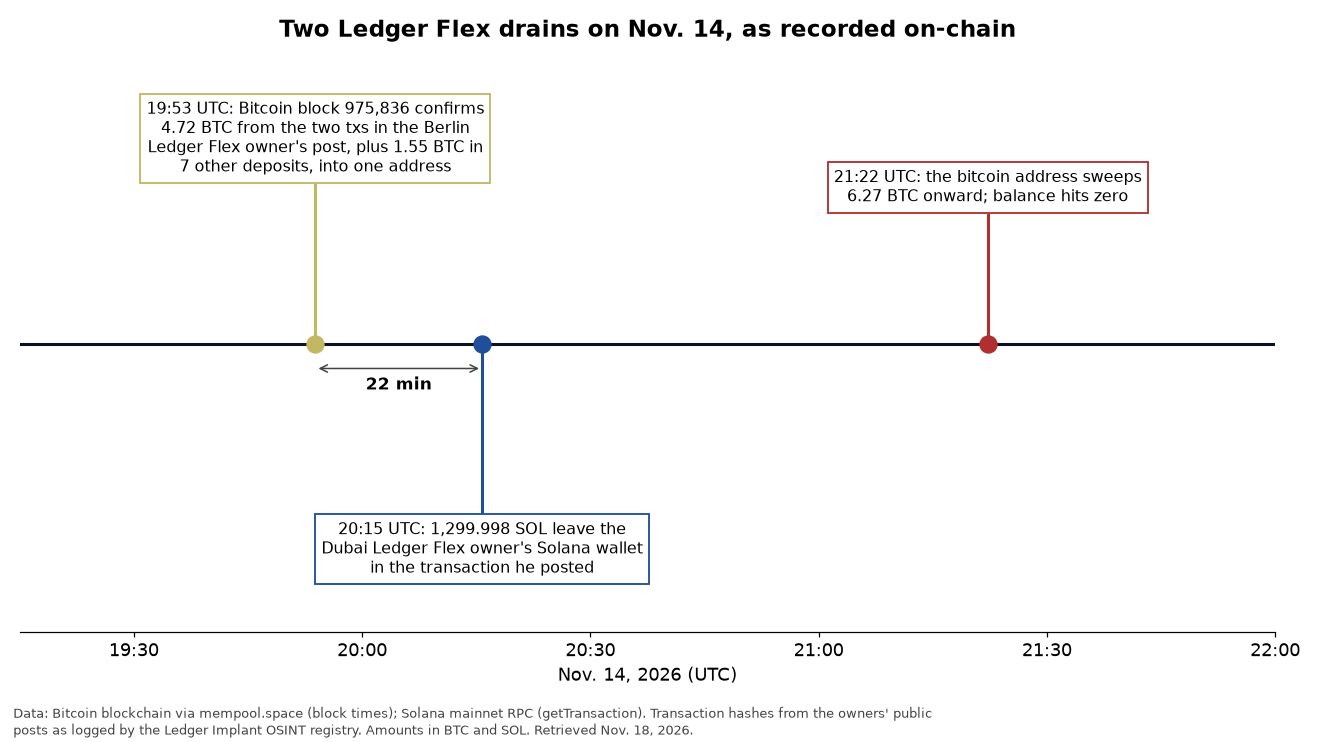
Timing alone does not prove the cases are linked.
Still, the pattern looks familiar. In October, the attackers behind the first wave struck many wallets in one coordinated burst, as Ledger itself described.
Is Ledger Safe After the Dubai and Berlin Reports?
Ledger’s own account of the attack, published Oct. 15, is the best guide to what went wrong.
The company said a “highly organized criminal group” spent months buying genuine Ledger devices, fitting hidden components designed to capture the recovery phrase during setup, and putting them back into distribution through resellers in Southeast Asia.
“There was no flaw in Ledger’s chip, operating system or servers,” Ledger wrote, calling it “a localized distribution attack.”
In other words, this is not a Ledger hack in the usual sense of a broken chip or leaked server. It is tampering with physical devices before they reach buyers.
Ledger also told resellers to keep stock off shelves, hand devices over at purchase and never resell returns.
The new cases test that “localized” description. Dubai is a new region, and MediaMarkt in Germany had already appeared in the registry in October.
Governments are also taking notice. In an advisory dated Oct. 28, the Singapore Police Force said at least two tampered Ledger cases had been reported since Sept. 10, with losses of about S$3.5 million.
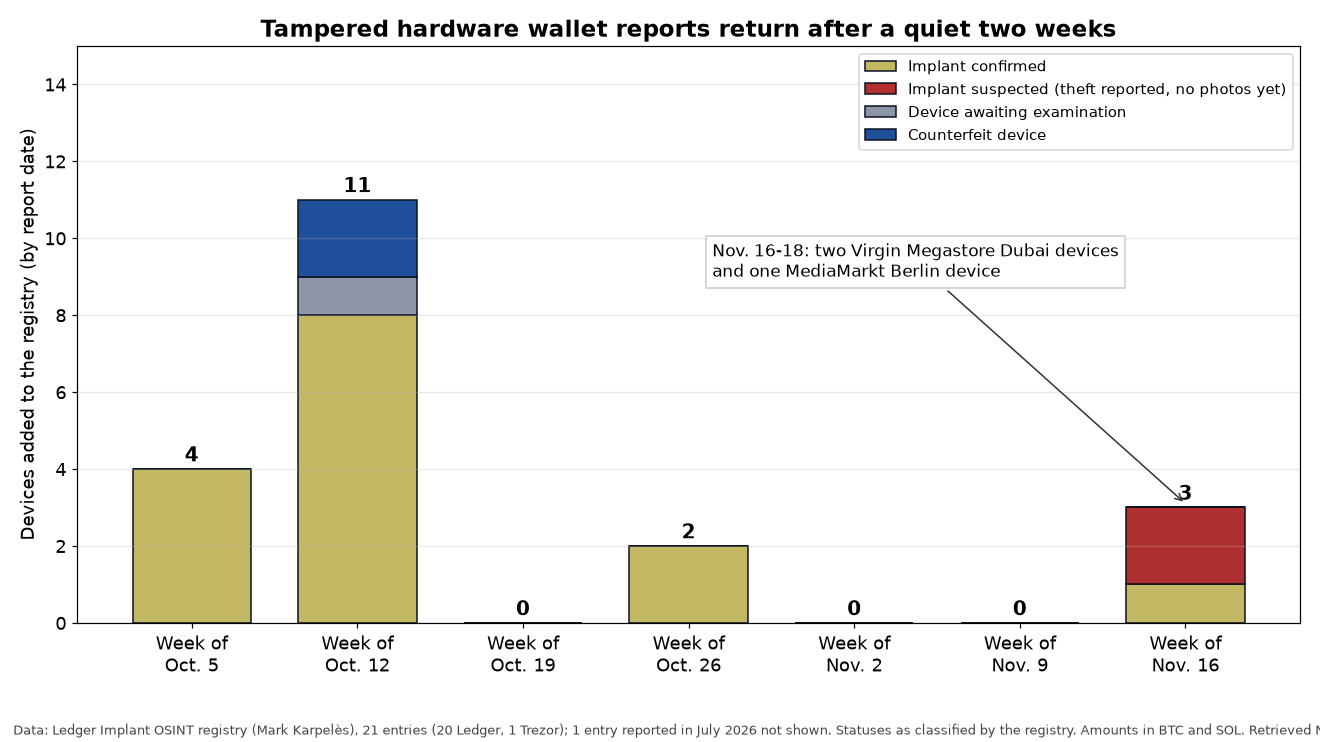
The registry now lists 21 devices: 15 with confirmed implants, two suspected, two counterfeits and one awaiting examination. One of the confirmed implants sat inside a Trezor Safe 5, a case we covered when Trezor cut 80% of its resellers.
Why Bitcoin’s Design Still Comes Out Ahead
None of these cases broke Bitcoin.
The network did exactly what it is built to do: it recorded every transfer publicly and permanently, which is why anyone can check the Berlin owner’s posted transfers down to the satoshi.
The weak point is the moment a recovery phrase appears on a screen. If someone else can see that screen, they control the coins.
That is a hardware supply chain problem, not a protocol problem. As we noted when Ledger’s CEO said “everybody will be hacked,” self-custody puts security in the holder’s hands, for better and worse.
We believe the practical lessons are clear:
- Buy hardware wallets directly from the manufacturer where possible.
- Treat any device bought from a retail shelf in recent months as worth checking, and follow your wallet maker’s official guidance.
- Move funds to a new recovery phrase, created on a device you trust, if you have any doubt.
- For large holdings, consider multisig across devices from different makers, so one tampered device cannot move the coins alone.
Owners asking whether a Ledger Stax or Ledger Flex is safe should note that the registry has no confirmed Stax implant from Dubai yet, and that Ledger says its own chip and software were never breached.
The coming days will show whether more Virgin Megastore or MediaMarkt buyers come forward, and whether Ledger widens its October sales suspension.
Either way, Bitcoin’s transparent ledger and fixed 21 million supply are not in question. What is being tested is the path a hardware wallet takes to reach its owner, and that is a problem the industry can fix.
DC Forecasts is a leader in many crypto news categories, striving for the highest journalistic standards and abiding by a strict set of editorial policies. If you are interested to offer your expertise or contribute to our news website, feel free to contact us at [email protected]












Discussion about this post