


Bitcoin mining stocks have quietly stopped trading like Bitcoin, and the data now shows them moving more closely with chipmakers than with the coin they mine.
Over the 52 weeks to Nov. 13, the CoinShares Bitcoin Mining and Digital Power ETF (WGMI) had a correlation of just 0.33 with Bitcoin’s weekly returns. That is the lowest reading since the fund’s first full year of trading.
Its correlation with the VanEck Semiconductor ETF (SMH) climbed to 0.74 over the same window, the highest in that same history.
For Bitcoin investors, that split matters. The miner sell-off since early October says more about the AI trade than about Bitcoin itself.
The bigger question is whether mining shares can still serve as a proxy for BTC, or whether that role now belongs to Bitcoin alone.
What the Correlation Data Shows
We built the series from adjusted daily closes for WGMI and SMH and Coinbase BTC-USD daily closes, all retrieved on Nov. 18. We measured weekly returns from Friday to Friday and rolled them over 52-week windows.
A correlation of 1 means two assets move in lockstep. Zero means there is no linear relationship.
In June 2023, WGMI’s link to Bitcoin peaked at 0.79. At the time, the miner ETF was essentially a leveraged Bitcoin bet.
That link has now fallen by more than half. Over the shorter 26-week window, it is close to zero at 0.05, while the chip-stock correlation sits at 0.72.

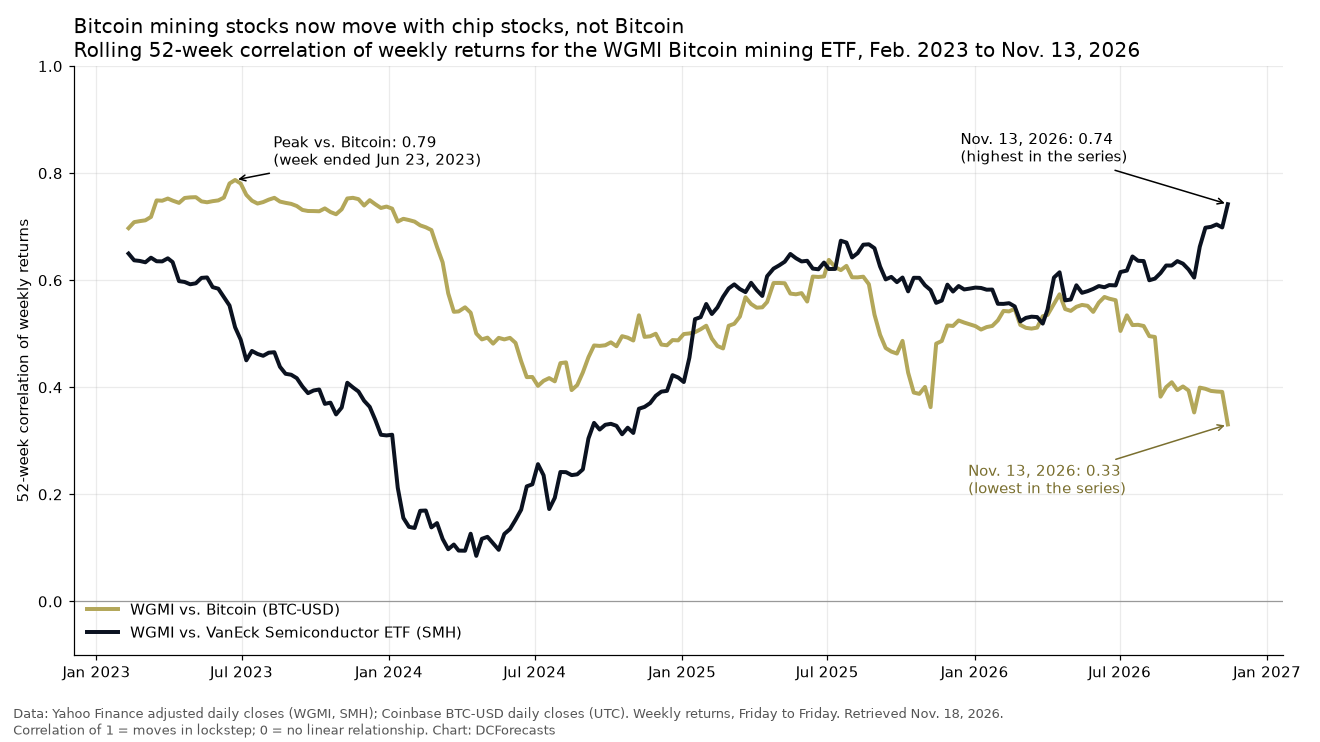
The shift is not new, but it has sped up. WGMI’s correlation with chip stocks has been higher than its correlation with Bitcoin for 33 straight weeks, starting with the week ended April 3.
Older pure-play names show the same pattern. An equal-weighted basket of MARA Holdings, Riot Platforms, CleanSpark, Hut 8, Cipher Mining and TeraWulf now has a 0.32 correlation with Bitcoin, its lowest since the series begins in late 2021.
Why Bitcoin Mining Stocks Follow the AI Trade
The fund’s full name hints at the answer: it now includes the words “Digital Power.” Many listed miners have signed deals to rent their sites, power and grid connections to AI and high-performance computing customers.
Once a company sells power and data center capacity to AI firms, its shares start to price in the same things as Nvidia and other chipmakers: AI spending, data center demand and chip supply.
That is why the stocks have reacted to AI headlines as much as to the hashprice. As we noted in our coverage of Nvidia’s $115.8 billion quarter, the AI cycle is now one of the market’s biggest swing factors.
Investors have also been reshuffling these names. One AI-focused hedge fund exited Riot and Core Scientific and cut IREN by 94% in the third quarter, according to its latest 13F filing.
Bitcoin Has Held Up Better Than Most Miners
The recent sell-off shows what this decoupling means in practice.
From Oct. 6 to Nov. 17, Bitcoin fell 24.2% on Coinbase’s daily closes. Over the same period, WGMI lost 46.1%, Nvidia lost 35.0% and SMH lost 27.3%. The Nasdaq-100 tracker QQQ fell 13.5%.
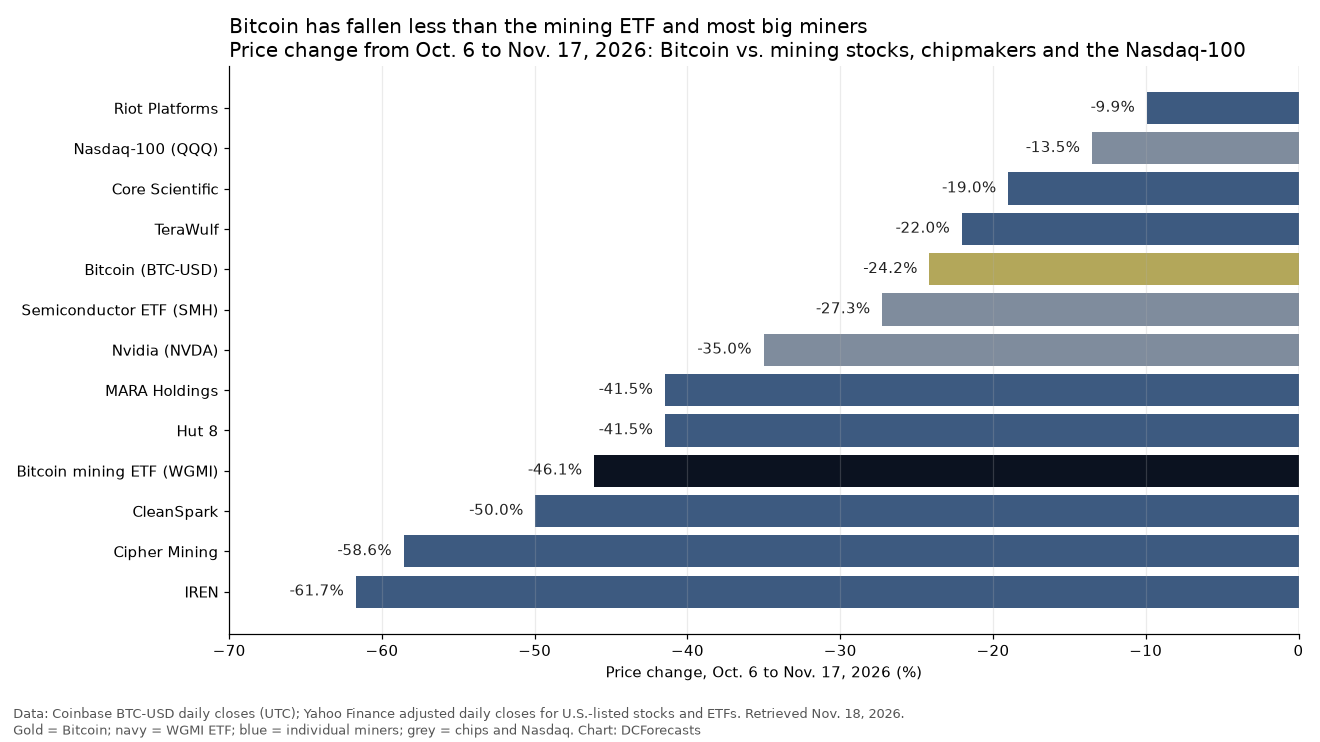
Results among individual miners were wide apart. Riot fell 9.9%, Core Scientific 19.0% and TeraWulf 22.0%, all less than Bitcoin.
Others fell far more. MARA and Hut 8 each lost 41.5%, CleanSpark 50.0%, Cipher Mining 58.6% and IREN 61.7%.
We have not tied any single stock’s move to one cause. Company-specific news, debt and AI contract terms all play a role.
Still, the pattern is clear. Five of the eight miners we tracked, and the mining ETF itself, fell harder than the asset they produce.
What It Means for Bitcoin Investors
We believe this is a constructive development for Bitcoin, even if it has been painful for miner shareholders.
First, it means Bitcoin is not simply an AI-adjacent tech trade. Over the same 52 weeks, Bitcoin’s own correlation with SMH was 0.26, far below the mining ETF’s 0.74.
Shorter windows can tell a different story. As we covered when the Fed modeled an AI bubble burst, Bitcoin’s 30-day daily correlation with the Nasdaq reached 0.68 in mid-November. Risk-off days still hit everything.
Second, weak mining stocks do not mean a weak network. After the latest difficulty cut, Bitcoin’s hashrate rebounded 15%, a sign that miners keep their machines running even as their shares trade on AI sentiment.
Third, investors who want Bitcoin exposure no longer get a clean version of it through mining equities. Spot Bitcoin and spot Bitcoin ETFs track the asset directly, without data center contracts, financing terms or chip-cycle risk.
Can Bitcoin Mining Stocks Reconnect With BTC?
The correlation could rise again. A sharp Bitcoin rally that lifts hashprice would likely pull the pure-play miners back toward the coin, as it did in 2023.
But the structural change looks durable. As more miners sign long-term AI hosting deals, a larger part of their earnings will depend on the chip and data center cycle.
We would watch three things in the coming weeks:
- Whether WGMI’s 52-week correlation with Bitcoin holds above 0.30 or keeps sliding toward the 26-week reading near zero.
- How mining stocks react to the next swing in chip stocks compared with the next swing in BTC.
- Whether hashrate keeps climbing toward the next difficulty adjustment while mining shares stay weak.
For now, the message from the data is simple. Mining stocks have become a bet on AI infrastructure, while Bitcoin remains a bet on Bitcoin.
With a fixed supply of 21 million coins and a network that keeps adding hashpower, we believe that focus is exactly what makes Bitcoin stand out when the AI trade turns volatile.
DC Forecasts is a leader in many crypto news categories, striving for the highest journalistic standards and abiding by a strict set of editorial policies. If you are interested to offer your expertise or contribute to our news website, feel free to contact us at [email protected]












Discussion about this post