



ARK Investment Management has shelved a planned family of eight Bitcoin buffer ETF products before a single share was sold. The decision came in a one-page letter to the SEC on Nov. 17, after more than a year of paperwork.
ARK ETF Trust asked to withdraw the registration amendments for its “DIET” Bitcoin funds, saying it “has determined not to proceed with the registration of the Shares at this time,” according to the withdrawal request on EDGAR.
Less than two hours later, Tidal Trust III pulled four Defiance funds built to bet on Bitcoin against ether or gold. Those funds had already gone effective in March and never launched.
For Bitcoin investors, the interesting part is what is being pruned. These were options-based and leveraged wrappers around Bitcoin, not the spot funds that hold the coins themselves.
The bigger question is whether demand for packaged, defined outcome ETF exposure to Bitcoin was ever there, or whether investors simply prefer to own the asset.
What ARK Planned With Its Bitcoin Buffer ETF Lineup
“DIET” stands for “Defined Innovation Exposure Term,” according to the preliminary prospectus ARK filed on Oct. 14, 2025. The lineup had eight funds in two flavors, each with four quarterly start dates.
The “Bitcoin 1” versions would sell at-the-money puts on spot Bitcoin ETFs and buy calls, so holders took roughly 50% of any decline over a 12-month outcome period. Upside would begin only after a 5% hurdle.
The “Bitcoin 2” versions were classic buffers. They aimed to absorb the first 10% of a decline, with upside limited by a cap set from option prices at the start of each period.
Outcome periods were to start on Jan. 1, April 1, July 1 or Oct. 1, depending on the fund. The options would reference spot products, with ARK 21Shares Bitcoin ETF (ARKB) and iShares Bitcoin Trust (IBIT) named in the filing.

The fee lines were never filled in.
Thirteen Filings and No Launch
The withdrawal letter lists 12 post-effective amendments: the original 485APOS and 11 follow-ups on Form 485BXT, which push back the effective date. They arrived roughly monthly, from Dec. 23, 2025 to Oct. 16, 2026.
No shares were ever issued or sold, the letter says.
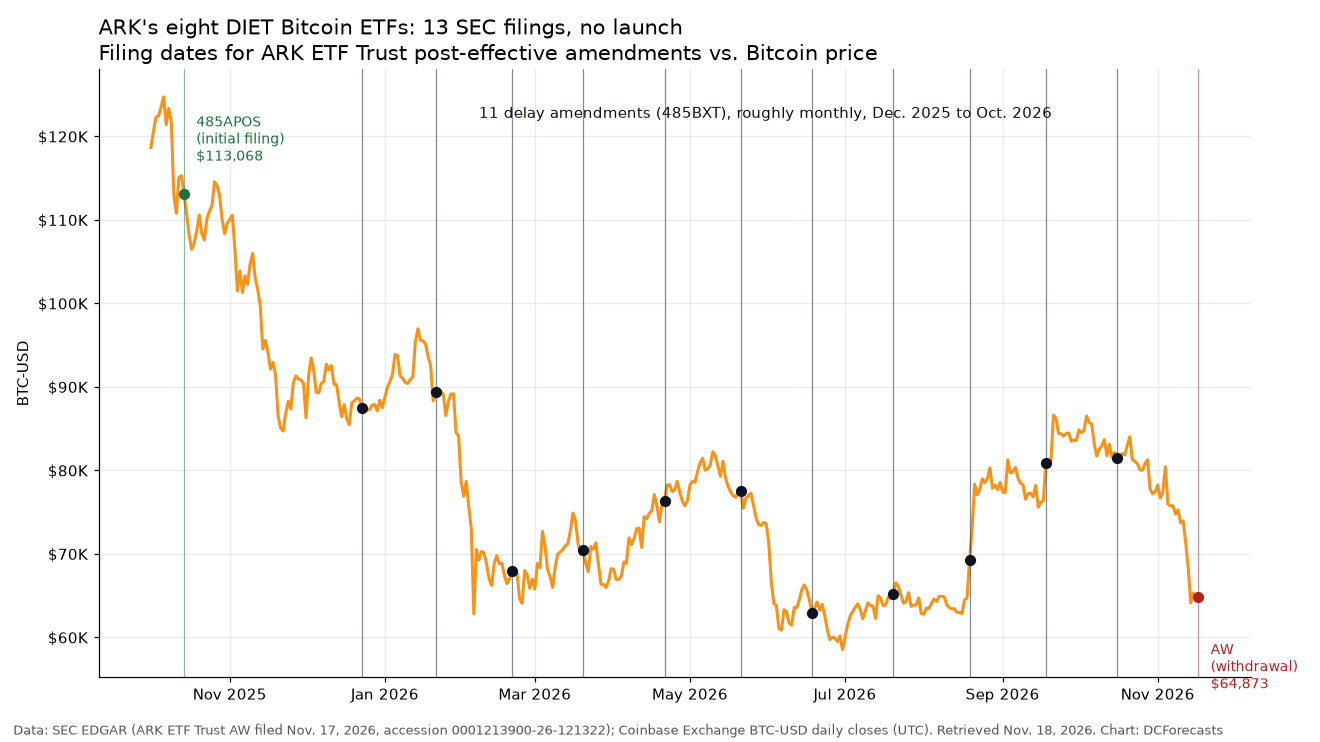
The timeline maps onto a hard year for the price. Bitcoin closed at $113,068 on Coinbase the day ARK filed and at $64,873 on Nov. 17, a 42.6% drop.
On paper, that is exactly the market where a downside buffer gets attention. We think the withdrawal says more about appetite for complex wrappers than about Bitcoin itself.
Defiance Drops Its Bitcoin vs Ethereum and Gold Bets
The Defiance funds were bolder. According to Tidal’s Nov. 17 withdrawal notice, the trust is withdrawing the Defiance Bitcoin vs Ether ETF, Ether vs Bitcoin ETF, Bitcoin vs Gold ETF and Gold vs Bitcoin ETF.
Their prospectus, effective March 16, 2026, described a leveraged long position of +150% to +220% of net assets in one asset and a matching short in the other. The management fee was 1.29%.
The funds “have not commenced operations, nor sold any shares,” the notice says, and they are now marked inactive on EDGAR.
The irony is that the Bitcoin-long side of both pairs would have been pointed the right way.
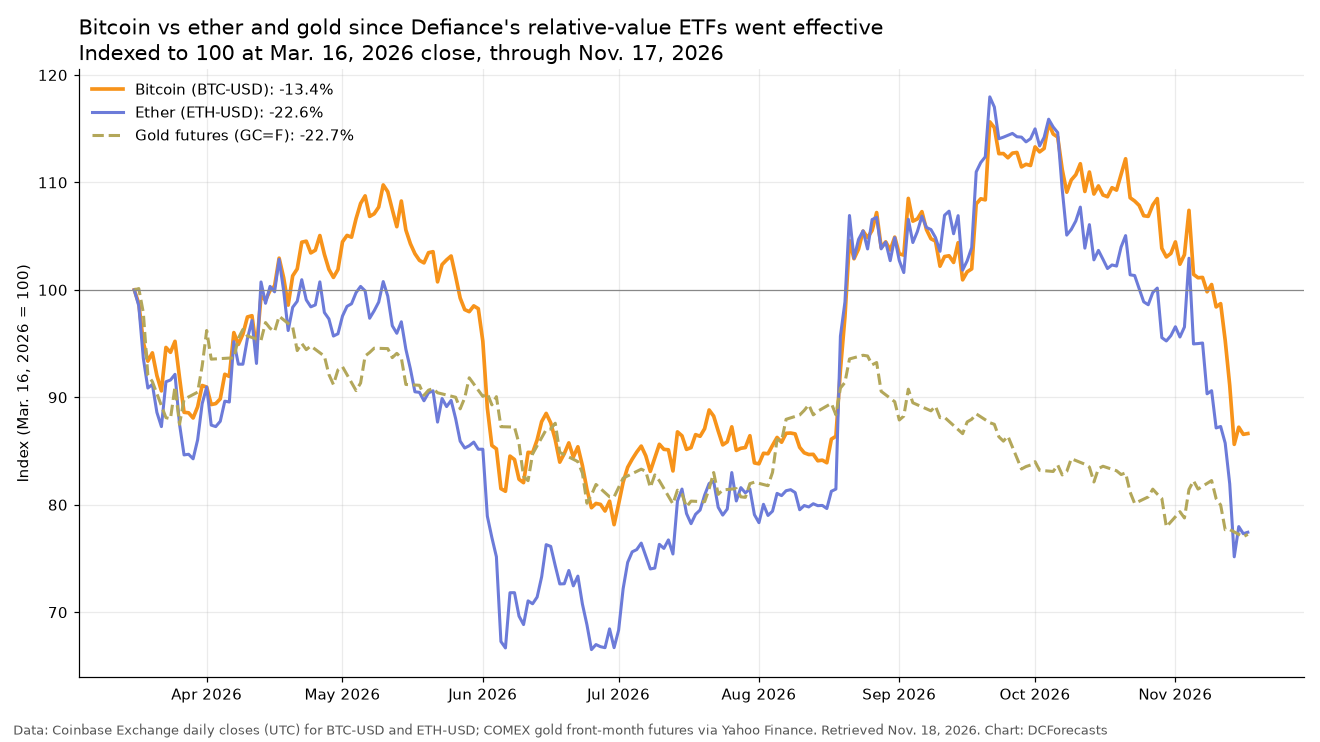
From March 16 to Nov. 17, Bitcoin fell 13.4%. Ether fell 22.6% and gold futures fell 22.7% over the same window.
That lifted the BTC/ETH ratio from 31.8 to 35.6 and the number of gold ounces one Bitcoin buys from 15.0 to 16.8. It is a pattern we tracked in our Bitcoin vs ethereum comparison and in our look at gold’s steepest slide since 2015.
Leverage, financing costs and daily resets mean a real fund would not have matched those spreads, so we treat them as context rather than missed profits.
Why Spot Bitcoin Funds Keep the Spotlight
Neither letter gives a commercial reason, and we will not invent one. What the filings do show is where the products stood.
The ARK funds would have depended on options written on spot ETFs. The Defiance funds needed derivatives on both legs. Each layer added cost and complexity on top of the plain exposure investors already have.
Spot funds remain the main channel. Even through the recent selling, our coverage of IBIT’s 11-day outflow streak found the fund still held 96.5% of its record net inflows.
For us, that is the key takeaway. When issuers clear out niche variants and the core spot products keep most of their assets, the market is telling them what it values.
What Should Bitcoin Investors Watch Next?
We would watch three things.
- Whether ARK files a slimmer buffer ETF design later, since the letter only says “at this time.”
- Whether other defined outcome ETF issuers keep their Bitcoin products on file or follow ARK out.
- Whether the BTC/ETH and BTC-gold ratios keep rising, which would support the relative-strength case the Defiance funds were built around.
A return to the $81,500 close of Oct. 16, the date of ARK’s last delay filing, would need a gain of about 25.6% from Nov. 17.
That is a big move, and no fund document predicts it. But Bitcoin’s fixed 21 million supply and the spot ETF plumbing built since 2024 stay in place whether or not these wrappers ever launch.
The coming months will show whether investors want Bitcoin with guardrails attached, or simply Bitcoin.
DC Forecasts is a leader in many crypto news categories, striving for the highest journalistic standards and abiding by a strict set of editorial policies. If you are interested to offer your expertise or contribute to our news website, feel free to contact us at [email protected]












Discussion about this post