


A SIM swap crew that drained at least $11.6 million in crypto from U.S. victims has now been fully sentenced.
On Nov. 17, U.S. District Judge John W. Holcomb in Santa Ana, California, gave Tyler Robert Buchanan, a 24-year-old from Dundee, Scotland, 72 months in federal prison.
He was the fifth and final defendant in the case, according to the U.S. Attorney’s Office for the Central District of California. A restitution hearing is set for Dec. 11.
One day later, a Federal Communications Commission notice set Dec. 18 as the date U.S. wireless carriers must comply with new rules against port-out fraud, a close cousin of the SIM swap.
The bigger question is whether phone-number attacks on crypto holders are finally losing their edge.
How the SIM Swap Scheme Worked
According to Buchanan’s plea agreement, the group ran from September 2021 to April 2023.
It sent hundreds of text messages to employees of telecom, technology, outsourcing, cloud communications and virtual currency companies. The messages posed as the employer or one of its IT suppliers and pointed to fake login pages.
Stolen credentials flowed into a Telegram channel that prosecutors say Buchanan ran with a co-conspirator. The crew used that access to pull company data, including names, emails and phone numbers.
That data then became a map to individual crypto holders.

To get past two-factor authentication, the conspirators had victims’ phone numbers moved to SIM cards they controlled. Every code sent by text message then landed with the thieves.
Prosecutors also said a device seized at Buchanan’s Scotland home in April 2023 held victims’ names and addresses, plus a text file with one victim’s cryptocurrency seed phrases and login details.
“Those thefts had severe, life-altering consequences for many victims,” prosecutors wrote in their sentencing memorandum.
Buchanan, who has been widely linked in public reporting to the loose hacking collective known as Scattered Spider, pleaded guilty on April 17 to conspiracy to commit wire fraud and aggravated identity theft. The Justice Department’s release does not use the group’s name.
Five Defendants, Five Sentences
All four co-defendants had already pleaded guilty and been sentenced before Buchanan.
Noah Michael Urban of Palm Coast, Florida, is serving 10 years. Ahmed Hossam Eldin Elbadawy of College Station, Texas, received 45 months on Sept. 18, and Evans Onyeaka Osiebo of Dallas got 45 months on Aug. 14. Joel Martin Evans of Jacksonville, North Carolina, is serving two years.
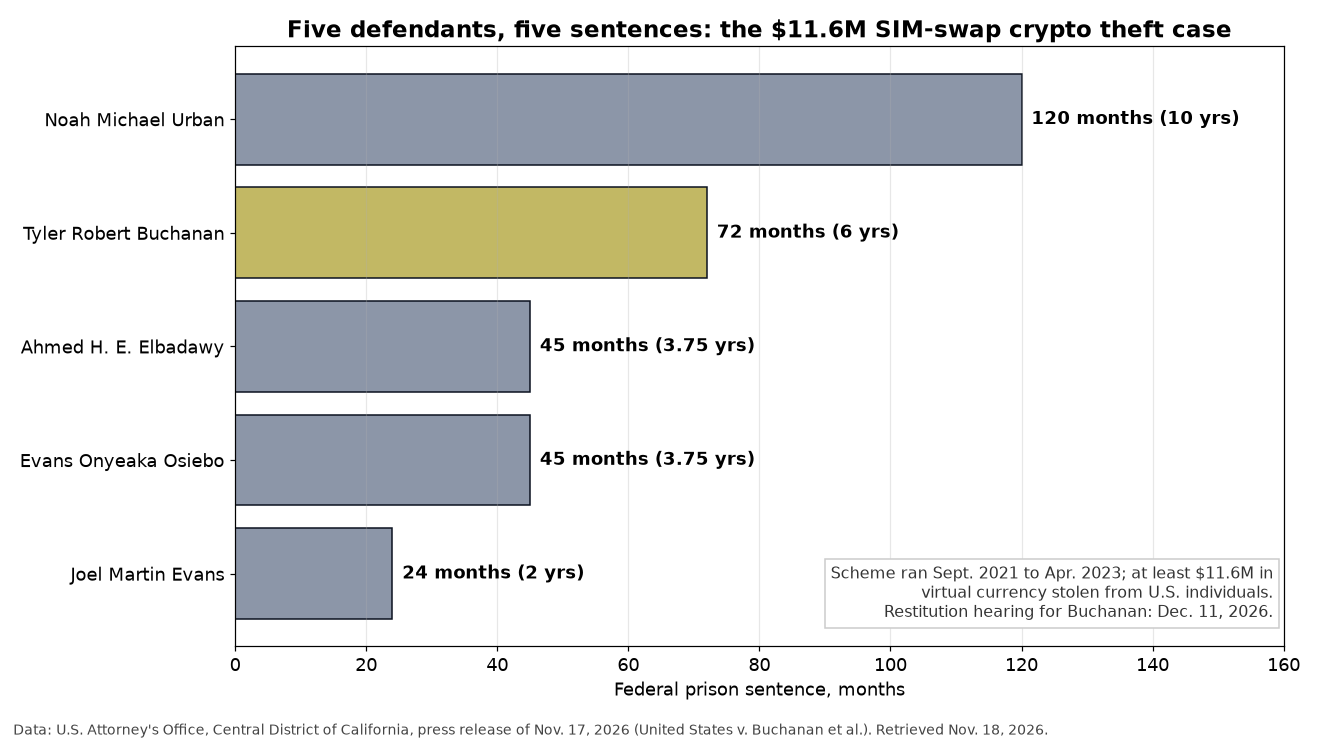
Together that is 306 months, or 25.5 years, of federal prison time across the crew.
The case also shows how far investigators will reach. Police Scotland and Spain’s national police assisted, along with FBI field offices in four U.S. cities.
That matters for crypto. Every serious conviction weakens the old idea that digital-asset theft goes unpunished, and it supports trust in the wider market, much like the security lessons we drew from the recent Gnosis Safe drain.
What the FCC Notice Changes on Dec. 18
The FCC adopted its SIM swap and port-out fraud order in November 2023, but left the compliance date open until the White House budget office cleared its paperwork and the agency published a notice. That clearance came on Jan. 15, 2025.
The Federal Register notice published Nov. 18, 2026 finally fixes it. The port-out rules take effect on Nov. 18, and mobile carriers must comply by Dec. 18.
Under the rules, carriers must:
- notify customers immediately of any port-out request before acting on it;
- give customers advance notice of the account protection measures they offer;
- let every customer lock or freeze their account, at no cost, to stop SIM change requests; and
- keep a clear process for reporting fraudulent ports and give victims documentation promptly.
Port-out fraud works much like a SIM swap. A fraudster impersonates the customer and has their number moved to a new carrier and a device the fraudster controls.
We see the free account lock as the most useful piece for crypto holders. It turns a hard-to-detect attack into one that needs the customer’s own approval.
Are SIM Swap Losses Already Falling?
The FBI’s own numbers suggest they are.
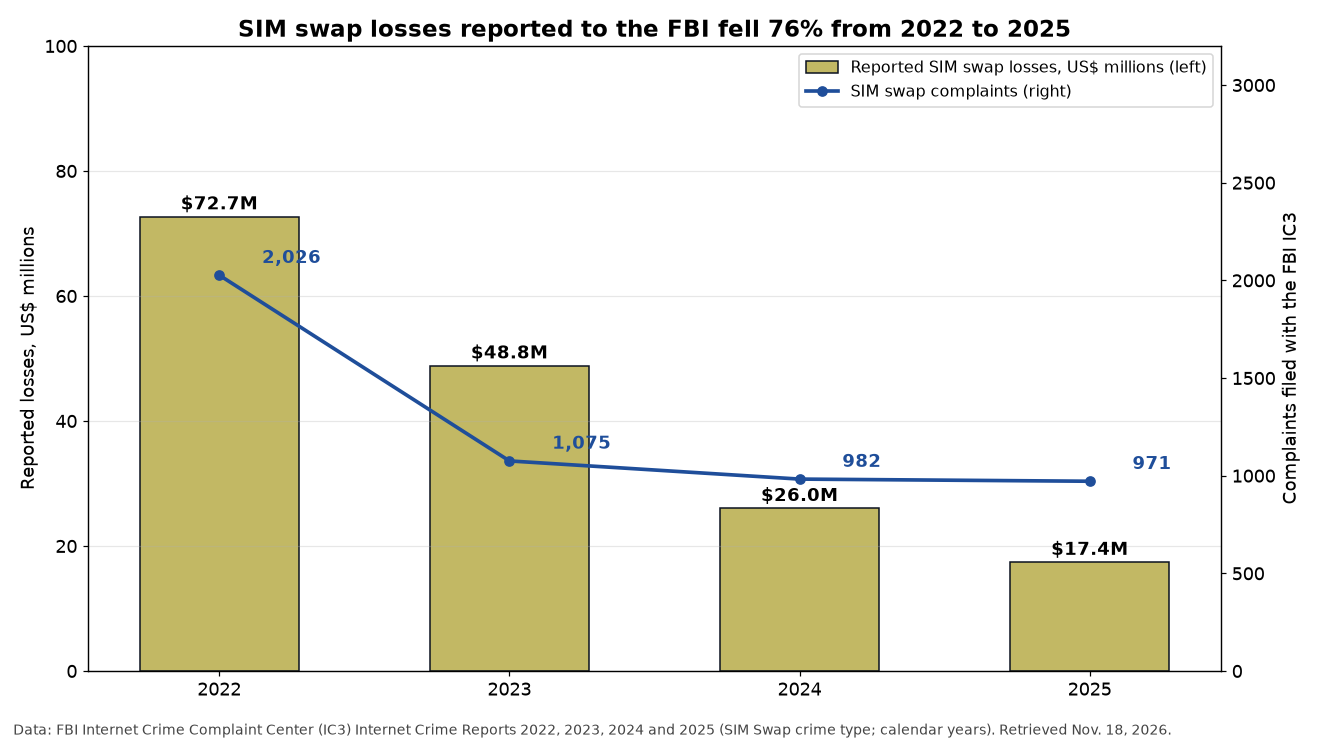
According to the FBI Internet Crime Complaint Center’s 2025 report and its earlier editions, reported SIM swap losses fell from $72.7 million in 2022 to $17.4 million in 2025. That is a 76% drop.
Complaints fell by about half over the same period, from 2,026 to 971.
The broader picture is less comforting. IC3 logged 181,565 complaints with a cryptocurrency nexus in 2025, up 21% from 2024, and $11.37 billion in related losses, up 22%.
Cryptocurrency investment fraud accounted for $7.2 billion of that, the largest source of reported losses to Americans last year. Reported SIM swap losses were equal to about 0.15% of the crypto-linked total.
In our view, that split is telling. Attackers are moving away from breaking into accounts and toward talking people into sending funds, which is why awareness matters as much as technology, a theme we also saw in the Trezor shipping partner breach.
Why Self-Custody Holds Up Better
Nothing in this case involved breaking Bitcoin’s cryptography. The weak points were phone numbers, text-message codes and seed phrases saved in a plain text file.
That is the strongest case for disciplined self-custody. A hardware wallet with an offline seed phrase cannot be reached through a phone carrier, and authenticator apps or security keys remove the SMS code that SIM swappers need.
Holders who keep coins on exchanges can still close the gap. We would turn off SMS recovery wherever possible, use the new carrier account lock once it is offered and keep seed phrases off any connected device.
Bitcoin’s design has never depended on a phone number. With Buchanan’s sentencing closing the case and carriers facing a Dec. 18 deadline, the attack path that funded this crew is getting harder to use.
The coming weeks will show how quickly carriers roll out the new protections, and whether the FBI’s 2026 figures keep falling.
DC Forecasts is a leader in many crypto news categories, striving for the highest journalistic standards and abiding by a strict set of editorial policies. If you are interested to offer your expertise or contribute to our news website, feel free to contact us at [email protected]












Discussion about this post