



Kalshi has added 36 more single-stock perpetual futures to its U.S. exchange, and this batch reaches deep into the chip supply chain. Taiwan Semiconductor, ASML, SK hynix, Arm, KLA and Lam Research are all on the list.
In a certification letter filed with the Commodity Futures Trading Commission dated Nov. 17, KalshiEX LLC said it intends to start listing the contracts on Nov. 18, on a continuous basis. The products are perpetual security futures, meaning they never expire.
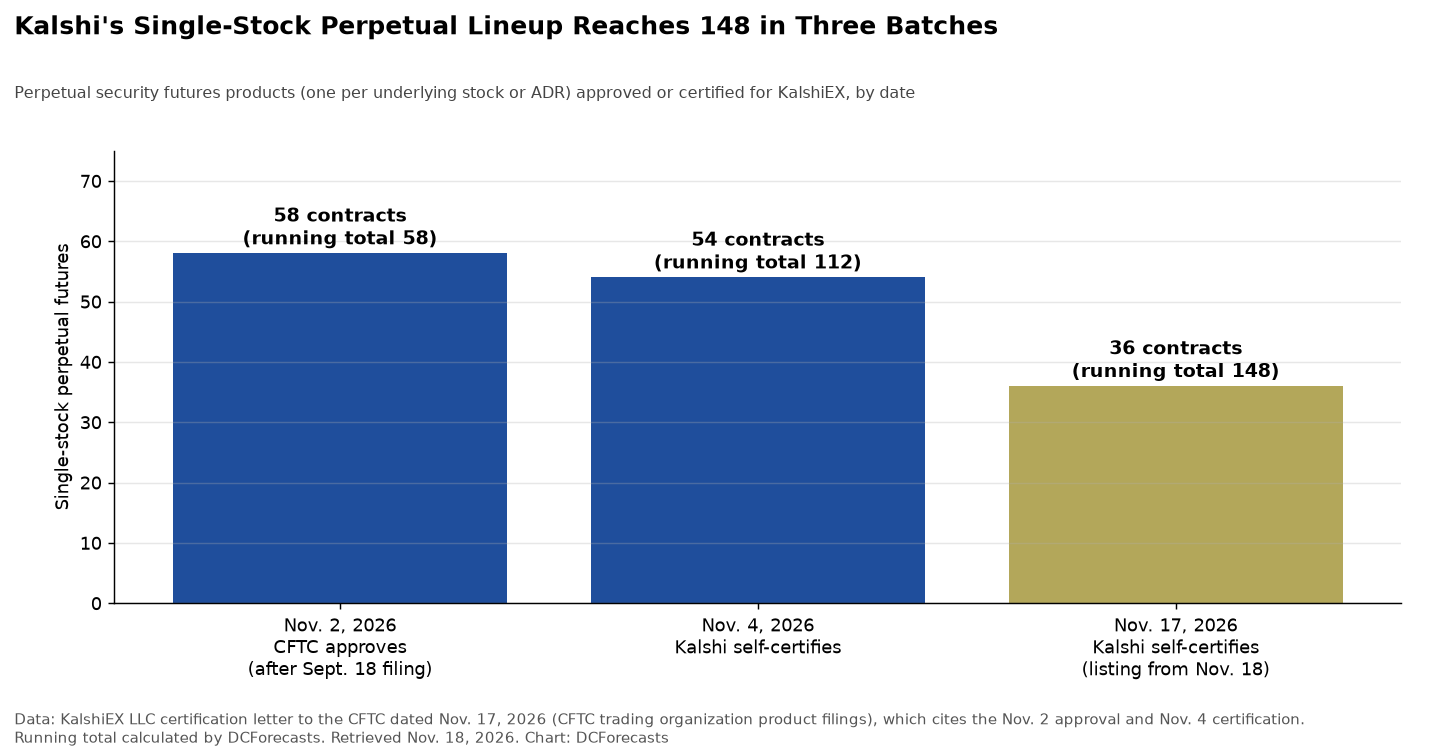
The filing also lays out how fast the product line has grown. With this batch, Kalshi’s single-stock perpetual lineup reaches 148 contracts in just over two weeks.
Three Batches in 16 Days
According to the letter, the CFTC approved Kalshi’s first 58 perpetual security futures products on Nov. 2, after the exchange submitted them for review on Sept. 18. We covered that decision when the CFTC cleared stock perps earlier this month.
Kalshi then self-certified 54 more on Nov. 4. The Nov. 17 filing adds 36, using the faster self-certification route under CFTC Regulations 40.2(a) and 41.23(a). Under that route, an exchange certifies that a product complies with the law rather than waiting for agency approval.
The letter says the new contracts have the same terms as the earlier ones in every respect except the underlying stock. Kalshi’s New Product Committee determined that each stock meets the listing standards in Chapter 14 of its rulebook, which has been filed with the Securities and Exchange Commission.
That dual oversight is part of the design. Kalshi is notice-registered with the SEC as a national securities exchange for security futures, so both regulators have a hand in these products.
Which Stocks Made the List
The schedule includes 33 common stocks and three American depositary receipts. The ADRs are Arm Holdings, SK hynix and Taiwan Semiconductor Manufacturing.
Semiconductors and chip equipment stand out. Besides the three ADRs, the batch covers ASML, Analog Devices, KLA, Lam Research, Amphenol, Arista Networks and Dell.

Wall Street names are well represented too. Goldman Sachs, Morgan Stanley, Citigroup, Wells Fargo, BlackRock, Charles Schwab and American Express are all included.
The rest span health care (Abbott, Danaher, Thermo Fisher, Intuitive Surgical, Gilead), industrials (GE Aerospace, GE Vernova, Deere, RTX, Union Pacific) and other sectors, including Accenture, CrowdStrike, Shopify, Linde, NextEra Energy, Philip Morris, TJX, T-Mobile US and Welltower.
By our count, 24 of the underlying shares have their primary listing on the NYSE and 12 on Nasdaq.
How the Contracts Work
Each contract covers 100 shares of its underlying stock, with a minimum tick of $0.005 and a tick value of $0.50. Traders do not need to buy a full contract. The minimum order is one five-thousandth of a contract, which equals 0.02 of a share.
In practice, the smallest position is worth about 2% of one share’s price. That is the same minimum unit Kalshi used for the 54 contracts it certified on Nov. 4.
Instead of an expiry date, the contracts use a once-daily funding payment to stay close to the stock price. Kalshi measures the gap between the contract and an underlying price index minute by minute during the regular U.S. stock session. If the contract trades at a premium, longs pay shorts. If it trades at a discount, shorts pay longs.
Trading runs from 6 p.m. ET on Sunday to 5 p.m. ET on Friday, with a one-hour daily maintenance break from 5 p.m. to 6 p.m. ET. That means the contracts can trade overnight on weekdays, when the stock market itself is closed. Settlement is in cash, and no shares change hands.
A Built-In Leverage Cap
The most important number in the filing may be 15.50%. That is the minimum margin Kalshi requires on each position, measured against its current market value. The exchange can set it higher.
Federal security futures rules already require at least 15% customer margin. Kalshi’s floor sits slightly above that, which caps leverage at roughly 6.45 times. Leverage is not user-selectable, according to the filing.
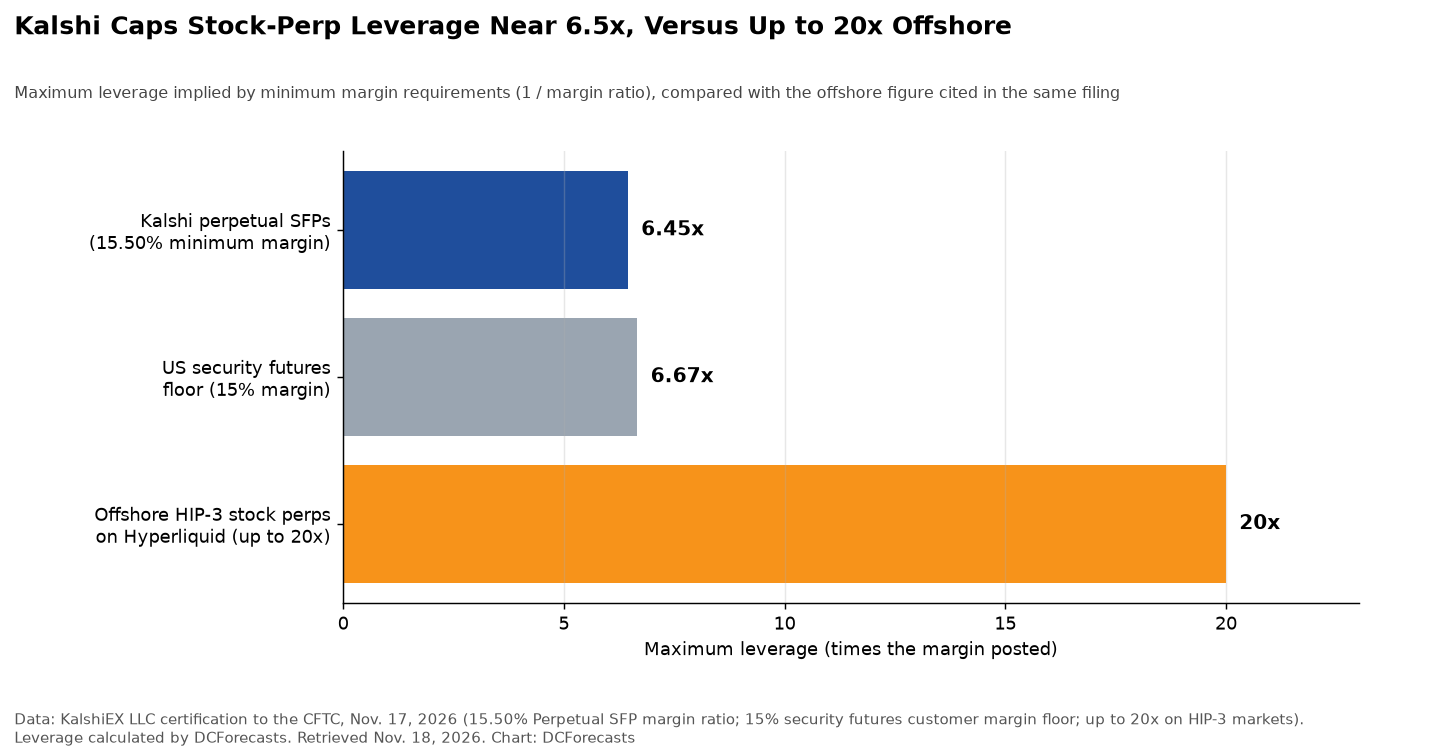
Kalshi contrasts this with venues outside U.S. rules. Its filing notes that independent builders on Hyperliquid deploy single-stock perpetuals under the HIP-3 standard, introduced in November 2025, with leverage of up to 20 times.
Citing a comment letter from the Hyperliquid Policy Center, the filing says HIP-3 markets recorded more than $480 billion in notional volume in their first ten months, with about $4 billion in open interest.
Crypto’s Product Goes Mainstream
Perpetual futures were invented in crypto, and for years Bitcoin traders were their main users. Kalshi’s filing even cites academic work on hedging with leverage on Bitcoin perpetuals.
Now the same structure is being applied to chipmakers and Wall Street banks inside a regulated, centrally cleared market. We see that as a strong endorsement of a design that the Bitcoin market tested at scale first.
It also connects back to Bitcoin holders. As we reported, Kalshi Prime now lets institutions margin Kalshi perpetual futures with Bitcoin held at Anchorage. Every new contract on the exchange widens the menu that Bitcoin-backed collateral can support.
The race is not limited to Kalshi. The CFTC recently cleared Backpack’s blockchain exchange for U.S. perpetual futures, and rival Polymarket US has certified new oil and gas contracts.
What to Watch
The filing notes that any stock not on the schedule must be submitted to the CFTC before listing. Kalshi has filed three batches in 16 days, so more additions would not be a surprise.
The bigger test is volume. Offshore crypto-native venues already have a head start in stock perps. Kalshi is betting that tighter margin, central clearing and oversight from both the CFTC and SEC will draw traders who want the nearly round-the-clock perpetual format inside U.S. rules.
If it works, the trading tool that Bitcoin popularized will have become a standard part of the U.S. stock market.
DC Forecasts is a leader in many crypto news categories, striving for the highest journalistic standards and abiding by a strict set of editorial policies. If you are interested to offer your expertise or contribute to our news website, feel free to contact us at [email protected]












Discussion about this post