


The Knaken bankruptcy has grown three times larger on paper in just three months. According to the curator’s second public report, dated Nov. 17, 1,159 creditors have now filed unsecured claims worth €26.02 million against the failed Dutch crypto broker.
The money set against those claims is far smaller. The estate account held €2.31 million, almost all of it from crypto that Dutch prosecutors seized and sold over the summer.
That leaves a paper gap of about €23.7 million. It also leaves a familiar lesson for anyone who keeps coins with a middleman.
How Fast the Knaken Bankruptcy Claims Grew
The first report, published on Aug. 17, listed 691 creditors seeking €8.45 million. The second report covers the period from Aug. 15 to Nov. 16. Over those three months, 468 more creditors came forward and the claimed total rose by €17.57 million, a 3.1-fold increase.
Curator Carl Hamm, appointed by the Rotterdam District Court, stresses that the claims are provisional. None has yet been checked against Knaken’s own records, and he expects more creditors to file.
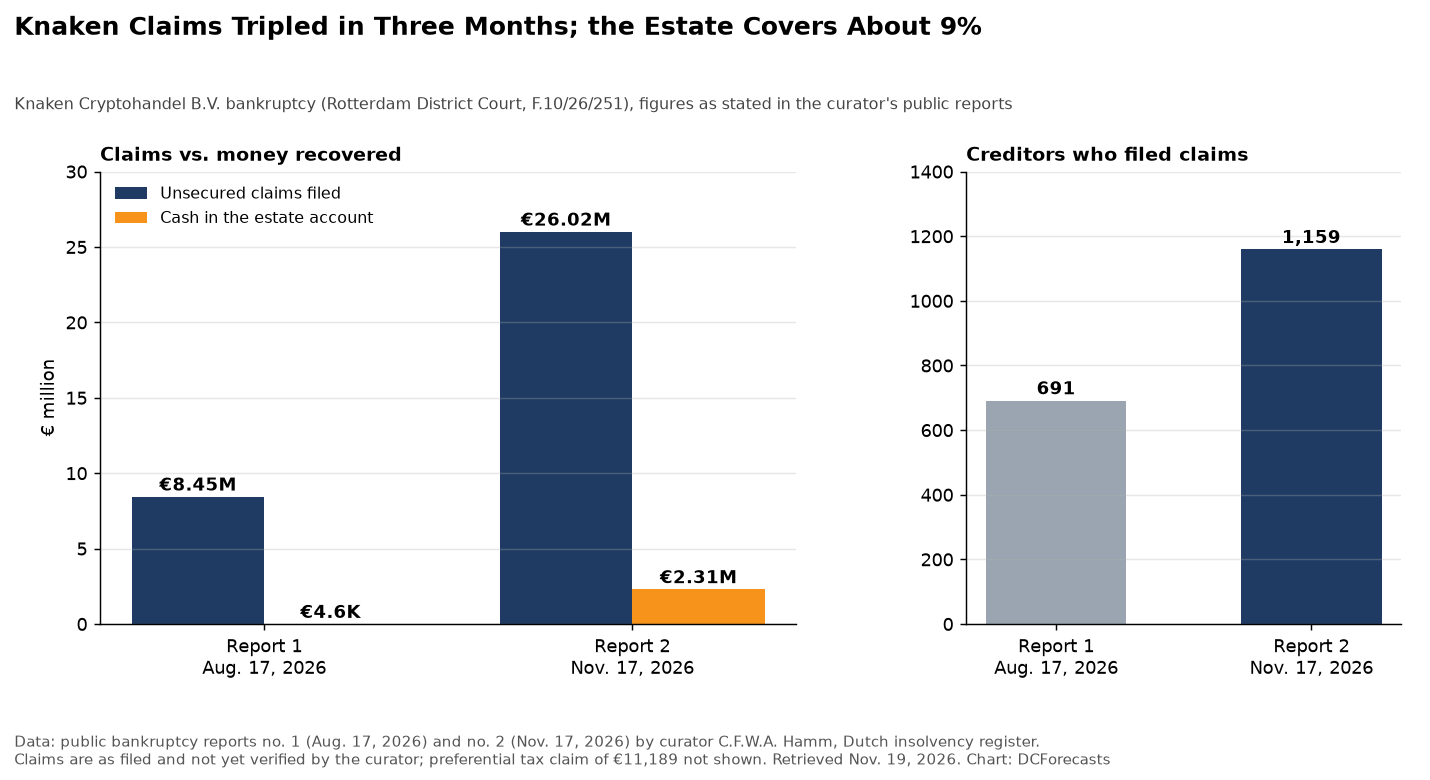
On the asset side, the estate grew from just €4,563 in August to €2,308,207 in November. Sale proceeds of €2,281,214 make up nearly all of it. The remaining roughly €27,000 came mainly from Knaken’s bank balances.
Measured against the claims filed so far, the estate covers about 8.9 cents per euro. The Dutch tax authority has also lodged a preferential claim of €11,189, which ranks ahead of ordinary creditors.
Hamm’s report warns that a large shortfall exists between available assets and creditor claims. Creditors should expect only a limited part of their claims to be paid, he writes, adding that no payout percentage can be estimated yet.
A Prosecutor-Led Collapse
Knaken, founded in 2017 and based in Rotterdam, let customers swap euros for coins such as Bitcoin and Ether and keep them in custody on the platform. In 2021 it became the crypto sponsor of Eredivisie football clubs including Ajax and Feyenoord.

Its end did not come from customers. On June 30, the Dutch Public Prosecution Service asked the Rotterdam court to declare Knaken Cryptohandel B.V. and its affiliated foundation, Stichting Knaken Payments, bankrupt in the public interest.
Prosecutors acted on warnings from the Dutch Authority for the Financial Markets (AFM). Knaken needed an AFM licence to keep offering crypto services and did not get one. It said it was winding down, but it had stopped paying customers out.
The fiscal investigation service FIOD searched several locations on June 29 and seized data carriers and company assets. Nobody was arrested.
The court declared both entities bankrupt on July 16. Prosecutors told the court that about €7 million in customer balances was missing. Customers had been locked out of the trading platform, and the court found a substantial coverage shortfall that clients had not been told about.
The Disputed €2.3 Million Receivable
The new report also turns up a curious entry. Knaken’s books show a receivable of about €2.3 million from Meier Media, a market research firm that Dutch public broadcaster NOS reports is owned by Knaken founder Ronald Jonkers.
Jonkers was also a director of the foundation meant to keep client money separate from the company. The curator could not find any records explaining what the receivable is for.
Meier Media denies owing the money. Hamm has decided not to pursue collection at this time.
The company’s own numbers were thin before the collapse. Rebuilt from the general ledger, because annual accounts for 2025 and 2026 are missing, they show a profit of just over €28,000 in 2024 and a loss of more than €220,000 in 2025. NOS has reported that management previously blamed long-running problems on a 2020 hack.
Both the curator and prosecutors are still tracing where the rest of the money went. The criminal investigation remains open.
Why Prosecutors Sold the Coins
Most of the estate exists because authorities moved early. The FIOD’s seizure caught more than €2.2 million in crypto still held by Knaken and its foundation. The coins were sold after the bankruptcy, and the euros were transferred to the estate account the curator controls.
Prosecutors chose a quick sale to protect the value for creditors against market swings. The trade-off is that claimants will be repaid in euros, not in the coins they originally bought.
What the Knaken Case Says About Custody
We believe the Knaken file is a story about intermediaries, not about Bitcoin. The Bitcoin network kept producing blocks throughout the collapse. What failed was a company that held customers’ coins and then could not show where they were.
Customers who withdrew their coins to wallets they controlled were never part of this estate. Those who left balances on the platform now hold an unsecured claim in euros, ranked behind estate costs and the tax authority.
That is why self-custody tools matter. Open-source software such as BTCPay Server exists precisely so users and merchants can hold their own keys rather than trust a third party.
The same pattern played out on a far larger scale at FTX, where creditors have spent years recovering value through the courts, as our report on FTX’s former Anthropic stake showed.
Europe’s MiCA licensing regime is doing part of its job here. Knaken could not secure authorization, and that is what brought the problem into view. Licensing cannot prevent every loss, but it forces weak operators out into the open.
What Comes Next for Creditors
The curator still has to verify every claim against Knaken’s records and investigate dealings with related parties. He is also examining the relationship between Knaken and its foundation, and whether directors or others can be held liable.
Until that work is done, no payout percentage will be published. For now, the numbers are stark: 1,159 creditors, €26.02 million claimed, and €2.31 million in the bank.
DC Forecasts is a leader in many crypto news categories, striving for the highest journalistic standards and abiding by a strict set of editorial policies. If you are interested to offer your expertise or contribute to our news website, feel free to contact us at [email protected]












Discussion about this post