



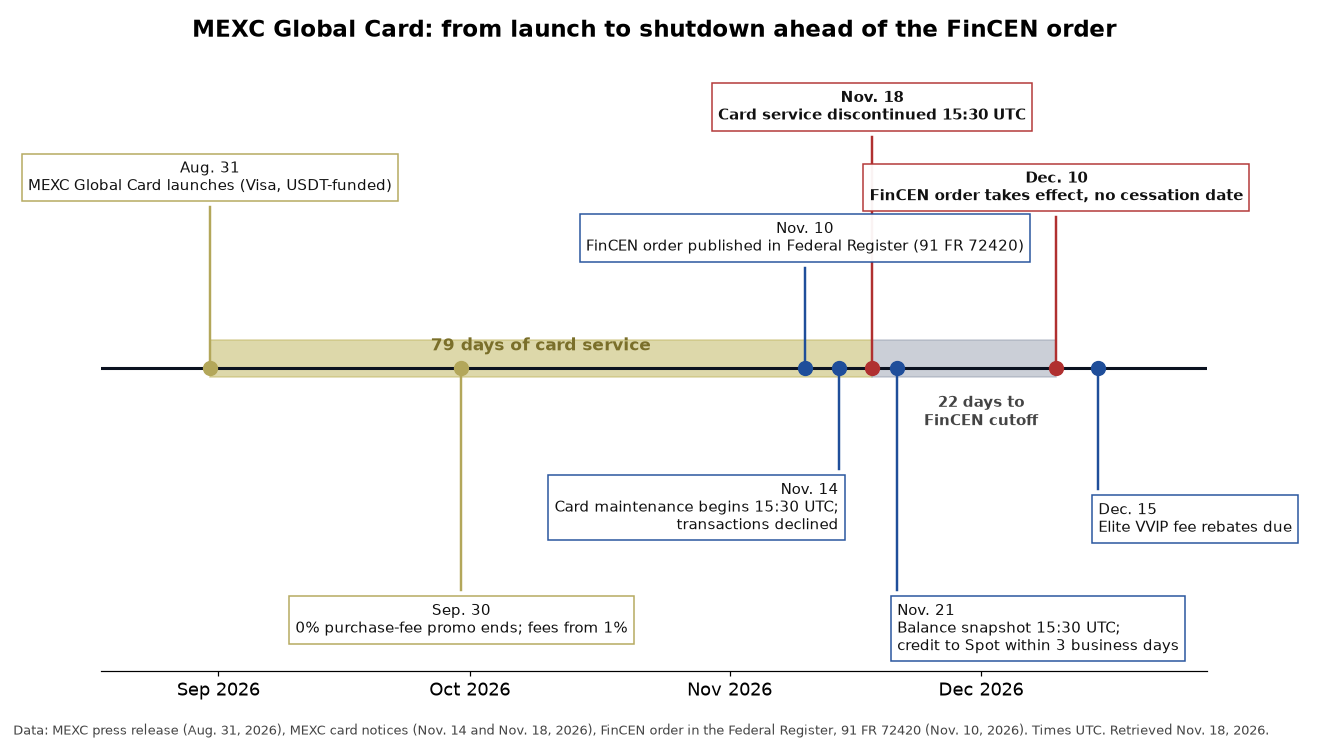
MEXC Global is switching off its Visa crypto card today, Nov. 18, at 15:30 UTC, just 79 days after the product launched.
The exchange told cardholders that existing cards will stop working for transactions at that moment, and that new card applications are suspended.
MEXC blamed “service adjustments by our third-party card issuer.” It did not name the issuer or link the decision to U.S. regulators.
The timing is hard to ignore, though. In 22 days, on Dec. 10, a FinCEN order takes effect that bars U.S. financial institutions from moving funds to or from MEXC Global.
The bigger question for crypto users is what happens to products built on bank and card rails once those rails start closing.
What MEXC Global Told Cardholders
The shutdown came in two steps.
On Nov. 14, MEXC put every Global Card into “maintenance” from 15:30 UTC, saying all card transactions and deposits would be declined until Nov. 18. That notice told users their funds “remain safe and unaffected.”
Four days later, the temporary pause became permanent. MEXC’s discontinuation notice asks cardholders to do two things before the 15:30 UTC cutoff:
- Withdraw any remaining card balance to their Fiat account from the Global Card page.
- Cancel or move subscriptions and other recurring payments linked to the card.
Users who miss the deadline do not need to file a claim. MEXC will take a balance snapshot on Nov. 21 at 15:30 UTC, leaving time for pending transactions to settle, and credit what remains to Spot accounts within three business days.

Refunds on earlier purchases will go to Fiat accounts once MEXC receives them. Pending cashback will be paid on schedule, and Elite VVIP fee rebates are due before Dec. 15.
Transaction histories stay viewable for three months, so users should save any records they need.
A 79-Day Life for a Crypto Visa Card
The product was pitched as a big push into everyday payments.
At its Aug. 31 launch, MEXC said the Global Card was a virtual crypto Visa card funded with Tether’s USDT. Users could add it to Apple Pay and Google Pay.
The launch terms were generous. There were no purchase fees through Sept. 30, then fees “as low as 1%.” Cashback ran from 4% to 10% in USDT, with a monthly cap of up to 800 USDT.
Spending limits reached 80,000 USDT per transaction and 1,000,000 USDT per day. A card-linked USDT savings product advertised annualized returns of up to 7%.
MEXC’s own guide described it as the exchange’s second Visa card, alongside an earlier card for selected Asia-Pacific markets.
None of that helped once the issuing partner stepped back. Card programs depend on licensed issuers and payment networks, and those partners answer to regulators.
Why the FinCEN Order Looms Over MEXC Global
As we covered when FinCEN first moved against the MEXC exchange, the action uses section 9714(a) of the Combating Russian Money Laundering Act.
The order published in the Federal Register on Nov. 10 finds MEXC Global to be a financial institution of primary money laundering concern in connection with Russian illicit finance.
From Dec. 10, any covered financial institution is prohibited from “any transmittal of funds from or to MEXC Global,” a definition that expressly includes crypto. The order has no cessation date.
FinCEN assesses that MEXC Global has facilitated at least $16.7 billion in likely illicit activity since May 2021. These are government findings in an administrative order, not court rulings.
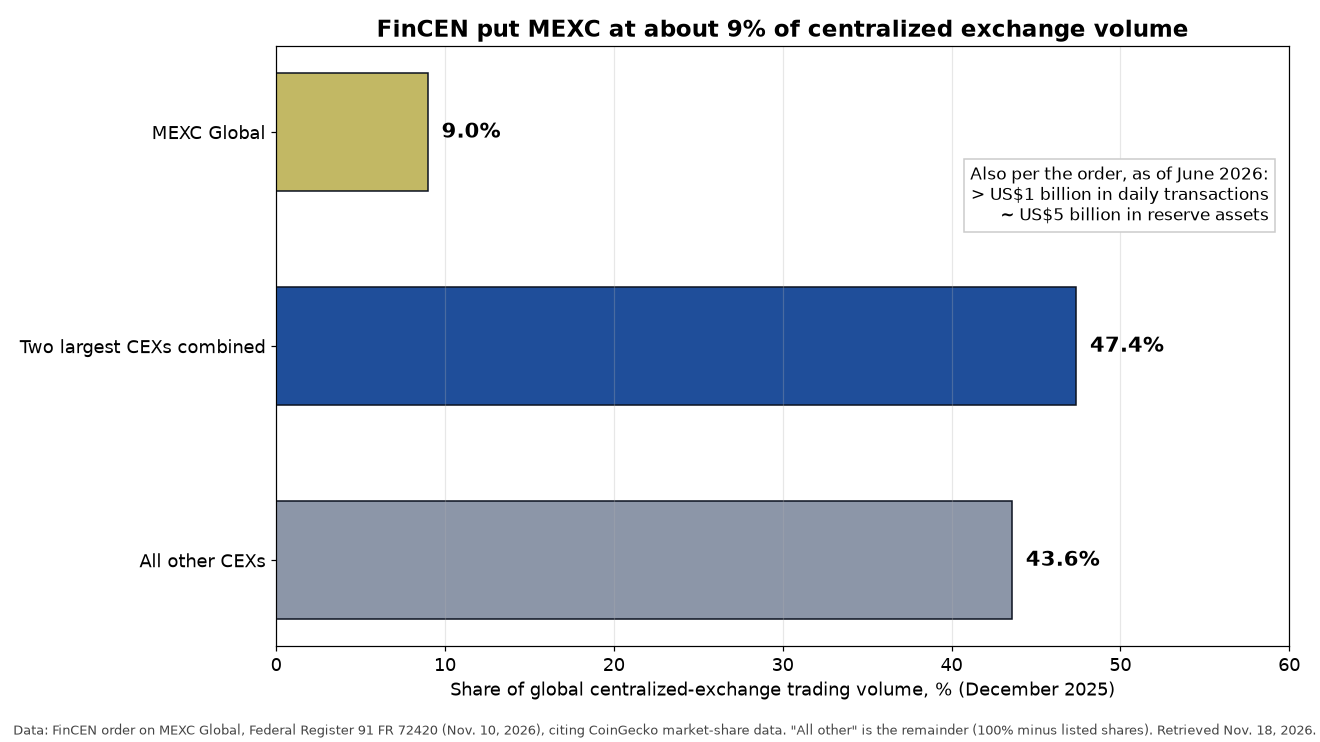
The order also shows how big the platform is. As of June 2026, FinCEN says MEXC Global handled more than $1 billion in daily transactions and held about $5 billion in reserve assets.
Is MEXC Safe for Users After the Card Shutdown?
That is the question many users are now searching, and the honest answer has two parts.
MEXC says card balances will be returned to user accounts, either by withdrawal before the cutoff or through the Nov. 21 snapshot. That process applies to the card product only.
The wider risk is the Dec. 10 deadline. After that date, banks and other covered U.S. institutions cannot send funds to or receive funds from MEXC Global, which can slow or block fiat and crypto transfers that touch them.
Card users can still act from the Global Card page on the MEXC website or in the MEXC app before 15:30 UTC. We would move any card balance early rather than rely on the snapshot.
What This Means for Bitcoin Holders
For Bitcoin investors, the MEXC Global card shutdown is a reminder of where the weak points actually sit.
A card program can be switched off by an issuer. An exchange can be cut off from U.S. banks. The Bitcoin network itself kept producing blocks through all of it, with BTC trading near $64,100 on Coinbase on Wednesday.
We believe the lesson is simple: assets held in self-custody do not depend on a third-party card issuer staying on board.
The crackdown also fits a longer pattern. Regulators are pushing activity toward licensed, transparent venues, and that is where most institutional Bitcoin demand already flows, from spot ETFs to bank custody. Projects like the Solflare and MoneyGram cash-out link for USDC show that compliant payment rails are still being built.
For now, the dates are fixed: card service ends today at 15:30 UTC, the balance snapshot follows on Nov. 21, and the FinCEN prohibition lands on Dec. 10.
The coming weeks will reveal how many MEXC Global users move to regulated platforms or to their own wallets, and either way, Bitcoin’s design, with its fixed 21 million supply and no card issuer in the middle, stays exactly the same.
DC Forecasts is a leader in many crypto news categories, striving for the highest journalistic standards and abiding by a strict set of editorial policies. If you are interested to offer your expertise or contribute to our news website, feel free to contact us at [email protected]












Discussion about this post