


The push toward 24/7 trading in US derivatives now has a date and a script. On Nov. 17, the Commodity Futures Trading Commission published the agenda for a Dec. 15 roundtable on whether futures markets should trade around the clock.
The three-hour session runs from 1 p.m. to 4 p.m. Eastern at CFTC headquarters in Washington. It will be open to the public and livestreamed.
Tokenization, stablecoins and blockchain technology are named directly in the agenda as possible fixes for 24/7 clearing.
For Bitcoin holders, the topic is familiar. The Bitcoin network has never had a closing bell, and its weekend data offers a real-world preview of what regulators are trying to plan for.
What the CFTC wants to learn about 24/7 trading
The agenda splits the afternoon into three sessions. Chairman Michael S. Selig opens and closes the event.
The first session asks which asset classes are ready for 24/7 trading now, which may be ready within one to two years, and which may never be. Physical delivery, regional differences and commercial needs are listed as factors.
The second covers risk management for round-the-clock clearing. That includes access to capital, collateral and margin, plus the risks of pre-funded models and separate weekend sessions.
The third looks at market structure. Weekend price discovery, liquidity, manipulation, circuit breakers, position limits, staffing and cybersecurity are all on the list.
Selig said the agency will tailor its rules to “the nuances of these markets and the varied asset classes that underpin them.”

The roundtable builds on a request for comment the CFTC ran earlier this year. It was first announced on Oct. 28.
Why tokenization sits at the center of 24/7 clearing
Clearing is the hard part. Exchanges can keep matching engines running, but clearinghouses need margin to move when banks and payment systems are closed.
That is why the agenda asks how tokenization and stablecoins could address “current roadblocks to 24/7 clearing.” Collateral that settles onchain can, in principle, move on a Sunday the same way it moves on a Tuesday.
The CFTC has been moving in this direction for weeks. We covered its approval of Backpack’s blockchain-based exchange and clearinghouse on Nov. 17, and Hong Kong already settles tokenized deposits around the clock.
We believe this is a meaningful shift. Regulators are no longer asking whether crypto infrastructure belongs in traditional markets, but how fast it can help them run longer hours.
What a year of Bitcoin weekends shows
Bitcoin is the obvious test case, because it has traded every day since its network launched in January 2009.
We pulled 365 days of daily BTC-USD candles from Coinbase Exchange’s public data, from Nov. 17, 2025 to Nov. 16, 2026. The pattern is clear.
Weekends are much quieter. Saturday averaged about $283 million in dollar volume and Sunday about $319 million, against $704 million to $784 million on weekdays.
Together, Saturday and Sunday made up 13.9% of the year’s dollar volume, even though they are 28.6% of the days.
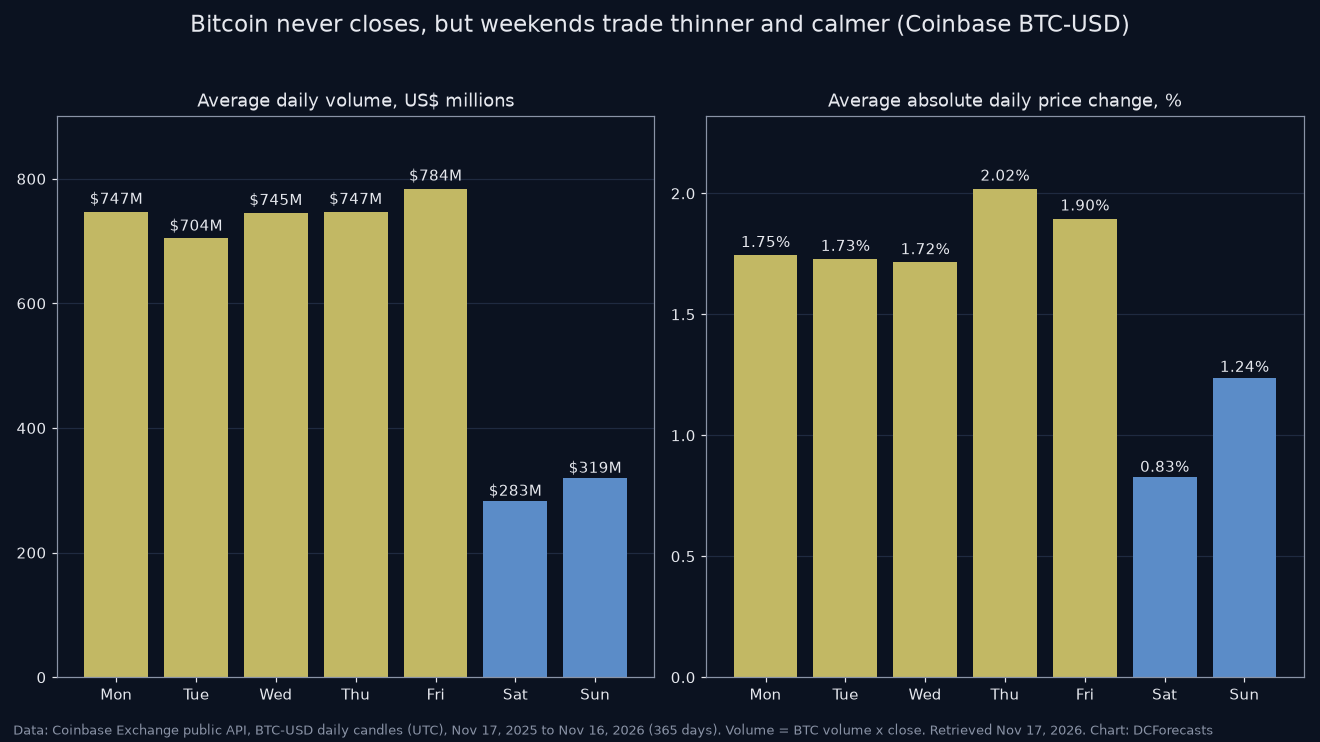
Prices were calmer too. The average absolute daily move was 1.03% on weekends, compared with 1.82% on weekdays.
That matters for the agenda’s concerns about weekend volatility. Thinner trading has not translated into wilder average days for Bitcoin.
The weekend risk weekday markets cannot hedge
Calm on average does not mean calm every time. Measured from Friday’s daily close to Sunday’s, 10 of the last 52 weekends moved 3% or more.
The largest was the weekend of Jan. 31, 2026, when Bitcoin fell 8.58%. The most recent large move came on the weekend of Nov. 14, a 4.28% decline.
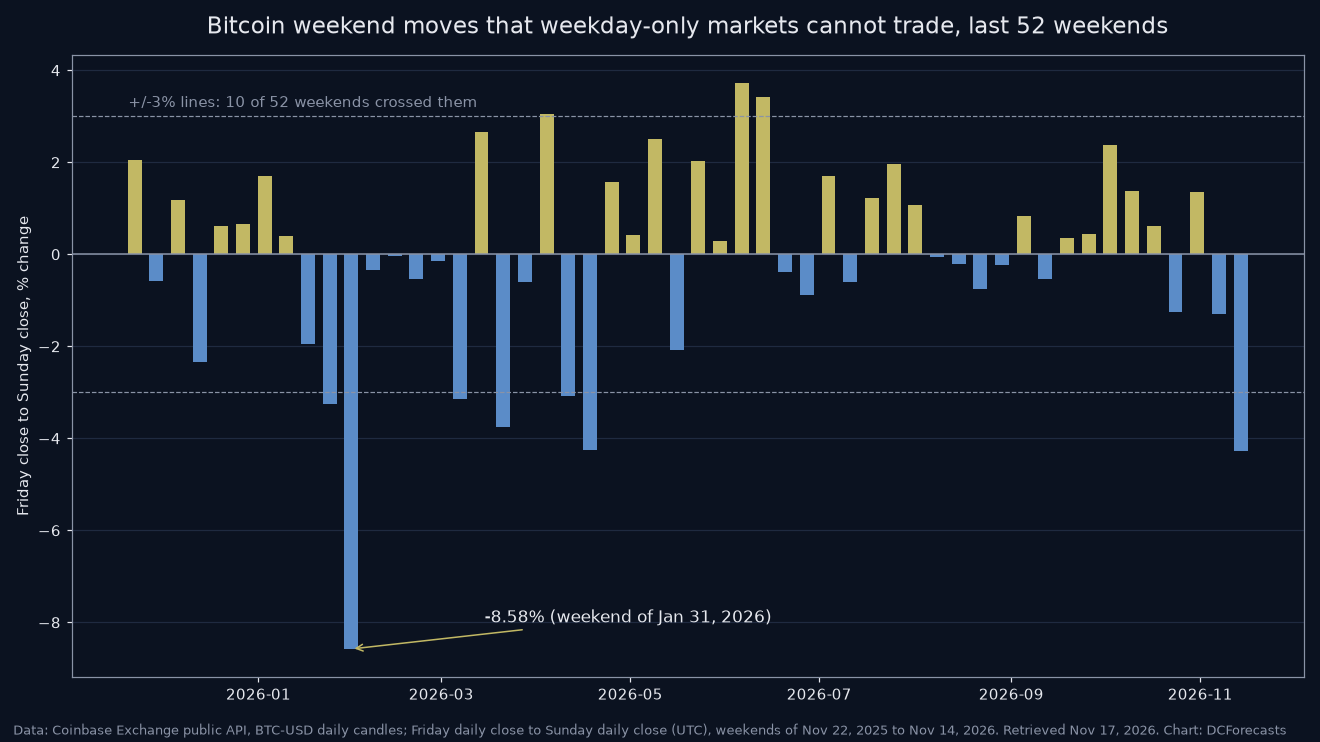
The split was even, with 26 weekends up and 26 down. The average weekend move, in either direction, was 1.63%.
For anyone holding a position in a market that closes on Friday, those moves arrive all at once on Monday. A 24/7 market lets traders respond as prices change instead.
That is the practical case the CFTC will hear on Dec. 15. Bitcoin has already shown that a market can price risk continuously for years without a pause.
Is Bitcoin’s always-on model becoming the standard?
The roundtable is a discussion, not a rule. No decision is expected on Dec. 15, and the agenda itself allows that some assets may never be suited to 24/7 trading.
Still, the direction is hard to miss. The agency is asking how to add weekend sessions, how to margin them and how blockchain tools could help.
We believe that is a quiet endorsement of the model Bitcoin introduced. A market that never closes was once treated as a crypto oddity, and it is now a planning question for the main US derivatives regulator.
The coming weeks will show which firms sign up to speak and which asset classes they push forward first. If Bitcoin futures and tokenized collateral lead that list, the gap between crypto hours and Wall Street hours could start to close.
DC Forecasts is a leader in many crypto news categories, striving for the highest journalistic standards and abiding by a strict set of editorial policies. If you are interested to offer your expertise or contribute to our news website, feel free to contact us at [email protected]









Discussion about this post