


Christopher Waller used his Nov. 17 speech in New York to set out a clear view of where tokenized finance is heading. In his telling, tokenized stocks, bonds and dollars will trade around the clock on blockchains, but central bank money should still sit underneath the whole system.
The Federal Reserve governor spoke at The Clearing House Annual Conference 2026. He called this “a transformational time in payments” and said a convergence between blockchain technology and established markets “is clearly under way.”
The full text is published on the Federal Reserve Board’s website. It was framed as his own view, not that of the Board or the FOMC.
What Christopher Waller said about tokenized assets
Waller kept his definitions simple. A blockchain, he said, is “simply a database” with rules on who can read it, copy it and update it.
He compared tokenization to casino chips. You cannot use cash at the tables, so you swap it for chips that work on that platform. A tokenized asset, in his framing, is the same claim moved onto a new rail where it can be used differently.
He noted that a few years ago blockchains were mainly used for crypto trading. Today, he said, “all kinds of assets—from stocks to bonds to commodities—are being tokenized.” He also said payment providers, banks and market infrastructures are already using these tools.
That is a notable admission from a sitting Fed governor. He also said open blockchains “operating 24/7/365” offer “a new paradigm for competition with traditional payment rails.” Bitcoin has run on that schedule since 2009.
Competition first, then a test of trust
Waller described himself as “a firm believer in the free market.” He sees a race between crypto-native firms and incumbent institutions. Some banks are building their own chains, some are pooling resources in consortiums, and some are partnering with blockchain start-ups.
He does not expect one winner. “I find it more likely that several different solutions will emerge,” he said, before asking the harder question: which of them can be trusted?

His “trust imperative” section raised open questions. Who is responsible when fraudsters exploit automatic smart contract execution? Who covers lost keys, erroneous transfers or pricing errors? What happens to assets left on abandoned “zombie chains”?
He pointed to the recent events around Binance as an example of the problems programmable blockchains can create. DCForecasts covered the heist wallets moving funds again on Nov. 17.
We believe this is the right lens. Trust in payments, as Waller put it, is “measured not in months and quarters, but in years and even decades.” Bitcoin earned its trust that way, block by block, without a central operator.
Tokenized deposits, stablecoins and atomic settlement
Waller listed a growing menu of settlement assets: stablecoins, tokenized deposits, tokenized money market funds and others. He expects treasurers, banks and asset managers to use several at once, just as they use multiple payment rails today.
He gave a concrete example. An investor could buy a tokenized stock on a Saturday and pay with tokenized money, with both sides programmed to swap at the same moment. That removes settlement delays and the risk that only one side delivers.
This is the kind of plumbing already being built. Earlier this week we reported how Kinexys and DBS opened a weekend lane for tokenized dollars between the US and Singapore.
Waller was careful on “atomic” settlement, where a multi-step trade completes in full or not at all. Market participants told him it should not be the only model. Net and batch settlement, he said, will stay useful where saving liquidity matters.
Stablecoin supply shows the market is still finding its level
The speech lands while dollar stablecoins are shrinking. DefiLlama data show total US dollar stablecoin supply at about $286.5 billion on Nov. 17. That is about $26.4 billion, or 8.4%, below the $312.9 billion peak reached on May 17, 2026.
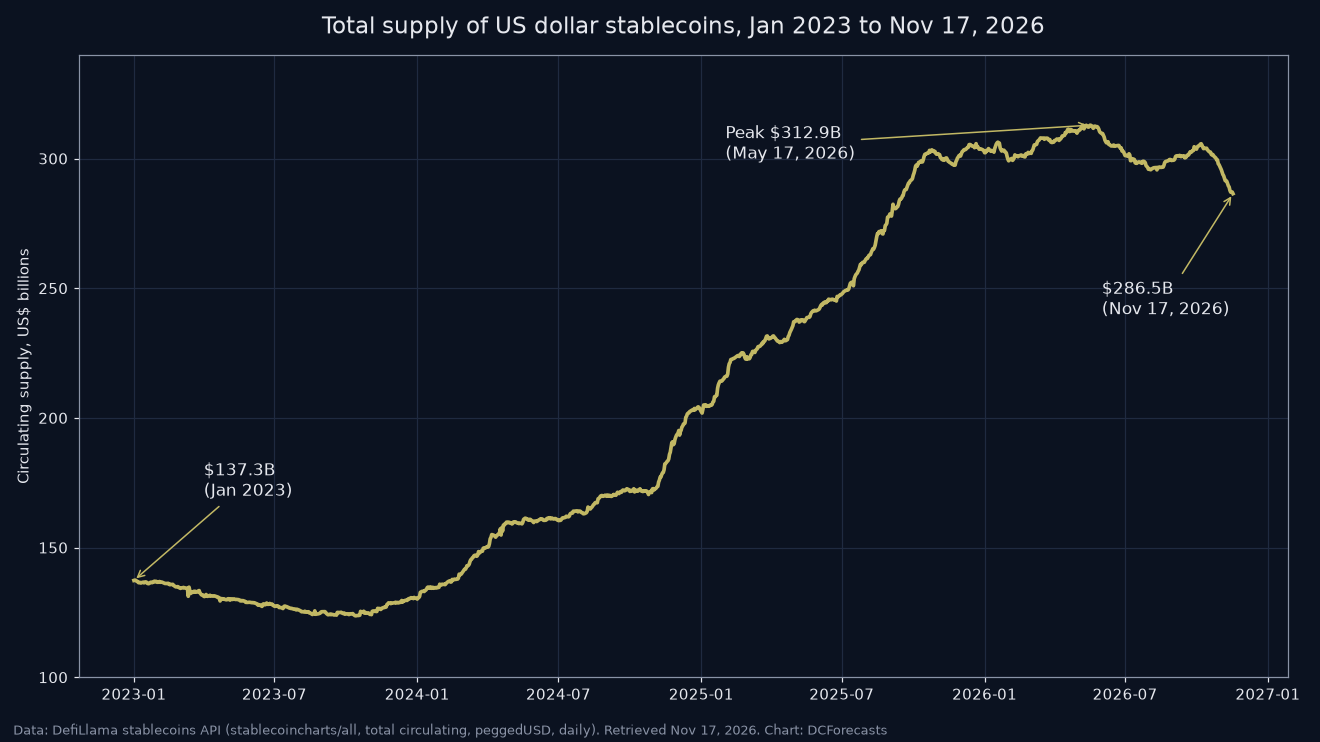
The longer view is far stronger. Supply stood near $137.3 billion at the start of 2023, so the market has more than doubled even after this year’s pullback.
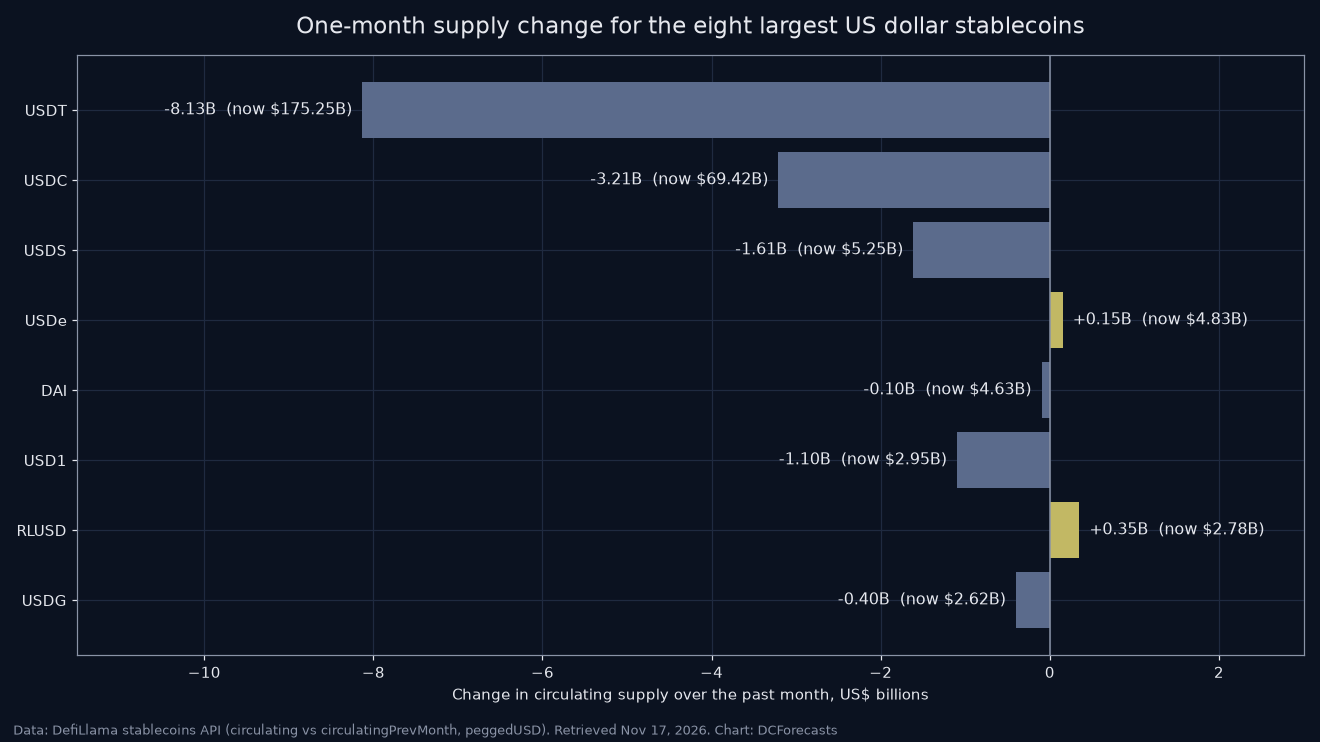
The past month was the weaker stretch. Tether’s USDT supply fell by about $8.13 billion to $175.25 billion, and USDC dropped about $3.21 billion to $69.42 billion. Ripple’s RLUSD and Ethena’s USDe were the only two of the eight largest to grow.
Grayscale recently tied part of Bitcoin’s slide to this drain of stablecoin liquidity, as we covered in our look at why Bitcoin is down. Bitcoin traded near $63,500 on Tuesday evening, down about 2.1% over 24 hours, according to CoinGecko.
Why the Fed wants central bank money at the base
Waller’s core message was about the foundation. “Central bank money need not be used in every transaction or on every platform,” he said, “but its presence at the foundation of the system is essential.”
He argued that traditional rails for large-value and instant payments have proven resilient. They already serve as the on- and off-ramps for stablecoins and settle tokenized deposit transactions. He invited more discussion on how the two worlds can connect.
He also linked tokenization to AI agents in commerce, calling the two technologies possible “catalysts for one another.” The Fed’s role, he said, is to listen to industry, provide core settlement infrastructure and act as “a connector and convener” where markets cannot solve a problem alone.
We read the speech as a constructive signal. A Fed governor is treating open, always-on blockchains as serious competition rather than a fringe experiment. That shift in tone matters for the wider digital asset market, including Bitcoin, the network that proved round-the-clock settlement could work.
The open questions he raised on accountability, legal treatment and interoperability are real, and their answers will shape how fast tokenized markets scale. For now, the direction of travel from the Fed is clear: more choice, more competition, and a trusted base layer underneath it all.
DC Forecasts is a leader in many crypto news categories, striving for the highest journalistic standards and abiding by a strict set of editorial policies. If you are interested to offer your expertise or contribute to our news website, feel free to contact us at [email protected]












Discussion about this post