


Alfa-Bank, Russia’s largest private bank, has been cleared to run a crypto exchange business. The Bank of Russia said on Nov. 18 that it had entered the lender into its register of organizations that carry out digital currency exchange, including its right to operate as one.
That makes Alfa-Bank the 31st name on the list. It joins Sberbank and VTB, the country’s two biggest state-controlled lenders, which were already on it.
The register only opened in October. In about six weeks, it has turned into a who’s who of Russian banking, and Bitcoin sits at the center of what these firms are now allowed to sell.
What the Bank of Russia Decided
The central bank’s notice was short. It said it had decided on Nov. 18 to add “Joint Stock Company Alfa-Bank” to the register, including information on its “right to carry out the activities of an organization that exchanges digital currencies.”
The regulator did not say when Alfa-Bank customers will be able to start trading.
The bank has been preparing for this for some time. On Oct. 15, Viktor Vasilyev, who heads Alfa-Bank’s directorate for digital currency development and infrastructure, said the lender plans to launch not only a crypto exchange service but also its own crypto depository for safekeeping clients’ coins.
Alfa-Bank does not yet appear in the central bank’s separate register of digital depositories.
A Register That Filled Up Fast
The Bank of Russia’s register file lists the date each firm gained the right to operate. The first four entries, including VTB, date to Oct. 6. Sberbank followed on Oct. 12.
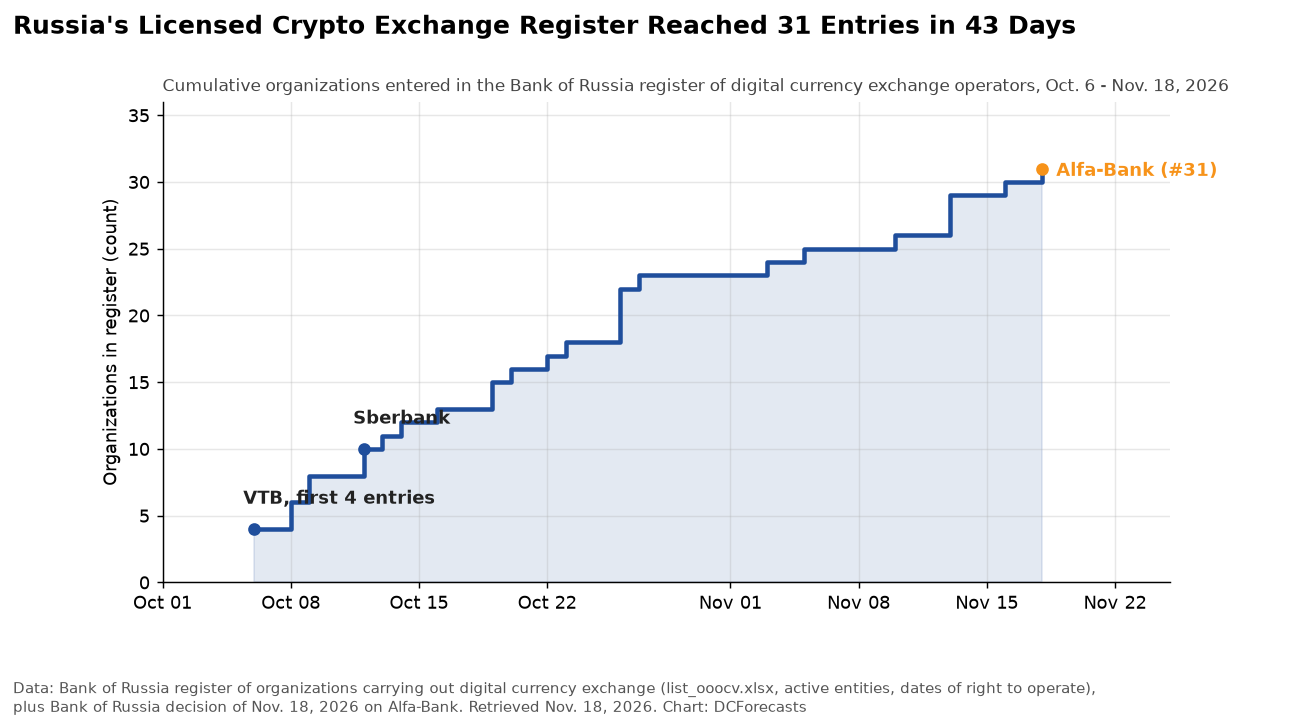
From there, the list kept growing almost every week. Three firms were added on Nov. 13 alone: settlement non-bank credit organization PlataPay, Waybank and Derzhava bank. Another company, Tranomica, was added on Nov. 16, two days before Alfa-Bank.

That is 31 licensed operators in 43 days, counting from the first entries.
Banks Are Moving Into Bitcoin Trading
Most entries are specialist companies set up for the new market. But traditional lenders are a growing share.
By our count of the register, nine of the 31 operators are banks: VTB, Sberbank, Alfa-Bank, ProBank, Khlynov, Bank Stavr, Bank Ingo, Waybank and Derzhava. Two more are non-bank credit organizations.
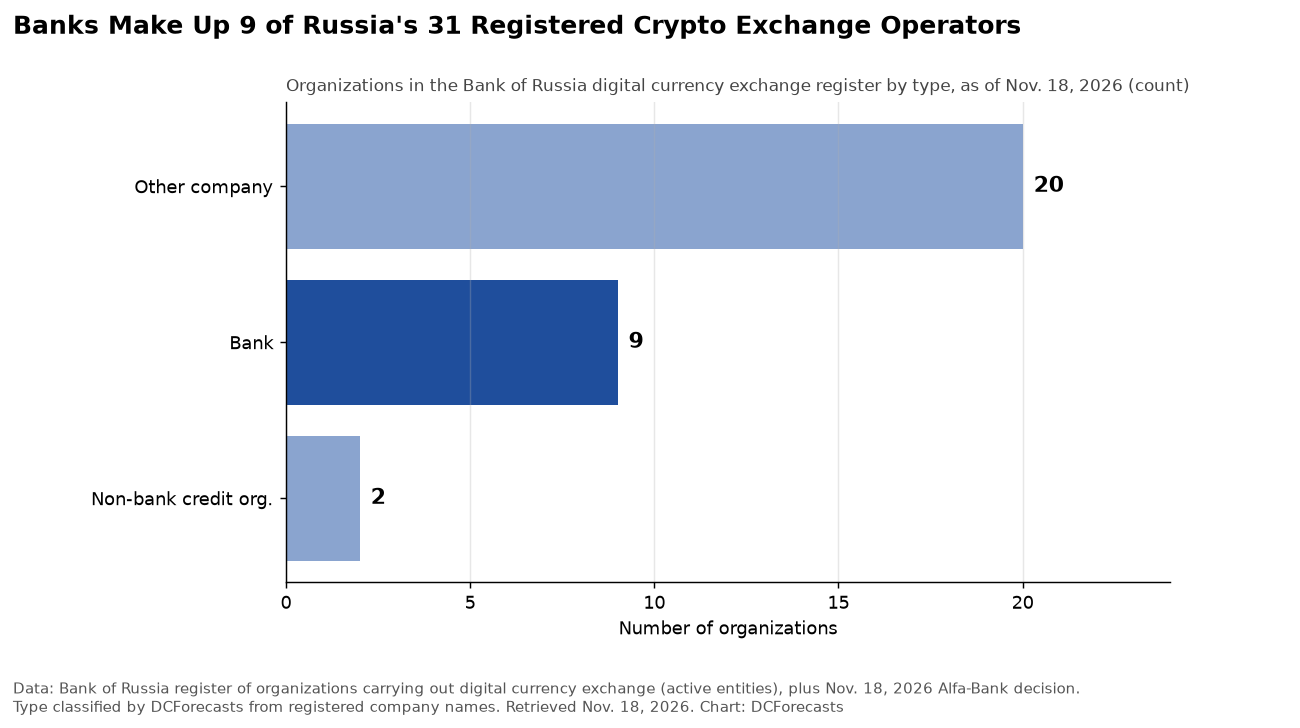
The list also includes a unit of T-Technologies, the holding company behind T-Bank, which brings another big retail brand into the market.
For Bitcoin, that matters. When the biggest banks in a country of more than 140 million people can legally offer it, buying Bitcoin becomes something ordinary customers can do inside the app they already use.
Why Bitcoin Comes First
The timing lines up with Russia’s wider rollout. Its law on digital currencies took effect on Sept. 1, creating a separate legal status for crypto exchange operators.
Then, on Nov. 6, the Bank of Russia approved Bitcoin, Ether and USDT for everyday investors. Since Nov. 17, non-qualified investors can buy those three assets through licensed intermediaries, capped at ₽300,000 a year per intermediary, after passing a test. Qualified investors face no asset restrictions.
The central bank said the retail list includes only the most liquid assets with a long pricing history. Bitcoin is named first.
Next comes the exchange floor. The Moscow Exchange plans to launch Bitcoin trading on Dec. 1, on the same systems used for stocks.
The Industry Is Building Its Own Rulebook
The new sector is also getting oversight structures. On Oct. 29, the national association of stock market participants, NAUFOR, received status from the central bank as the self-regulatory organization for crypto exchange operators and digital depositories.
In mid-November, Vasilyev joined a Bank of Russia committee on standards for crypto exchange operators. The 13-member body includes representatives of Sberbank, VTB, T-Technologies, PSB, the central bank, the Finance Ministry and NAUFOR.
On Oct. 30, Kirill Pronin, director of the central bank’s financial market infrastructure department, said the regulator does not plan to hide the registers despite sanctions risks, because customers need an open list to check whether a service is legal.
Recent enforcement shows why that check matters. On Oct. 28, Interior Ministry spokeswoman Irina Volk said police had shut down five unlicensed crypto exchangers that a darknet drug market had used to cash out its revenue. Investigators recorded more than 185,000 exchange operations through them.
For ordinary Bitcoin buyers, a licensed bank desk offers a cleaner path than that gray market.
The Sanctions Question
That sanctions point is real. The U.S. Treasury imposed full blocking sanctions on Alfa-Bank in April 2022, calling it Russia’s largest private bank, along with six of its subsidiaries. Sberbank was sanctioned on the same day.
So the new service will be built for Russian customers, inside Russia’s own rules. It is not a door into Western markets.
Still, the direction is clear. One of the world’s largest economies has spent 2026 writing Bitcoin into its banking system, from the retail asset list to licensed exchange desks at its biggest lenders. Alfa-Bank’s entry shows that demand for regulated Bitcoin access is strong enough that even the largest private bank wants a seat at the table.
DC Forecasts is a leader in many crypto news categories, striving for the highest journalistic standards and abiding by a strict set of editorial policies. If you are interested to offer your expertise or contribute to our news website, feel free to contact us at [email protected]











Discussion about this post