



K3 Capital has paused its sBOLD vault on Ethereum after attackers drained about $3.43 million from it on Wednesday, Nov. 18, according to blockchain security firm Blockaid.
The attack did not break Liquity V2, the borrowing protocol the vault is built on. It turned Liquity’s normal liquidation process against the vault’s own share math.
Minutes earlier, Blockaid flagged a second, unrelated drain of about $454,000 in stablecoins from Reental’s lending markets on Polygon. Together, the two incidents took close to $3.9 million out of DeFi in under an hour.
How the K3 Capital Exploit Worked
Blockaid posted its first alert on X at 12:45 UTC. It said the attackers flash-loaned wstETH, Lido’s wrapped staked ether, and used it to open and then self-liquidate a Liquity V2 trove, the protocol’s name for a borrowing position.
That liquidation pushed collateral into Liquity’s stability pools, which is where sBOLD deposits earn their yield. According to Blockaid, the attackers then minted sBOLD shares cheaply, swapped the collateral and redeemed BOLD that belonged to other depositors.
The damage grew quickly. An edited version of Blockaid’s alert showed about $300,000 drained at 12:47 UTC. Two minutes later, the figure was about $3.43 million. Blockaid counted roughly 34 exploit transactions and shared the addresses of an exploiter, a helper contract and the victim vault.
In simple terms, the vault’s accounting briefly valued new shares too low. That let the attacker buy in cheap and walk out with more than they put in.
K3 Capital Pauses, and Liquity Draws a Line
K3 Capital responded on X at 13:08 UTC: “We are investigating malicious activity involving sBOLD. Contracts have been paused.”
Liquity followed at 13:59 UTC. It described sBOLD as “a vault built and run independently by K3 Capital,” told users not to deposit into sBOLD until further notice and stated that “Liquity V2 is NOT affected.” Liquity added that it is supporting K3 and will share updates.

That distinction matters. Liquity V2 is an immutable borrowing protocol that lets users draw BOLD loans against ETH, wstETH and rETH. sBOLD is a third-party wrapper that sits on top of it and automatically reinvests stability pool rewards.
K3 Capital itself is a much larger operation than this one vault. DefiLlama lists it as a risk curator with about $189.9 million in total value locked across nine chains on Wednesday, most of it on Monad, with about $19.3 million on Ethereum.
The Reental Drain on Polygon
Blockaid’s first alert of the day actually came at 12:39 UTC and concerned Reental, a platform that tokenizes real estate projects.
According to Blockaid, an admin upgraded the USDT and USDC aToken proxies in Reental’s markets to a contract that “lets anyone drain the underlying tokens,” then swept the remaining stablecoins. About $454,000 left across two transactions.
The affected markets belong to RNT Lend, which DefiLlama describes as a lending market where investors borrow USDT0 or USDC against tokenized real estate. Reental says the product runs on Aave V3-based infrastructure.
The mechanism is very different from K3’s case. Nothing about the math failed here. Instead, the ability to upgrade contracts, held by an admin role, was used to swap in malicious code. Reental had not posted an incident statement on its X account when we checked on Wednesday evening.
How Big Were the Losses?
Neither drain was large by the standards of DeFi’s worst hacks, but both were meaningful relative to the pools involved.
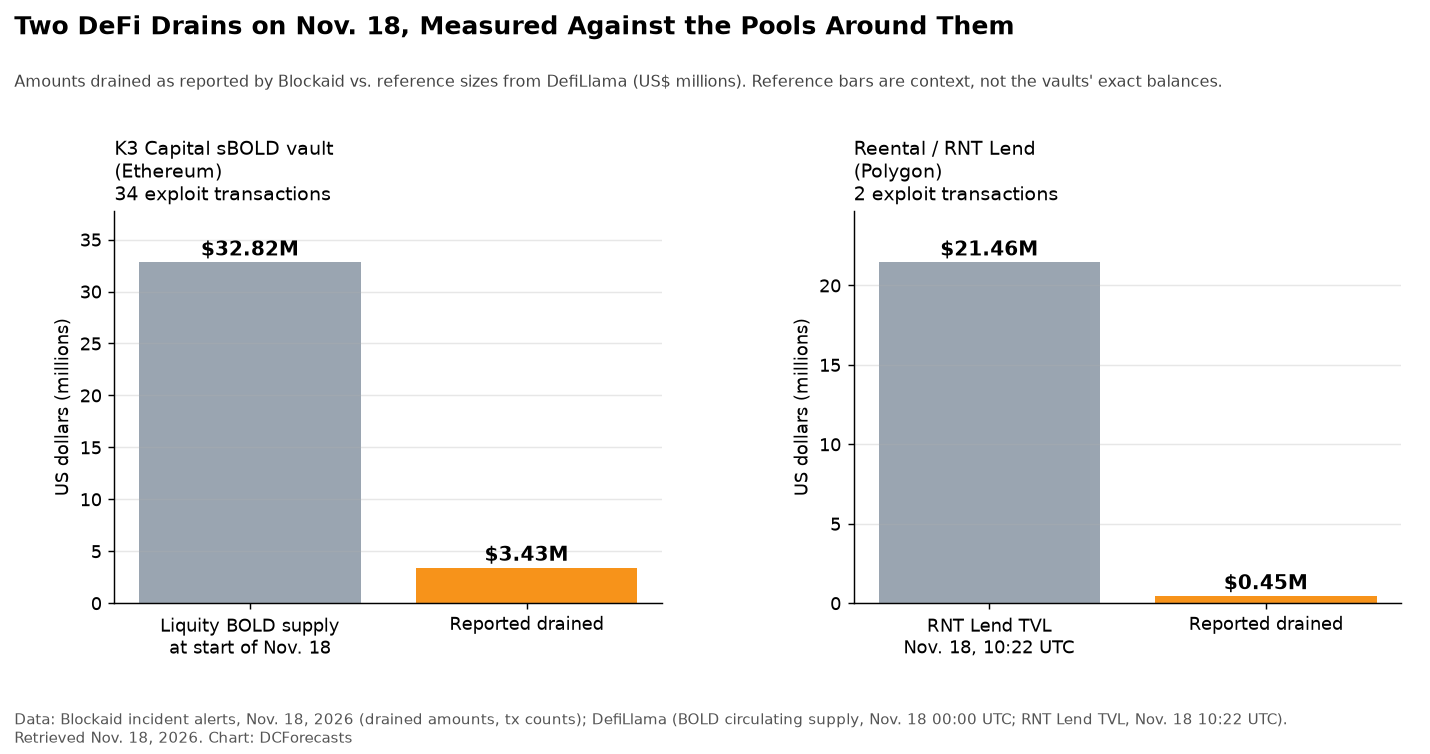
BOLD had about $32.8 million in circulation at the start of Wednesday, according to DefiLlama, so the $3.43 million taken from sBOLD equals a little over a tenth of the stablecoin’s entire supply.
RNT Lend held about $21.5 million in total value locked on Wednesday morning, hours before the attack. Reental’s $454,000 loss works out to about 2% of that.
BOLD Supply Was Already Off Its Peak
BOLD launched with Liquity V2 in 2025 and grew quickly. Its supply peaked at about $49.0 million on Oct. 8, 2025, according to DefiLlama, before settling in a range of roughly $29 million to $38 million through 2026.
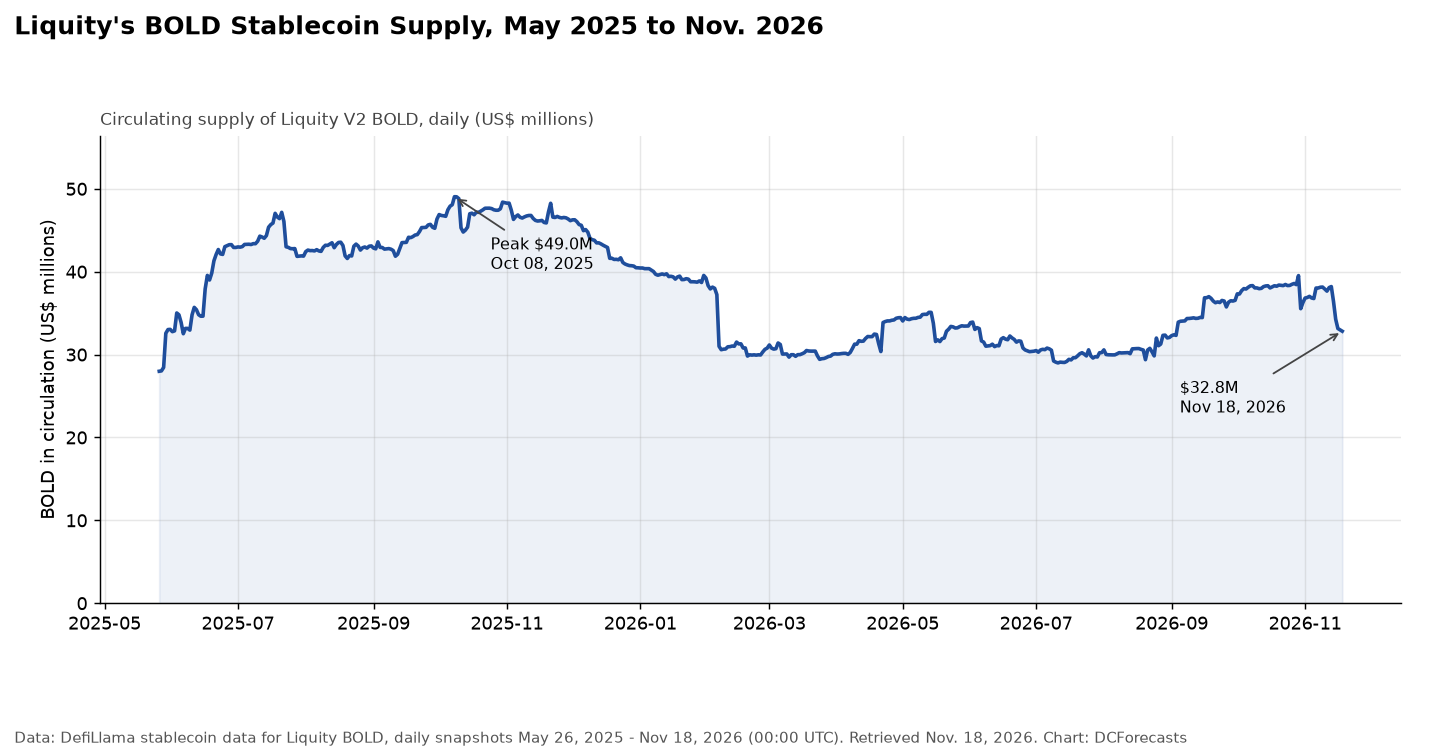
DefiLlama’s live reading on Wednesday afternoon showed about $29.5 million in circulation, down from the $32.8 million daily snapshot. The data alone does not show how much of that change is tied to the exploit and how much reflects normal redemptions and repayments.
A Busy Week for DeFi Security
Wednesday’s two incidents follow a run of attacks on crypto platforms. On Nov. 16, a Gnosis Safe wallet was drained through a role key that had been used hundreds of times before. On the same day as the K3 and Reental alerts, Etherscan and LOBSTR disclosed support desk intrusions.
Each case hit a different weak point: vault accounting, admin upgrade rights, wallet permissions and customer support tools.
We believe the common thread is that the base layers held up. Ethereum kept producing blocks, Liquity V2’s core contracts were not touched, and the damage stayed inside individual products built on top.
That is also the case for Bitcoin’s simpler design. Holders who keep coins in self-custody, without smart contract wrappers or upgradeable admin keys, avoid this category of risk entirely.
For sBOLD and RNT Lend users, the next step is clear. Watch for official updates from K3 Capital, Liquity and Reental, avoid depositing into paused products and ignore unsolicited messages offering refunds.
DC Forecasts is a leader in many crypto news categories, striving for the highest journalistic standards and abiding by a strict set of editorial policies. If you are interested to offer your expertise or contribute to our news website, feel free to contact us at [email protected]












Discussion about this post