



Singapore’s central bank has issued S$100 million of tokenized government-backed bills on its own distributed ledger, paid for entirely in wholesale central bank digital currency. It is the largest tokenized MAS Bill issue so far, and 100 times the size of the first one just six weeks earlier.
The Monetary Authority of Singapore (MAS) disclosed the Nov. 6 issuance on Nov. 19, during the Singapore FinTech Festival. The four-week bills were issued natively on the MAS-operated Singapore Dollar Test Network and mature on Dec. 4.
Demand was solid. Five primary dealers took part, and applications came to more than double the amount on offer, according to the MAS announcement.
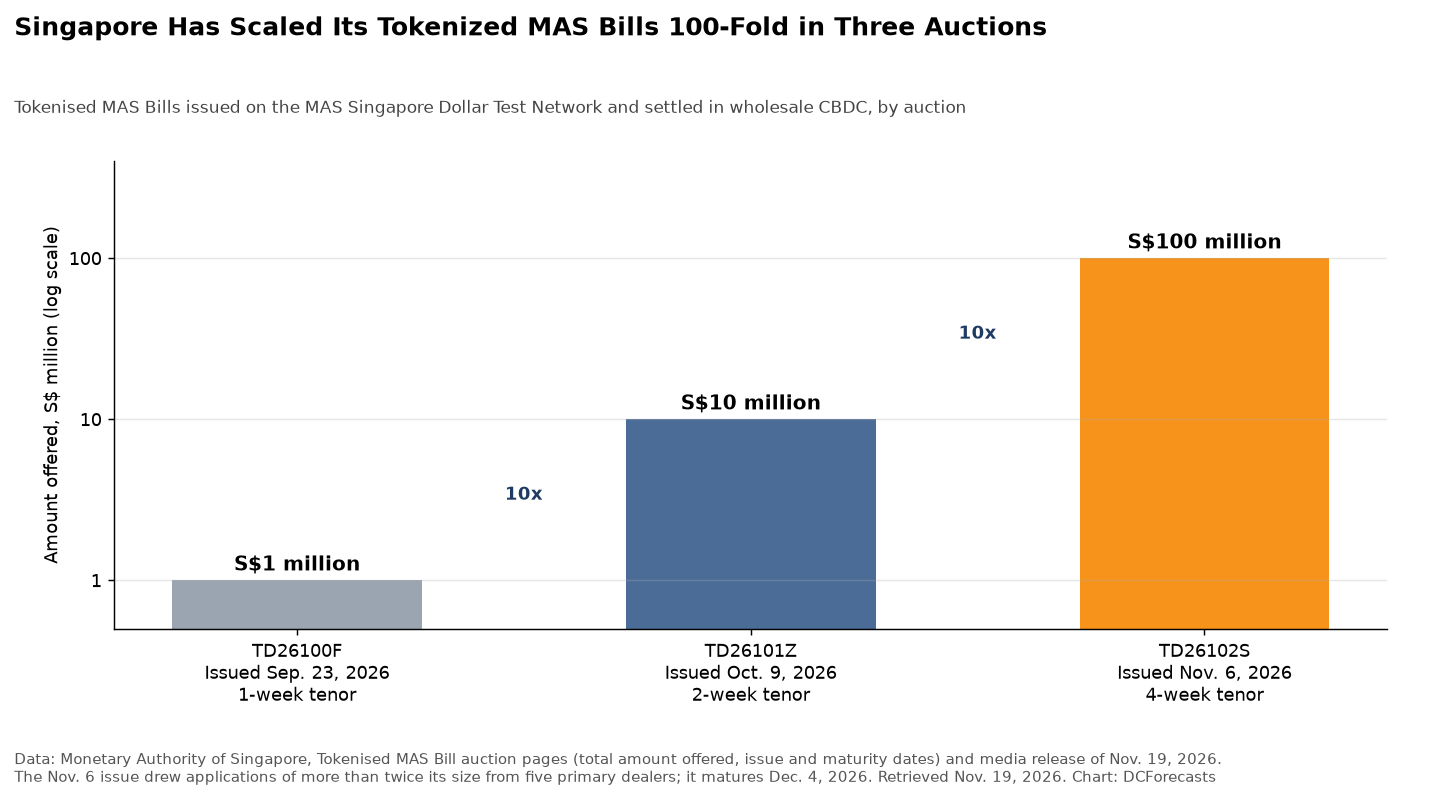
Tokenized MAS Bills Grew 100-Fold in Three Auctions
The MAS auction pages show a steady, tenfold scale-up across three issues this autumn.
- TD26100F: S$1 million, issued Sept. 23 and maturing Sept. 30, a one-week tenor.
- TD26101Z: S$10 million, issued Oct. 9 and maturing Oct. 23, a two-week tenor.
- TD26102S: S$100 million, issued Nov. 6 and maturing Dec. 4, a four-week tenor.
Each issue was ten times larger than the one before it, and each lasted twice as long. All three were sold by uniform price auction with a minimum denomination of S$1,000, and only institutional investors could apply.
The five banks in the November auction were DBS Bank, the Singapore branch of HSBC, OCBC, Standard Chartered Bank (Singapore) and United Overseas Bank. All are primary dealers, the banks MAS approves to make markets in Singapore government securities.
MAS notes that its regular MAS Bill statistics exclude the tokenized issues, so these trials sit apart from the conventional bill market for now.
Why Native Issuance Matters
The key detail is that the bills were born on the ledger rather than converted later. MAS says native issuance “eliminates the need for reconciliation and intermediaries, unlike instruments that are issued conventionally and tokenised subsequently.”
That cuts out a step that adds cost and delay in many tokenization projects, where a traditional security sits with a custodian while a digital twin trades on a blockchain. Here, the bill and the central bank money used to buy it live on the same network.

The trial also builds on a live interbank overnight loan that MAS settled in wholesale CBDC in 2025. Adding a trusted bill to the network makes the next step possible: secured lending, where a bank pledges tokenized bills as collateral for a loan settled on the same ledger.
“The live issuance allowed us to test a new method of issuance, and further enhance our in-house distributed ledger infrastructure,” said MAS Managing Director Chia Der Jiun. “Over time, tokenised MAS Bills can play a complementary role to conventional MAS Bills.”
The Test Network Becomes the SG Digital Ledger
In a keynote at the festival, Chia said the test network will no longer be just a sandbox. MAS will reposition it as an operational utility and rename it SG Digital Ledger, able to support settlement across institutions, tokenized assets, forms of digital money and ledgers.
MAS also wants to grow the bill program. Its next phase aims to scale up issuance, bring more financial institutions on board and widen the use of tokenized MAS Bills in collateral management, with further live trials planned for 2027.
Chia described collateral as the use case the industry wants most. It sits at the center of derivatives, secured funding and liquidity management, and tokenization can make posting and moving it faster and cheaper.
To that end, MAS and industry partners published a Guardian Tokenised Collateral Framework on the same day. It covers eligibility, custody, valuation, return and enforcement across the collateral life cycle. MAS said it could also tokenize widely used foreign government securities and money market funds.
Singapore’s Wider Tokenization Push
The bill trial is one piece of a broader program. Chia said MAS has issued guidance on tokenized bank deposits, is introducing a regulatory regime for stablecoins, and runs a digital money platform called BLOOM with 24 industry members and policymakers from the region.
On cross-border settlement, MAS has tested a synchronized mechanism with the Bank of England and the Bank of Thailand, a type of trial DCForecasts covered in its look at how central banks are tackling FX settlement risk. Singapore banks are also moving on their own, with DBS opening a weekend lane for tokenized dollars between the U.S. and Singapore.
The approach mirrors a debate in the U.S., where Fed Governor Christopher Waller recently argued that central bank money should sit beneath tokenized markets. Singapore is already doing that in production-scale trials.
What It Means for Blockchain Adoption
For the digital asset industry, a central bank issuing its own debt on a shared ledger is a strong endorsement of the core technology. Distributed ledgers, once seen as a crypto niche, are becoming part of how a major financial center plans to move its safest assets.
That shift builds the rails that open, decentralized networks first proved out. Bitcoin showed that value can settle on a shared ledger without a middleman. Banks and central banks are now adopting the same principle for their own instruments, and every step toward on-chain settlement makes digital assets more familiar to institutional investors.
The numbers are still small. At S$100 million, the latest issue is modest next to Singapore’s conventional bill market. But a 100-fold scale-up in six weeks, an oversubscribed auction and a plan to turn the test network into permanent infrastructure all point the same way.
The next marker comes on Dec. 4, when the four-week bills mature and are redeemed in wholesale CBDC. After that, the focus turns to how quickly MAS lifts issuance sizes and brings more banks onto the SG Digital Ledger in 2027.
DC Forecasts is a leader in many crypto news categories, striving for the highest journalistic standards and abiding by a strict set of editorial policies. If you are interested to offer your expertise or contribute to our news website, feel free to contact us at [email protected]












Discussion about this post