



The USDS stablecoin lost roughly $1.96 billion of circulating supply on Nov. 19, as holders rushed to redeem after a report questioned who had been using Sky’s swap facility.
DefiLlama data shows Sky Dollar (USDS) supply at $5.24 billion at midnight UTC. By 20:00 UTC it stood at $3.28 billion, a drop of about 37%.
Yet the token never lost its footing. DefiLlama priced USDS at $0.9999 at the same reading.
For Bitcoin investors, the episode is a live stress test of how a decentralized stablecoin behaves when trust is questioned, and a reminder of why an asset with no reserve to freeze stands apart.
The bigger question now is whether the outflow has run its course or whether more holders will head for the exit.
What Triggered the USDS Stablecoin Outflow?
The redemptions arrived on the same day as an investigation by crypto risk analytics firm Inca Digital into Sky’s Peg Stability Module, or PSM.
The PSM is the on-chain tool that lets users swap Circle’s USDC for USDS or DAI at a 1:1 rate, and back again. It is a key part of how both tokens hold their dollar value.
USDS is the successor to DAI, the stablecoin that made Sky’s predecessor MakerDAO one of DeFi’s earliest success stories. Both tokens remain in circulation side by side.
Inca’s findings alleged that wallets linked to hackers, sanctioned entities and North Korean actors had moved funds through the module.

Sky responded on X on Thursday afternoon. It said it was “aware of the recent” report and that such reports “are taken seriously across the Sky Ecosystem.”
The protocol argued for scale: the PSM “has processed over $968 billion in volume since inception,” and the alleged figures “would represent roughly 0.03% of that.”
Sky added that the activity ran “predominantly via third-party permissionless platforms” and that its own front ends, including Spark, Grove, Sky.money and Osero, screen and block flagged wallets and users in sanctioned jurisdictions.
A $1.96 Billion Hole, Measured on Chain
The numbers are large even by recent standards.
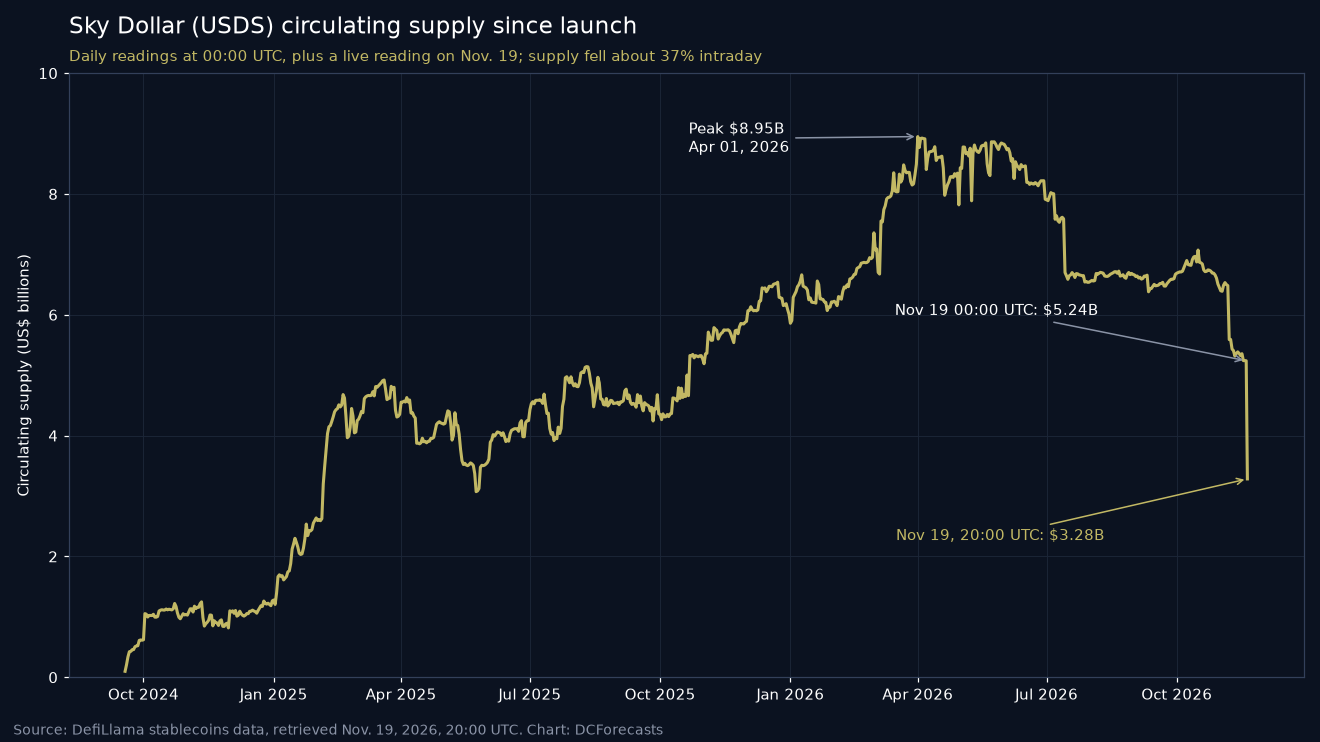
USDS peaked at $8.95 billion on April 1, 2026, according to DefiLlama. Thursday’s reading of $3.28 billion is about 63% below that high.
We cross-checked the move directly on Ethereum, where nearly all USDS lives. The token contract reported a total supply of about $3.24 billion at our check, consistent with the DefiLlama figure.
This was not the first sharp step down this month. Supply also slid from $6.48 billion on Nov. 6 to $5.59 billion on Nov. 7, before Thursday’s far larger move.
When USDS is redeemed through the PSM, tokens are returned and USDC flows out of the module, so a falling supply shows holders choosing to step back rather than sell at a discount.
Why the Peg Held
A 37% contraction would break many pegs. This one did not, and that deserves credit.
The PSM did exactly what it was designed to do. Holders who wanted out could swap USDS for USDC at par, so there was no need to dump tokens on the open market below $1.
Put simply, anyone redeeming through the PSM received one USDC for each USDS. Nobody using it had to accept 95 cents to get out.
That is the difference between an orderly exit and a panic. A redemption window with deep reserves turns fear into a queue rather than a crash.
We believe this is the most constructive takeaway for the wider stablecoin market, which has already shed $16 billion in a month as liquidity tightened.
DAI Barely Moved
The contrast with Sky’s older stablecoin is striking.
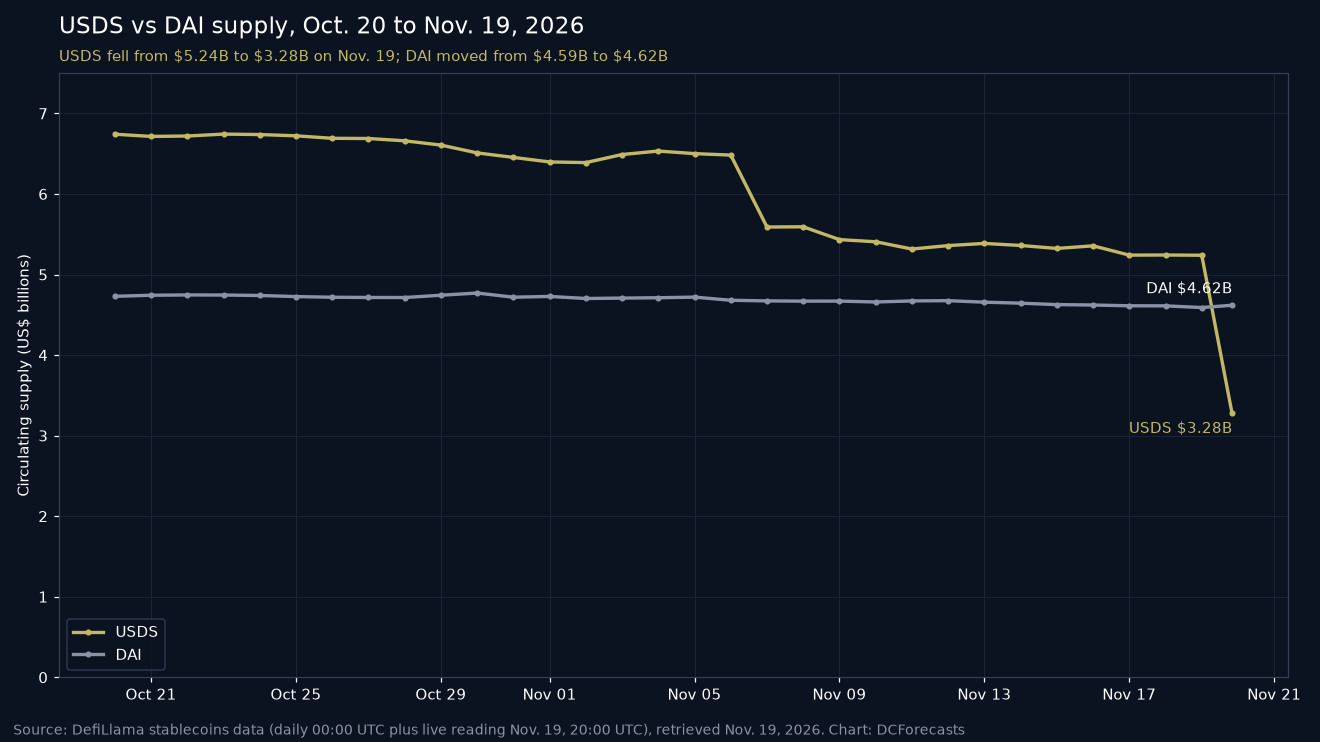
DAI supply actually edged up during the day, from $4.59 billion at midnight UTC to $4.62 billion by our 20:00 UTC reading.
Both tokens share the same PSM, so the split suggests the exit was driven by a concentrated group of USDS holders rather than a broad loss of confidence in Sky’s system.
That nuance matters. A run spreads; this, so far, looks contained.
The Freeze Question Facing Stablecoins
The deeper issue is structural. The PSM’s reserves are held in USDC, a token whose issuer can freeze addresses.
That means a decentralized stablecoin still leans on a centralized one for its first line of defense, a tension regulators and lawmakers are now actively working through, as seen when six senators pressed Treasury on GENIUS Act rules for state issuers.
Bitcoin sidesteps this problem entirely. There is no reserve pool, no issuer and no single address whose blacklisting could stall redemptions for everyone else.
What We Are Watching Next
We would track three signals in the coming days: whether USDS supply stabilizes above $3 billion, whether the token keeps trading at $1, and whether Sky publishes further detail on PSM screening.
If the peg keeps holding through heavy redemptions, Sky will have passed a meaningful test of its design.
And for investors weighing where to park value through stress like this, Bitcoin’s fixed 21 million supply and lack of any freezable reserve remain a powerful argument. The coming days will show whether Thursday’s exit was a one-off or the start of a longer reshuffle in DeFi dollars.
DC Forecasts is a leader in many crypto news categories, striving for the highest journalistic standards and abiding by a strict set of editorial policies. If you are interested to offer your expertise or contribute to our news website, feel free to contact us at [email protected]












Discussion about this post