



Deutsche Bank crypto custody is now open to paying clients, and this week the companies behind its plumbing started to step forward.
On Nov. 17, Crypto Finance, part of Deutsche Börse Group, said Deutsche Bank had selected it to provide institutional-grade wallet infrastructure for the bank’s new custody service. Bitpanda Enterprise said the same day that it is also one of the bank’s technology partners.
Together, the announcements show how Germany’s largest bank built its Bitcoin vault: not on a single vendor, but on what Crypto Finance called a “multi-provider setup” that keeps Deutsche Bank in charge.
A Live Service, Not a Pilot
Deutsche Bank said on Wednesday, Nov. 11, that its digital asset custody service had begun serving paying clients. The bank first unveiled the plan on Sept. 16 and has now received approval from Germany’s Federal Financial Supervisory Authority, BaFin.
The service is available to clients of the bank’s Corporate Bank and Investment Bank. That includes corporates, asset managers, hedge funds, custodians, brokers and sovereign institutions. Retail customers are not part of the launch.
Bitcoin and ether are the first two crypto assets supported, along with three stablecoins or e-money tokens: USDC, EURC and EURAU. Tokenized financial instruments are set to follow at a later date.
Clients can store assets, transfer them to third parties and move them between warm and cold storage inside the bank. Access runs through Autobahn, Deutsche Bank’s multi-channel gateway, or its Corporate Bank portal.
The service is booked out of Deutsche Bank AG in Frankfurt. It is available in Germany and can serve clients across Europe under the EU’s Markets in Crypto-Assets regulation (MiCA).
Who Holds the Keys
Crypto Finance’s statement is careful on one point. Its technology lets Deutsche Bank use “secure and scalable wallet technology while maintaining full control over wallets, processes and transaction lifecycle management” within the bank’s own governance framework.

In other words, the vendors supply the tools, while the bank runs the vault.
“Deutsche Bank is working with a number of established partners to deliver a secure and scalable offering for institutional clients,” said Paul Maley, Deutsche Bank’s Global Head of Trust and Securities Services. He described Crypto Finance as “one of these trusted partners.”
Stijn Vander Straeten, CEO of Crypto Finance Group, called the selection “a strong endorsement of our technology, security standards and institutional expertise.”
Crypto Finance runs regulated entities in two countries. Crypto Finance AG is supervised by FINMA in Switzerland, and Crypto Finance (Deutschland) GmbH is supervised by BaFin. The company said it was among the first in the EU to obtain a MiCA licence, in early 2025.
Bitpanda Enterprise said its modular custody infrastructure supports digital asset safekeeping for the bank’s corporate and institutional clients.
Deutsche Bank’s own description of the security model matches that layered approach. Private keys are created and protected in dedicated hardware. Important actions need approval from more than one person, and key material is split across separate environments, including offline cold storage.
Bitcoin Gets a Seat at Germany’s Biggest Bank
For Bitcoin, the significance is simple. A treasurer, fund manager or sovereign client can now hold BTC with the same bank that handles its cash and securities.
“Digital assets are not a replacement for the traditional financial system but an important complement to it,” said Gerald Podobnik, Co-Head of Deutsche Bank Corporate Bank. He described them as “new rails that can coexist with existing market infrastructures.”
Maley set a bigger goal. “In the medium term we aim to deliver a fully integrated, regulated ecosystem that supports the custody, tokenisation, and settlement of digital assets,” he said when the launch was announced.
The bank has said it plans to take the service to Asia. It also signed a memorandum of understanding with Deutsche Asset Management, formerly known as DWS, to explore working together on tokenized money market funds, crypto exchange-traded commodities and stablecoins.
Crypto Finance said the same infrastructure is “asset-class-agnostic” and could later support investment services, stablecoin payments and the safekeeping of tokenized securities.
The Euro Stablecoin on the List Is Growing Fast
One detail stands out in the asset list. Two of the three supported stablecoins, EURC and EURAU, are pegged to the euro.
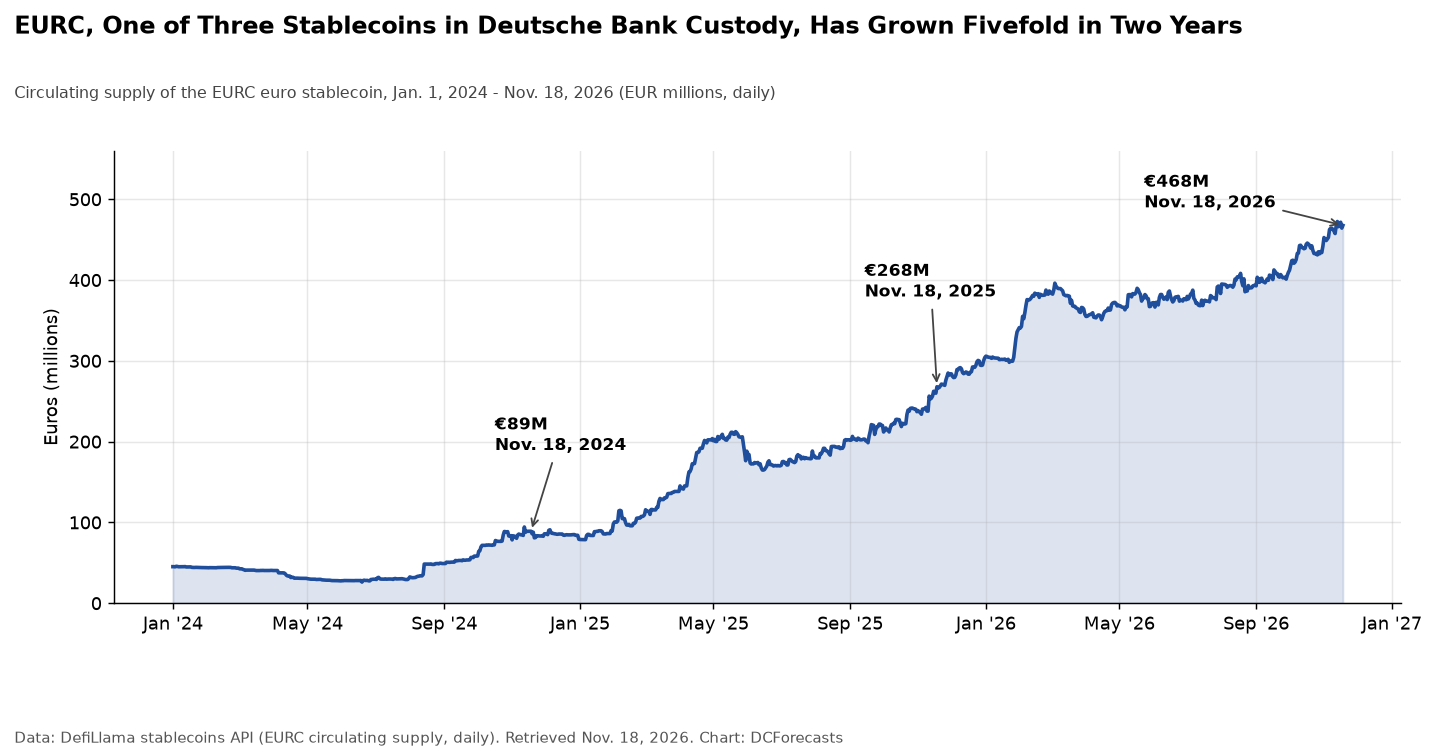
EURC’s circulating supply reached about €468 million on Nov. 18, according to DefiLlama data. That is up roughly 75% from €268 million a year earlier and more than five times the €89 million of November 2024.
Deutsche Bank Research puts the wider trend in context. It estimates that the global market for tokenized assets, excluding stablecoins, grew from about $10 billion in January 2025 to $39 billion in September 2026.
Part of a Wider Bank Shift
Deutsche Bank is not moving alone. In the United States, Coinbase recently moved its custody business into a federally chartered trust bank. In Israel, Israel Discount Bank is adding Bitcoin to its banking app. And on Wall Street, Morgan Stanley’s Bitcoin ETF doubled its holdings in the third quarter.
The bank has not named its first clients, said how many have signed up or disclosed its fees. It also warns that crypto held this way is not covered by deposit guarantees and that custody does not protect against price swings.
Still, the message from Frankfurt is clear. Bitcoin is now a standard asset that Germany’s largest bank will safeguard for its biggest clients, backed by regulated partners and a BaFin licence. For long-term holders, that kind of quiet infrastructure is how adoption grows.
DC Forecasts is a leader in many crypto news categories, striving for the highest journalistic standards and abiding by a strict set of editorial policies. If you are interested to offer your expertise or contribute to our news website, feel free to contact us at [email protected]












Discussion about this post