



The world’s securities regulators want banks, exchanges and blockchains to stop treating quantum computing as a distant problem. A new report from the International Organization of Securities Commissions (IOSCO) says the financial system should prepare for code-breaking quantum machines that could arrive within five years.
The 63-page final report, “Implications of Quantum Computing on Financial Markets,” was published in November by IOSCO’s board. It finds that no quantum computer can break today’s encryption yet, but that the work to replace it will take years, and most firms have barely started.
On the same day, Nov. 19, UK regulators made a similar point. The Bank of England, the Prudential Regulation Authority and the Financial Conduct Authority jointly published effective practices for managing quantum-related cyber risk.
A Shorter Timeline Than the Official Estimates
IOSCO notes that conservative estimates place the arrival of a “cryptographically relevant” quantum computer in the 2030 to 2035 window. That alone creates near-term urgency, because migrations to new cryptography take years.
But the report goes further. “The timeline for quantum attacks has compressed materially,” it says, adding that quantum technologies “have moved beyond experimentation and into a scaling phase, with several platforms already highly advanced.”
Several industry participants told IOSCO that organizations should prepare for relevant capabilities emerging within the next five years, potentially sped up by artificial intelligence. “The debate is therefore no longer about whether or even when quantum computing will become a threat,” the report states. “The more pressing question is how far behind the financial system already is in preparing for it.”
The report adds that attackers “will not need to own a quantum computer — they will only need access to one,” and that institutions should plan for a genuine cryptographic zero-day with little warning.
Banks Face the Same Problem as Blockchains
The warning is not aimed at crypto alone. IOSCO says the public-key algorithms at risk, RSA and elliptic curve cryptography, underpin secure communications, digital signatures and authentication across banking, payments, securities markets and asset management.
It also flags “harvest now, decrypt later” attacks, where data stolen today is unlocked years later. Long-dated loan documents and merger data rooms are among the examples it gives.

Preparedness is thin. Most activity IOSCO observed was awareness-raising, governance, training and building inventories of vulnerable systems. Migration testing and deployment “remain limited.” The report describes “quantum-procrastination,” where firms see the need to act but wait for clearer rules or more mature technology.
Among regulators themselves, about 55% of IOSCO members surveyed have set up cross-functional working groups on quantum readiness, and only about 25% have dedicated teams.
The Bigger-Signature Trade-Off
For public blockchains, IOSCO highlights a practical cost. Elliptic-curve signatures are compact, typically 64 bytes, while the main NIST-standardized replacement is far larger. Under FIPS 204, an ML-DSA-44 signature is 2,420 bytes, and the stronger ML-DSA-65 and ML-DSA-87 sets reach 3,309 and 4,627 bytes.
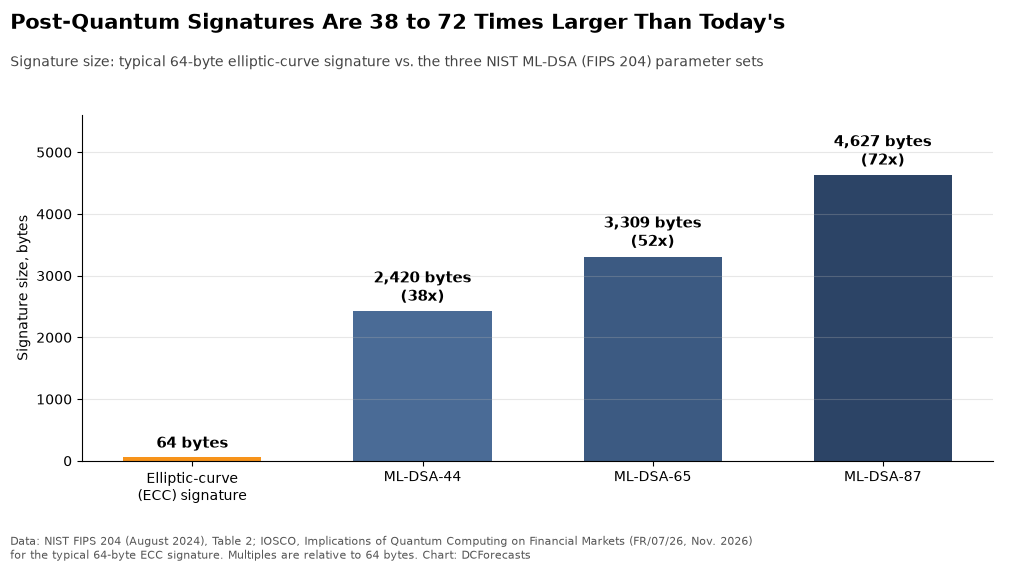
Bigger signatures mean more data per transaction, which can weigh on throughput, storage and fees. The report cites evidence from Solana’s quantum-resistant testnet showing throughput fell by about 90% when elliptic-curve signatures were swapped for post-quantum ones. DCForecasts saw the same scale problem when Stacks moved sBTC with a post-quantum signature far larger than a normal Bitcoin signature.
IOSCO adds that decentralized networks need thousands of independent node operators to agree on upgrades, so migration could be slower than for a bank that can push a patch overnight.
Why Bitcoin Starts From a Stronger Position
The report names Ethereum, Solana and Tron as examples of networks that rely heavily on elliptic curve cryptography. It also explains why the address model matters. In some systems, a public key stays hidden until an address is used, so an attacker would have only the short window before confirmation to strike.
That is how Bitcoin’s hashed addresses work. Coins sitting in an unused address do not reveal a public key at all, and DCForecasts found that most of Bitcoin’s exposed public keys can be fixed simply by moving coins to fresh addresses.
Bitcoin also has time on its side. The standards already exist: NIST has finalized FIPS 203, 204 and 205, the three post-quantum standards IOSCO lists as the basis for migration. NIST has also set a 2035 cutoff for ECDSA, which gives developers a clear target date.
Bitcoin’s conservative, consensus-driven upgrade process can look slow, but it has delivered major soft forks such as SegWit and Taproot without splitting the network. A quantum upgrade would follow the same careful path, and Bitcoin developers are already debating how to approach it.
What Comes Next
IOSCO’s report is guidance, not a rulebook. But it points securities regulators worldwide toward the same message as the UK: inventory your cryptography, plan your migration and build “crypto-agility” now.
For Bitcoin holders, the practical takeaway is simple. Avoid reusing addresses, keep coins in addresses that have never spent, and watch for the protocol proposals that will eventually add quantum-resistant signatures. The banking system is only now waking up to a challenge that Bitcoin’s developers have been studying for years.
DC Forecasts is a leader in many crypto news categories, striving for the highest journalistic standards and abiding by a strict set of editorial policies. If you are interested to offer your expertise or contribute to our news website, feel free to contact us at [email protected]












Discussion about this post