



PowerCompute retired its bitcoin-backed loan in September by handing over about 267 of the 307 BTC it had pledged, and its latest SEC filings show what the small Nasdaq-listed miner looks like on the other side of that trade.
The deal cut its secured debt by roughly 94%, to $1.25 million, and left no bitcoin pledged anywhere.
Yet the company, formerly LM Funding America, now holds just 65.7 BTC, and its quarterly report still carries a going-concern warning.
For Bitcoin investors, the most useful part of the story is the timing: the coins were sold near $84,000, close to the top of the autumn range.
The bigger question is whether a leaner, debt-light miner can rebuild its stack from production alone.
How the Bitcoin-Backed Loan Was Settled
PowerCompute’s mining subsidiary borrowed about $21.89 million from Arch Lending on Aug. 25, 2026, under a non-recourse, collared 30-day loan secured by 307 BTC at 6.5% interest, according to its Form 10-Q for the September quarter.
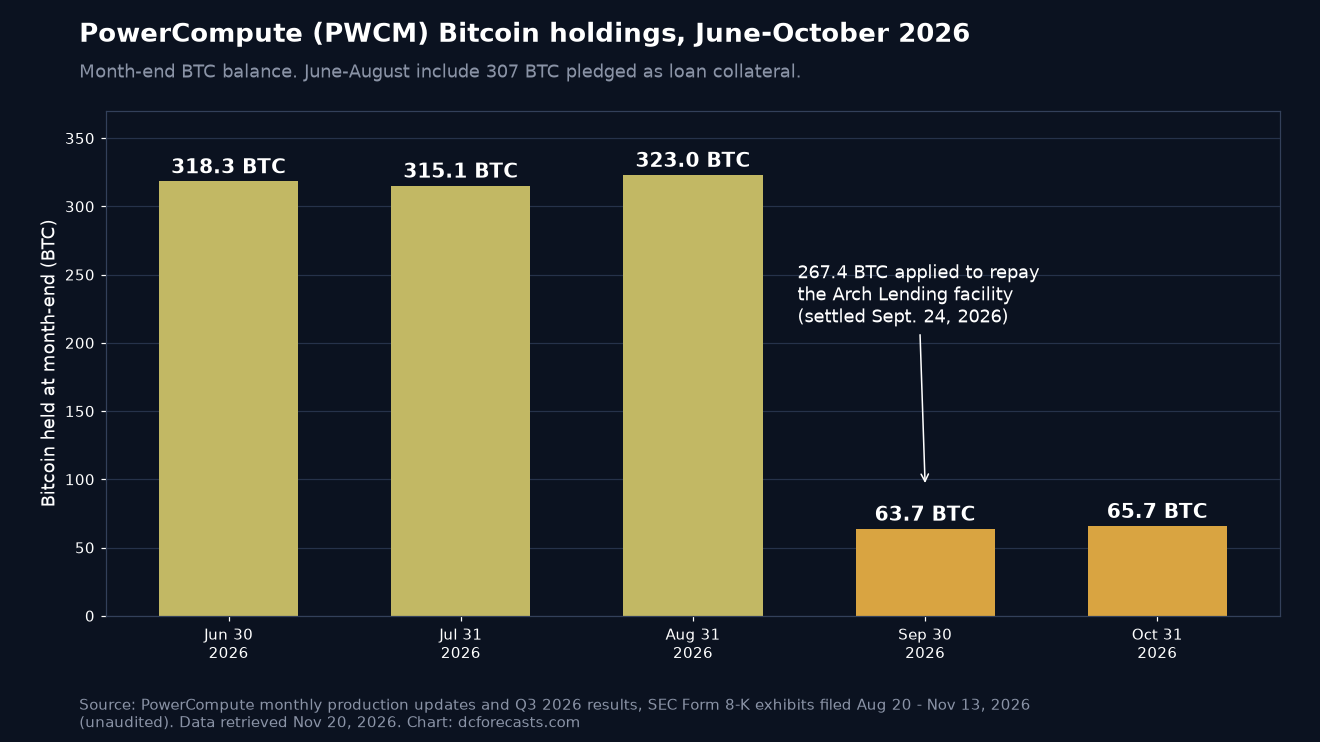
On Sept. 24, the facility’s scheduled reset date, Arch sold about 267.3 of the pledged coins.
The proceeds covered $21,892,132 of principal, $118,582 of accrued interest and a $440,122 fee, or roughly $22.45 million in total. About 39.6 BTC came back to the company.
The company stressed in its Sept. 30 release that the facility had no margin-call or price-triggered liquidation provisions, and that the settlement was not a forced sale.

Simple division puts the effective price at about $84,000 per coin. Coinbase data shows bitcoin closed Sept. 24 at $84,385.
With BTC near $61,600 on Friday morning, the same 267 coins would now be worth about $16.5 million, almost $6 million less than the debt they cleared.
A Thinner Treasury, but a Cleaner Balance Sheet
The trade-off is visible in the monthly numbers. PowerCompute held 323.0 BTC at the end of August and 63.7 BTC a month later.
By Oct. 31, after mining 9.0 BTC and selling 7.0, the balance stood at 65.7 BTC, which the company valued at roughly $5.1 million, or about $2.00 per share.
The liabilities side moved much further. Total liabilities fell to about $3.7 million at Sept. 30 from $21.6 million at June 30.
The only remaining secured debt is a $1.25 million note whose maturity was extended to Dec. 31, 2027, and the company puts annual secured interest at about $138,000.
We believe that is the real lesson of the deal. The bitcoin held its value well enough to clear the debt in full, and the company exited leverage before BTC slid another 27% from the settlement-day close.
Production Is Climbing on the Same Power
The operating side of the 10-Q reads better than the headline warning.
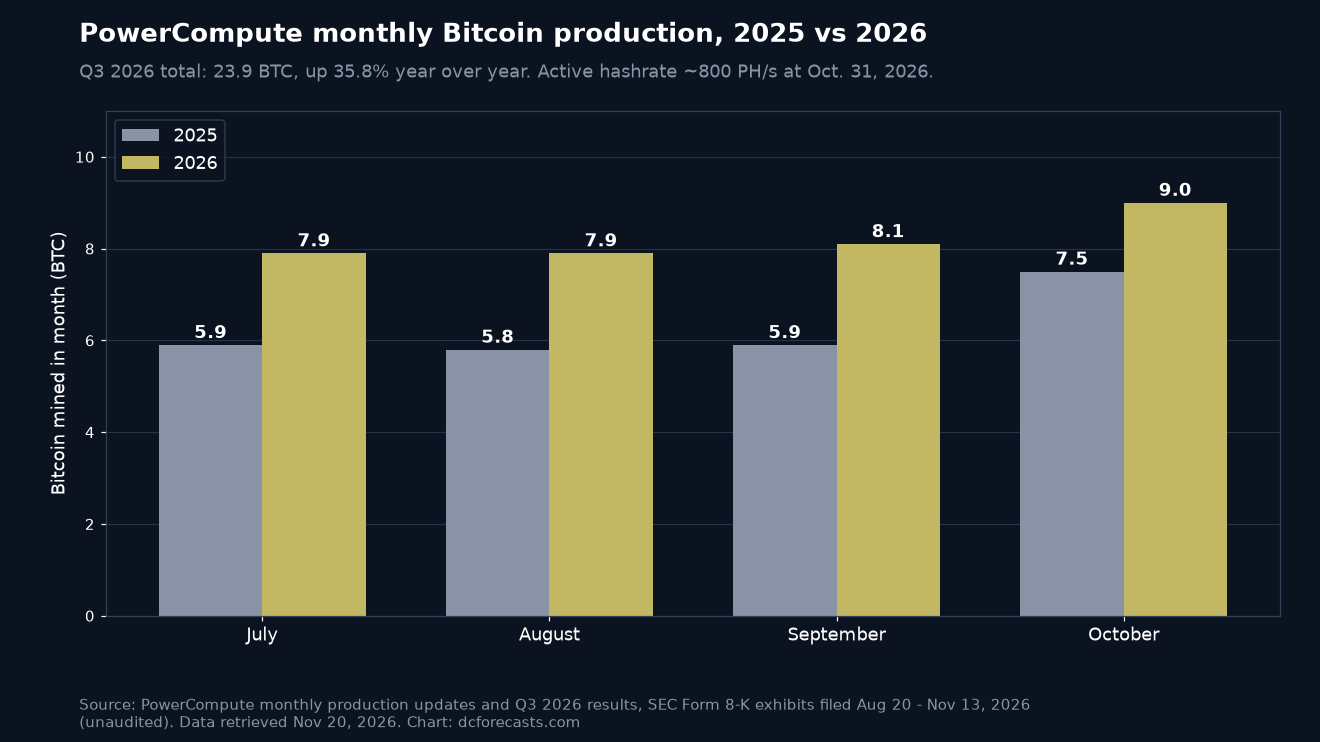
PowerCompute mined 23.9 BTC in the third quarter, up 35.8% from a year earlier, and its mining margin improved to 50.7% from 29.0% in the second quarter.
The energy cost to mine one bitcoin, net of curtailment and energy sales, fell to about $35,000 from about $58,000 a year earlier, at a blended net power cost of about 2.4 cents per kilowatt-hour.
October output reached 9.0 BTC, up 20% year over year, as active hashrate rose 11.4% to about 800 PH/s without adding a megawatt.
In November, the company paid about $1.0 million in cash for 600 Bitmain Antminer S21++ machines. It expects them to add 80 to 85 PH/s, about 10% more hashrate, once deployed by mid-December.
Those gains help explain how other miners are approaching the same squeeze. As we covered when MARA and Riot disclosed 60,845 BTC in 2026 sales, the industry is now trading coins for power and efficiency rather than holding everything it mines.
Why the Going-Concern Warning Remains
Cash is the pressure point. PowerCompute ended September with $652,628 in cash, plus about $5.35 million of bitcoin and a small amount of marketable securities.
The 10-Q states that “substantial doubt about the Company’s ability to continue as a going concern has not been alleviated.”
Management’s plan leans on refinancing and its at-the-market share program with Maxim Group, which had about $71.4 million of capacity left at Sept. 30. The filing warns that further equity financings “may have a dilutive effect on shareholders.”
Shareholders have already felt that. On Nov. 17, holders approved a reverse stock split of between 1-for-2 and 1-for-10, with 757,029 votes for and 392,283 against, according to an 8-K filed the next day. A 1-for-25 split took effect only on July 13.
Market data shows the stock closed Thursday at about $0.40. Across 2,535,061 shares, that is a market value near $1 million, well below the roughly $4 million its last reported 65.7 BTC would fetch today.
That gap reflects doubts about the company’s runway, not about the coins on its books.
Can a Debt-Light Miner Rebuild Its Stack?
The next checkpoints are concrete. We would watch the November production update, the S21++ deployment in Mississippi and whether bitcoin sales stay below monthly output.
Network conditions matter too. As we noted when bitcoin mining difficulty dropped 9.1%, lower difficulty lets the same hashrate earn more coins.
For us, PowerCompute is a reminder that bitcoin itself did its job. It was liquid collateral that settled $22.45 million of debt in a single day, with no margin call.
The open question is whether this miner can turn cheaper power and newer machines into a growing treasury again. The coming months of production data will show whether the comeback holds.
DC Forecasts is a leader in many crypto news categories, striving for the highest journalistic standards and abiding by a strict set of editorial policies. If you are interested to offer your expertise or contribute to our news website, feel free to contact us at [email protected]












Discussion about this post