



A Bitcoin income ETF promises something plain Bitcoin never does: a regular cash payout. Over the past 12 months, three of the best-known funds paid out the equivalent of 21% to 34% of their share prices.
Yet the full cycle tells a different story. In the rally to Bitcoin’s October 2025 peak, these funds trailed BlackRock’s iShares Bitcoin Trust (IBIT) by 15 to 37 percentage points. In the slide that followed, they fell nearly as far.
We compared three option-income funds with IBIT using daily closing and dividend-adjusted prices from Yahoo Finance through Nov. 18, 2026. The numbers make a strong case for simply holding Bitcoin.
How a Bitcoin Income ETF Earns Its Payout
The three funds we tracked are the NEOS Bitcoin High Income ETF (BTCI), the Roundhill Bitcoin Covered Call Strategy ETF (YBTC) and the YieldMax Bitcoin Option Income Strategy ETF (YBIT).
All three generate most of their income by selling call options tied to Bitcoin. The buyers of those options pay a premium for the right to Bitcoin’s gains above a set level. The fund collects the premium and passes it on to shareholders.
That trade has a clear cost. When Bitcoin climbs fast, much of the upside belongs to the option buyer rather than the fund. When Bitcoin falls, the premium softens the blow only slightly.
Payout schedules differ, too. BTCI pays monthly, while YBTC and YBIT made roughly 52 payments each over the past year, a weekly rhythm.
The Rally Showed What Investors Gave Up
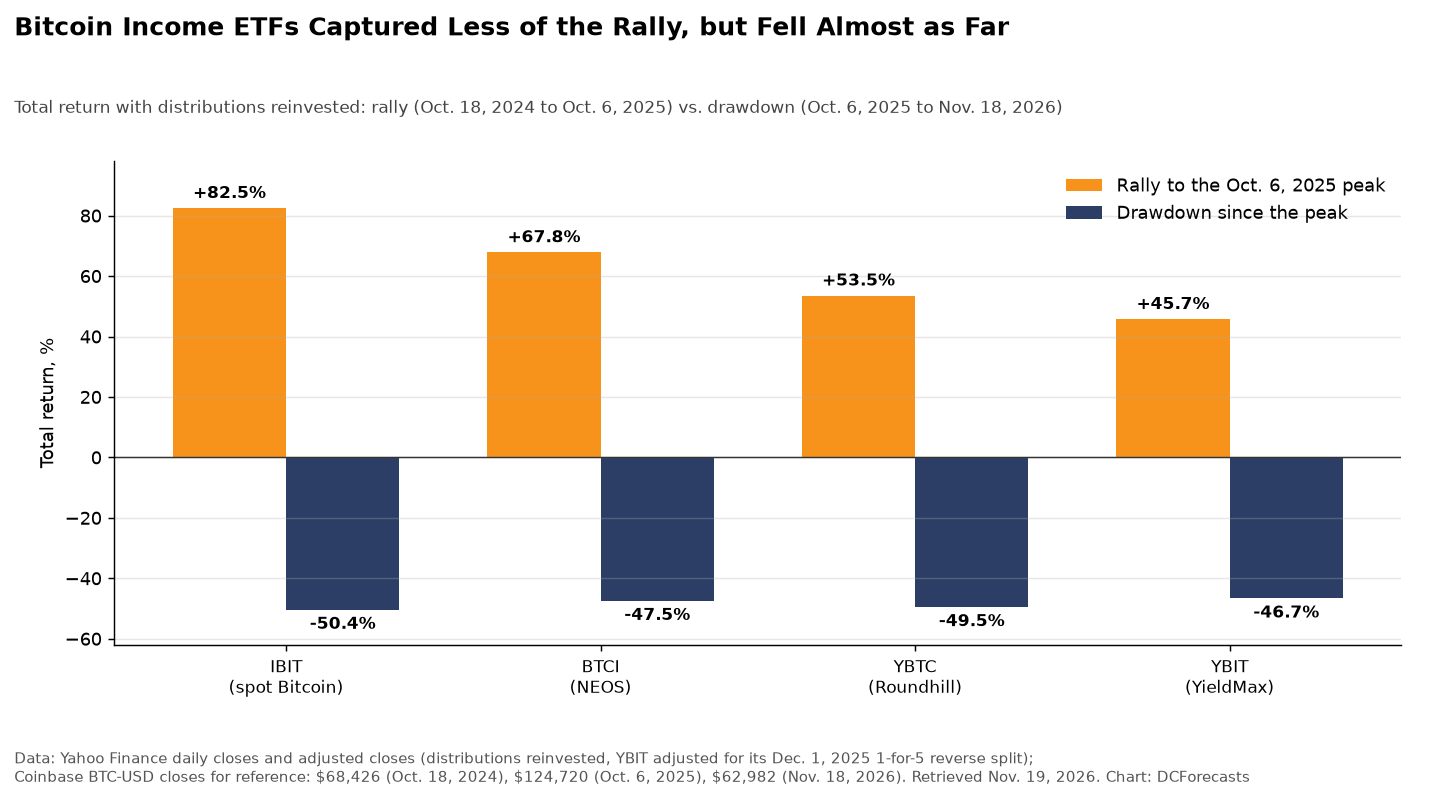
From Oct. 18, 2024, BTCI’s first full trading day, to the Oct. 6, 2025 peak, Bitcoin climbed from $68,426 to $124,720 on Coinbase. That was a gain of 82.3%.
IBIT tracked it closely, returning 82.5%. The income funds, even with every distribution reinvested, lagged well behind:

- BTCI returned 67.8%, about 15 points less than IBIT.
- YBTC returned 53.5%, about 29 points less.
- YBIT returned 45.7%, nearly 37 points less.
On price alone, the gap was starker. YBTC’s share price was roughly flat over the period, and YBIT’s fell 23.2%, even as Bitcoin nearly doubled. Investors who spent their payouts instead of reinvesting them missed most of the bull run.
The Downturn Offered Little Protection
The usual argument for covered-call products is that the income cushions a decline. The past 13 months put that idea to a hard test.
Bitcoin closed at $62,982 on Nov. 18, 2026, down 49.5% from its peak. IBIT’s total return over that stretch was -50.4%.
The income funds did only marginally better. YBIT lost 46.7%, BTCI 47.5% and YBTC 49.5%, a cushion of roughly one to four percentage points.
Put the two halves together and the trade-off looks lopsided. Investors gave up between 15 and 37 points of upside in exchange for a few points of downside relief.
Bitcoin Income ETF Payouts Shrink as Prices Fall
Another detail often missed is that the payouts are not fixed. They tend to move with the value of the fund.
BTCI paid $1.043 per share on Jan. 21, 2026. Its Nov. 18 distribution was $0.548, nearly half as much. YBTC’s weekly payouts fell as low as $0.068 in late August, after a $1.385 payment on Dec. 31, 2025.
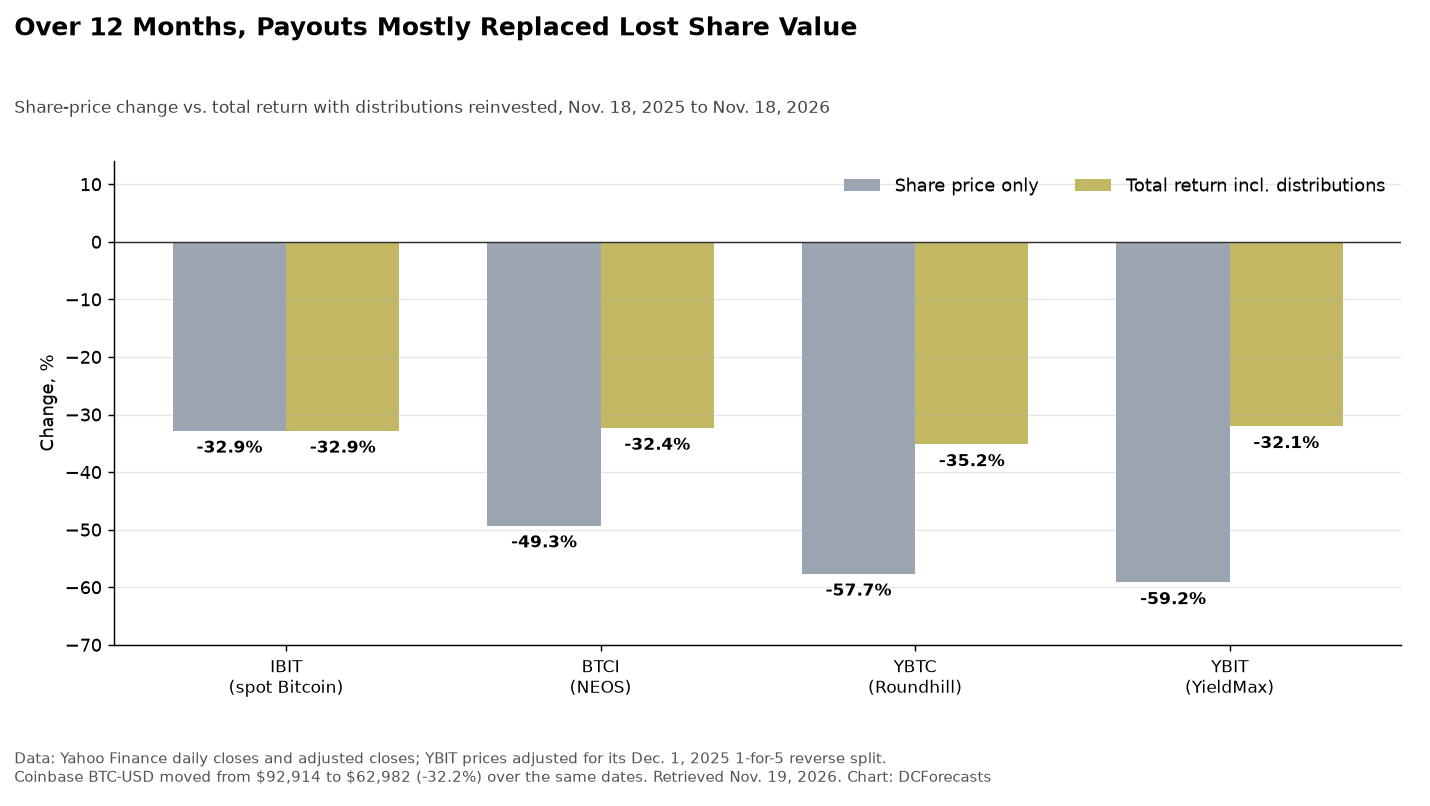
Over the past 12 months, BTCI distributed $10.08 per share, YBTC $9.85 and YBIT $12.56. Those totals equal 20.8%, 29.7% and 33.5% of each fund’s price a year earlier.
The share prices, however, fell further. BTCI dropped 49.3%, YBTC 57.7% and YBIT 59.2%, compared with 32.9% for IBIT.
After reinvesting every payout, all four funds ended within about three points of each other. BTCI returned -32.4%, YBIT -32.1%, YBTC -35.2% and IBIT -32.9%. Bitcoin itself fell 32.2% on Coinbase over the same dates.
Why Holding Bitcoin Still Looks Stronger
In other words, the high payouts largely handed investors back value that the share price lost. Over a full year, they produced no clear edge over owning Bitcoin outright through a spot fund.
Spending the distributions instead of reinvesting them would have left holders with a far smaller position by now. YBIT also carried out a 1-for-5 reverse split in December 2025, a sign of how far its share price had fallen.
We believe that is the key lesson. Bitcoin’s long-term appeal comes from its upside in strong markets, and that is exactly what option-income funds trade away.
Bitcoin is about half its peak today, but its past cycles have been driven by sharp, fast rallies. A fund that caps those rallies is built for a different investor than one looking to own Bitcoin’s full potential.
Product choice matters in other ways, too. Earlier this week, DCForecasts reported that ARK shelved eight Bitcoin buffer ETF filings, another type of fund that limits gains in exchange for protection.
What Investors Should Weigh
Income funds can still suit some investors. Those who want regular cash flow and expect sideways prices may value the steady payouts.
But the data shows the costs. In a rally, the gap grows wide. In a sell-off, the cushion stays thin. Over a full year, the payouts mostly came out of the investment itself.
Meanwhile, plain spot exposure remains the core of the market. Even after $2.89 billion in November outflows, U.S. spot Bitcoin ETFs hold most of the money that has entered them since 2024.
For investors who believe in Bitcoin’s next leg higher, the evidence points in one direction. Owning the asset keeps the full upside in their own hands.
DC Forecasts is a leader in many crypto news categories, striving for the highest journalistic standards and abiding by a strict set of editorial policies. If you are interested to offer your expertise or contribute to our news website, feel free to contact us at [email protected]












Discussion about this post