


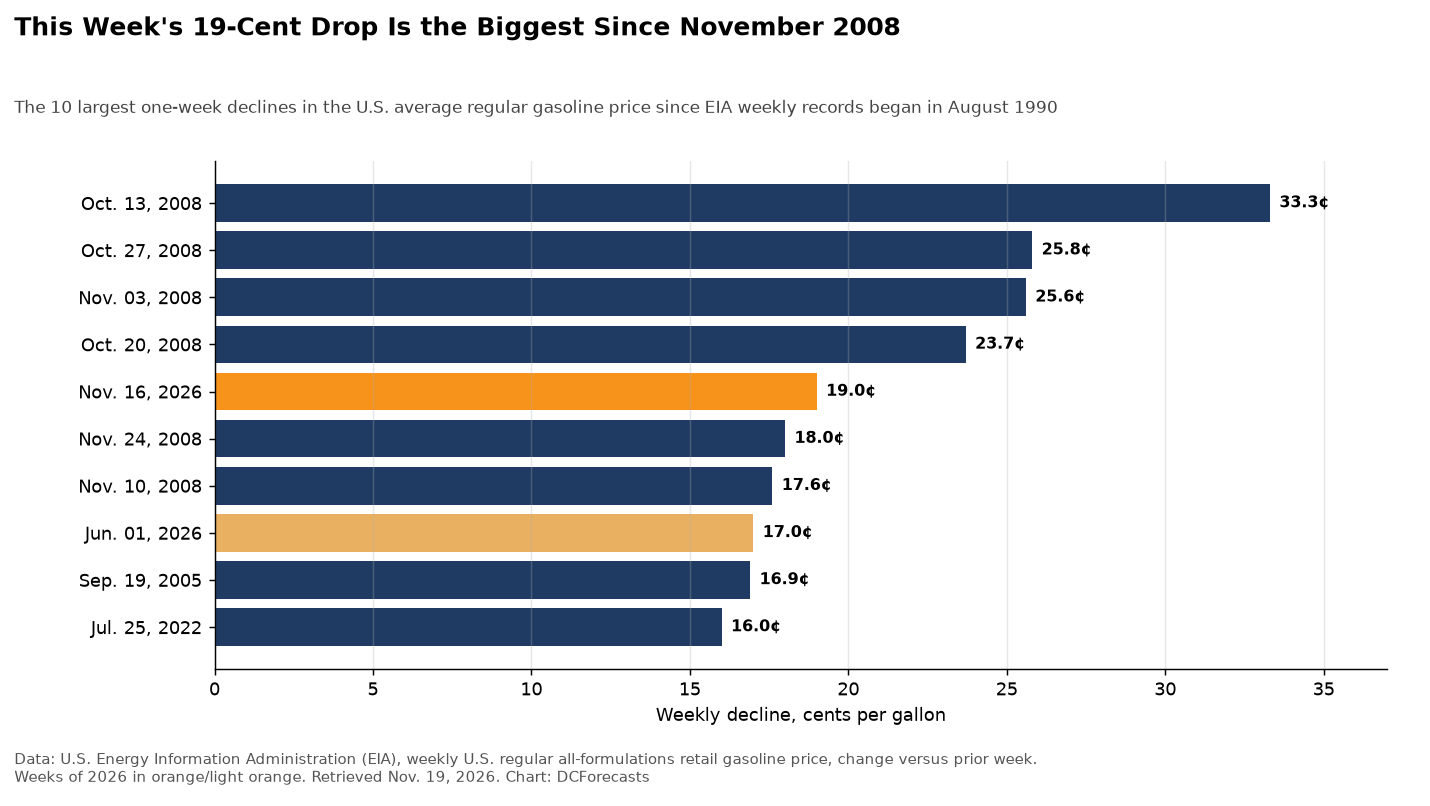
U.S. gasoline prices fell 19 cents a gallon in a single week, the sharpest weekly drop in 18 years. The decline lands just as Federal Reserve officials line up behind further interest rate hikes, and it chips away at one of the main inflation worries in their own meeting record.
The national average for regular gasoline was $3.805 in the week of Nov. 16, according to the U.S. Energy Information Administration. A week earlier it was $3.995, and two weeks earlier $4.153.
That is the eighth straight weekly decline. For Bitcoin investors watching the rate outlook, the timing is worth noting.
Gas Prices Post the Biggest Weekly Drop Since 2008
The 19.0-cent fall is the fifth-largest one-week decline since the EIA’s weekly series began in August 1990. Only four weeks in October and November 2008, during the global financial crisis, saw bigger drops. The largest was 33.3 cents in the week of Oct. 13, 2008.
The two-week slide of 34.8 cents is also the steepest since 2008. Pump prices have dropped 15.0% from $4.478 on Sept. 21 and 15.4% from this year’s high of $4.500, set on May 11.
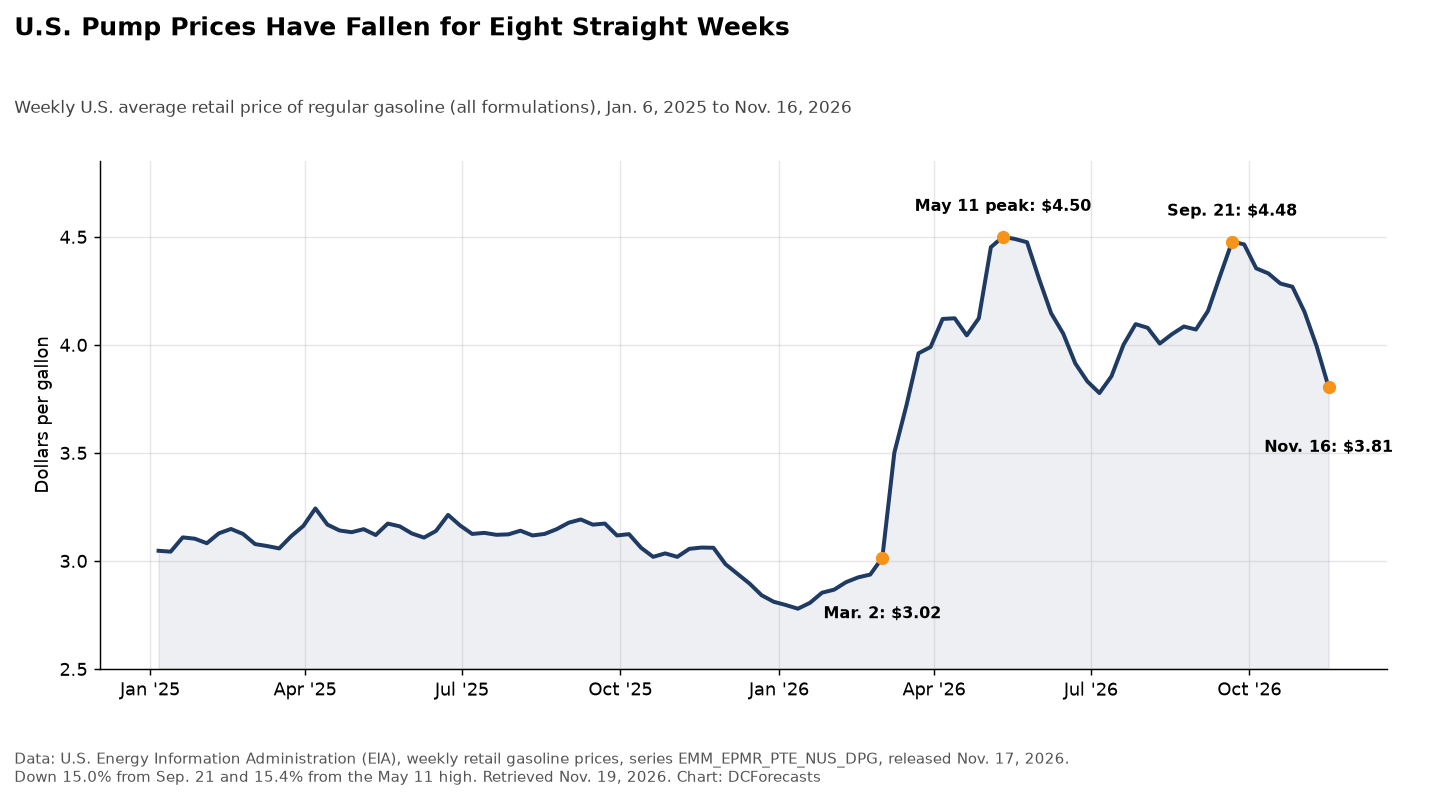
Prices are still far above where they started the year. The national average was $3.015 in the week of March 2, before the Middle East conflict sent energy costs soaring, and $3.062 in the same week last year. The current price is 24.3% higher than a year ago.
But the direction has clearly turned. The three November readings average $3.984, which is 7.6% below the October average of $4.310.
What the Fed Minutes Say About Energy
The timing matters because energy was a central concern in the minutes of the Fed’s Oct. 27–28 meeting, released on Nov. 18. According to the minutes, the vast majority of participants noted that “high energy prices continued to contribute to current inflation pressures.”
The vast majority also saw upside risks to the inflation outlook, “citing higher energy prices and continued supply constraints with regard to refined fuel products.” Gasoline is a refined fuel product, and its retail price has now fallen for two months.

The same record shows how hawkish the committee has become. Almost all participants judged that further action to raise the federal funds rate “would likely be appropriate.” A couple said a move of more than 25 basis points could be considered at the next meeting if incoming inflation data were unfavorable, as DCForecasts reported in its coverage of the minutes.
The minutes also point to relief ahead. Fed staff expected total inflation “to step down sharply next year as energy prices decelerated.” Most participants expected inflation to fall toward 2% over time, citing in part “a reduction in energy prices’ contribution to inflation.”
Why the CPI Data Lags the Pump
The data the Fed has in hand still reflects higher fuel costs. In the October consumer price index, the seasonally adjusted gasoline index rose 1.0% from September, according to the Bureau of Labor Statistics. DCForecasts covered the October inflation report when it was released.
The November CPI report, due next month, will be the first to capture most of the recent slide. EIA weekly prices are not the same as the CPI gasoline index, which is seasonally adjusted and collected differently. Still, a 7.6% drop in the average pump price from October to November points to a clear downward pull on headline inflation.
That is the gap many market watchers are focused on. Official inflation reports look backward, while pump prices move week by week. If the slide continues, the Fed’s next set of inflation numbers could look quite different from the ones behind its hawkish tone.
What Cheaper Fuel Could Mean for Bitcoin
Bitcoin has felt the pressure of the rate outlook. It closed at $62,981.71 on Coinbase on Nov. 18, as higher rate expectations weighed on risk assets across markets.
Easing energy inflation does not guarantee the Fed will change course, and officials have stressed that decisions depend on incoming data. But cooling inflation is exactly the kind of data that can soften a hawkish stance over time.
History is also encouraging for patient holders. DCForecasts found that Bitcoin was higher a year later after 16 of the last 20 Fed rate hikes, suggesting tightening cycles have rarely stopped its long-term climb.
Lower fuel costs also help households directly. The minutes noted that higher prices of necessities were straining lower- and middle-income budgets. Cheaper gasoline frees up cash, and some of that money can find its way into savings and investments.
What to Watch Next
The EIA’s next weekly reading, covering Nov. 23, arrives ahead of Thanksgiving travel. Another decline would extend the streak to nine weeks.
After that, attention shifts to the November CPI report and the Fed’s December meeting. Markets will be watching whether officials start to acknowledge the energy relief that their own minutes anticipated, or keep the focus on earlier inflation readings.
For now, the pump is delivering a message that the inflation reports have not yet caught up with. Prices are falling, and fast.
DC Forecasts is a leader in many crypto news categories, striving for the highest journalistic standards and abiding by a strict set of editorial policies. If you are interested to offer your expertise or contribute to our news website, feel free to contact us at [email protected]









Discussion about this post