



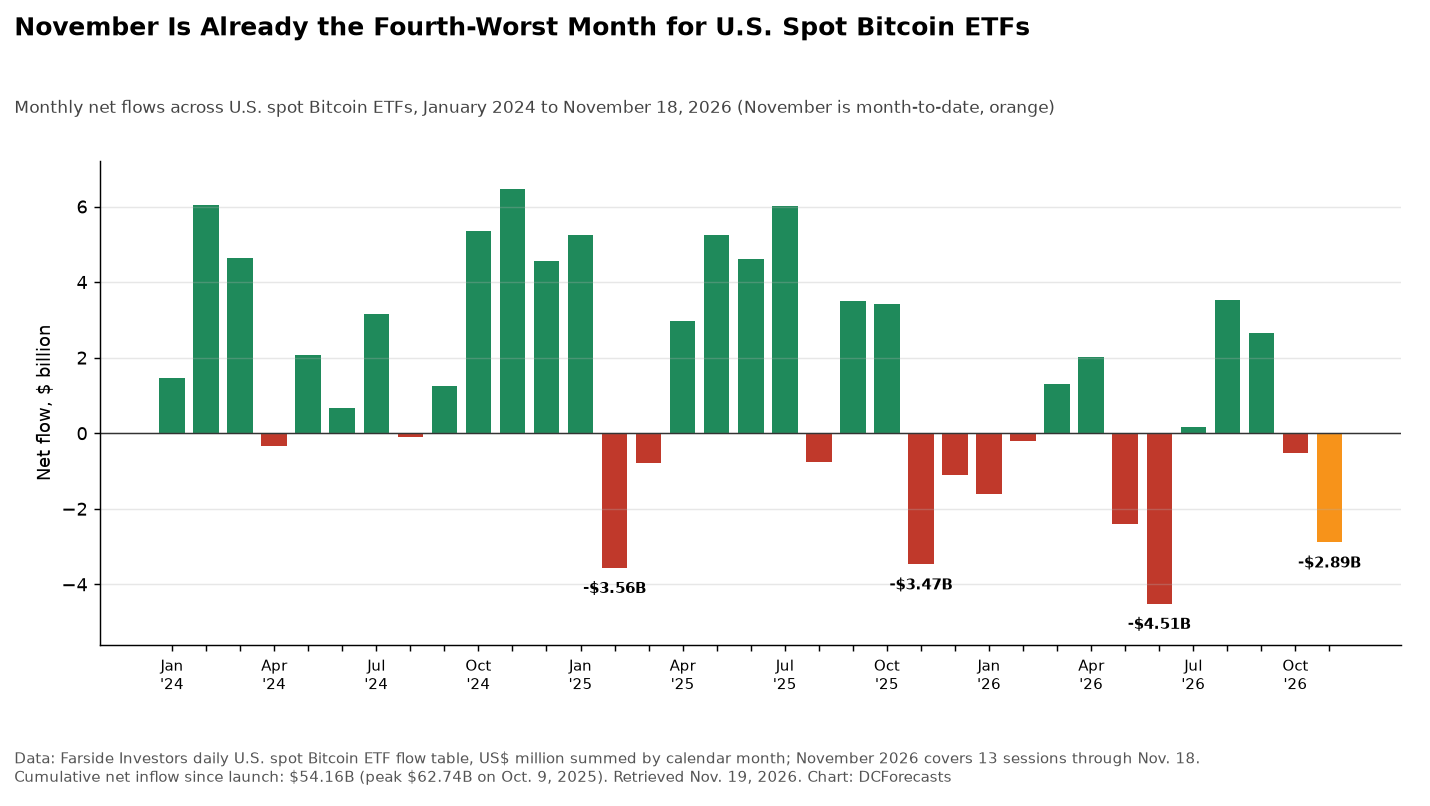
U.S. spot Bitcoin ETFs have now shed $2.89 billion in November, with seven trading sessions still left in the month. That is already the fourth-largest monthly outflow since the funds launched in January 2024.
Wednesday added another $306.5 million to the tally. Of the 12 funds in the Farside Investors flow table, seven posted redemptions and five recorded no flows at all. Not one took in fresh money.
The month-to-date figures also reveal a lopsided picture. One fund is doing most of the selling, while the newest and cheapest product is the only one still growing.
Bitcoin ETF Outflows Rank Fourth Since Launch
Through Nov. 18, November’s net outflow of $2,885.5 million trails only three months on record. June 2026 lost $4.51 billion, February 2025 lost $3.56 billion and November 2025 lost $3.47 billion. May 2026, at $2.41 billion, has now dropped to fifth.
The selling has been steady rather than sudden. Eleven of November’s 13 sessions ended with net outflows. The only positive days were Nov. 4, at $74.6 million, and Nov. 16, at $7.9 million, the day that ended a seven-session outflow streak.
The price has moved with the flows. Bitcoin closed at $62,981.71 on Coinbase on Nov. 18, down 18.7% from its Oct. 31 close of $77,423.98.
BlackRock’s IBIT Carries 83% of the Selling
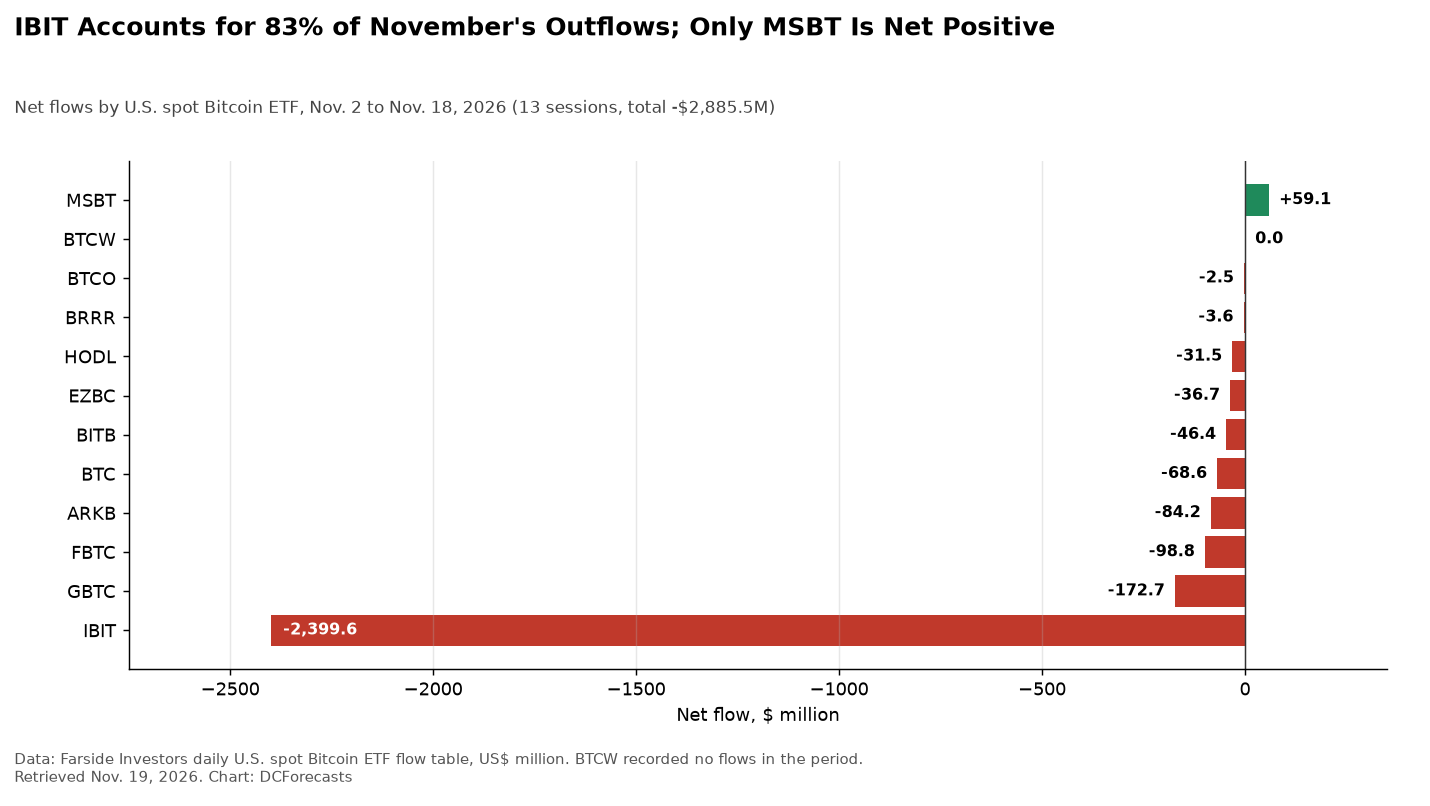
The breakdown by fund shows how concentrated the redemptions are. BlackRock’s iShares Bitcoin Trust (IBIT) has lost $2,399.6 million this month, or 83% of the group total. It posted outflows in 12 of 13 sessions, with the largest on Nov. 2 ($405.3 million) and Nov. 6 ($403.0 million).
As the largest Bitcoin ETF, IBIT is the natural place for big holders to trim. Earlier this week, DCForecasts noted that the fund still keeps the vast majority of its record net inflows despite its longest redemption run.
The rest of the field has seen far smaller moves. Grayscale’s GBTC lost $172.7 million, Fidelity’s FBTC $98.8 million and ARK’s ARKB $84.2 million. Grayscale’s lower-cost Bitcoin Mini Trust (BTC) gave back $68.6 million, and Bitwise’s BITB $46.4 million.

Franklin’s EZBC lost $36.7 million and VanEck’s HODL $31.5 million. Invesco’s BTCO and Valkyrie’s BRRR each moved by less than $4 million, and WisdomTree’s BTCW recorded no flows at all.
Morgan Stanley’s MSBT Is the Lone Gainer
Against that backdrop, one product is still taking in money. Morgan Stanley Bitcoin Trust (MSBT) has collected a net $59.1 million in November, the only positive total among U.S. spot Bitcoin funds.
MSBT logged inflows on six days this month, including $22.1 million on Nov. 9 and $20.0 million on Nov. 10. Its only outflow was $1.5 million on Nov. 16.
The fund launched on April 7, 2026, and its 0.14% sponsor fee was the lowest of any Bitcoin ETP at the time, according to Morgan Stanley Investment Management. Its regulatory filings already showed the trust doubled its Bitcoin holdings in the third quarter without a single redemption.
Morgan Stanley offers the trust through its wealth management network, which may help explain why its demand has held up while larger rivals shrink.
What Followed the Three Worse Months
History offers some perspective, although three cases are too few for firm rules.
After February 2025, the funds lost another $801 million in March, then took in $2.97 billion in April and $5.25 billion in May. Bitcoin’s Coinbase close was 25.2% higher 90 days after the end of February.
After June 2026, the worst month on record, July brought a small $173 million inflow, followed by $3.54 billion in August and $2.65 billion in September. Bitcoin was 42.6% higher 90 days later, as heavy selling near the lows gave way to renewed buying.
November 2025 was the exception. Outflows continued through December, January and February, and Bitcoin was 25.8% lower 90 days later.
So two of the three record outflow months were followed by a rebound in both flows and price within a quarter. That does not guarantee the same this time. It does show that large redemption months have often marked periods of capitulation rather than the start of a lasting exodus.
The Bigger Picture for Spot Bitcoin ETFs
Even after this month’s selling, the funds have taken in $54.16 billion in net inflows since launch. That is 86.3% of the cumulative peak of $62.74 billion reached on Oct. 9, 2025, meaning most of the capital that entered over nearly three years has stayed put.
Inflows have also been the norm rather than the exception. Of the 35 calendar months since January 2024, including November so far, 22 ended with net inflows.
The sharp drawdown has come with relatively calm trading, too. DCForecasts found that Bitcoin’s recent 20% monthly fall unfolded at about half the volatility of past sell-offs, which points to orderly selling rather than panic.
What to Watch for the Rest of November
November still has seven sessions, including a holiday-shortened week. U.S. markets close on Thanksgiving, Nov. 26, and trade a half day on Nov. 27. Thin holiday volume could slow the pace of redemptions in either direction.
To move past June’s $4.51 billion record, the funds would need to lose another $1.62 billion before the month ends. That would require an average of more than $230 million in daily outflows, close to the month’s pace so far.
IBIT remains the swing factor, given its share of the selling, while MSBT’s run shows whether new money keeps arriving.
For long-term holders, the takeaway is simple. Despite a sharp month, most of the money that came into Bitcoin through ETFs is still invested, and fresh demand is still arriving through the cheapest door on Wall Street.
DC Forecasts is a leader in many crypto news categories, striving for the highest journalistic standards and abiding by a strict set of editorial policies. If you are interested to offer your expertise or contribute to our news website, feel free to contact us at [email protected]












Discussion about this post