



Britain’s main crypto trade body has told the Financial Conduct Authority that its draft DeFi regulation guidance reaches further than the law, and could pull open-source developers into a licensing regime built for financial firms.
CryptoUK, which says it represents more than 150 companies, filed its response on Nov. 18, the day the FCA’s consultation closed, and published it on Nov. 19.
The 12-page letter broadly backs the regulator’s plan. Its sharpest objection is narrow but important: writing code is not the same as running a financial service.
The question now is whether the FCA writes that distinction into the final rulebook it plans to publish in January 2027.
What the FCA Is Consulting On
The consultation, CP26/36, proposes changes to the FCA’s Perimeter Guidance Manual. That guidance tells firms whether their activities fall inside the UK’s new crypto regime and therefore need authorisation.
The regime itself comes from the Financial Services and Markets Act 2000 (Cryptoassets) Regulations 2026 and takes effect on Oct. 25, 2027.
A second set of amendments laid by the government in September added new exclusions. They cover temporary settlement, backing assets for UK qualifying stablecoins, proprietary trading and market making, and technical services that only give users access to a third party or a decentralised protocol.
The FCA has admitted the late timing created uncertainty. It says it will give extra time to firms whose applications were held up by questions over the technical services exclusion.
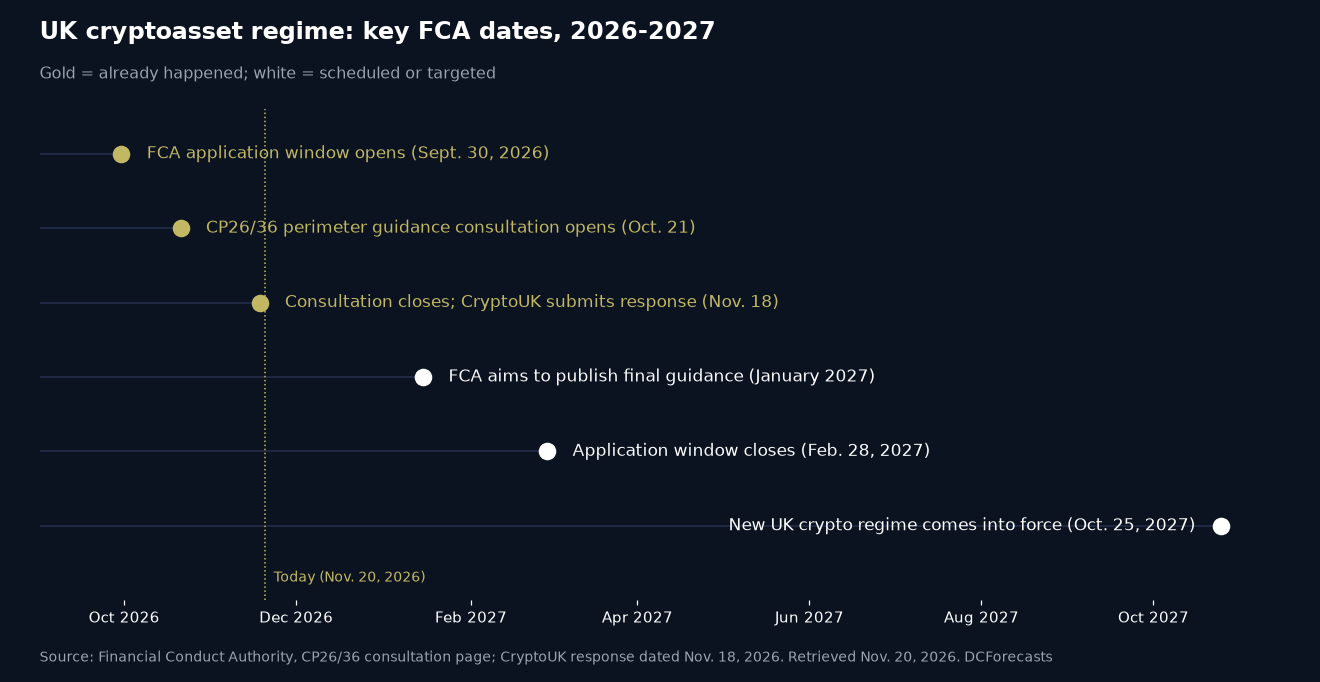
The FCA says firms already doing UK crypto business must apply inside that window to benefit from its savings provision, a process we explained in our look at the FCA’s crypto authorisation gateway.

Why CryptoUK Says DeFi Regulation Should Target Control
The core dispute sits in draft paragraph PERG 18.1.17. It refers to people who “determine or materially influence” the design or parameters of automated arrangements, or who develop, maintain or govern them.
CryptoUK warns that, read alone, this “could catch open-source developers, upgrade contributors or governance token holders.”
It points back to the FCA’s own policy statement PS26/11, in which the regulator said it would apply its rules to DeFi only where there is a clear controlling person.
“Software development, maintenance, security work and participation in decentralised governance should not, by themselves, establish that a person carries on a regulated activity,” the group wrote.
The letter lists activities it wants confirmed as unlikely, on their own, to count as running a regulated crypto business:
- holding or voting governance tokens;
- receiving grants or bounties for code, audits or security reviews;
- operating a node or validator in the ordinary course of blockchain validation;
- using a protocol as an end user or on one’s own account.
It also welcomed a draft line, PERG 18.1.20, that accepts some DeFi arrangements may involve no person carrying on a regulated activity at all.
A UK Link Based on Where Code Is Written
The second objection concerns geography. Draft PERG 18.3.1A says UK involvement in governing, maintaining or developing a decentralised arrangement “may be sufficient to establish a territorial link with the UK.”
CryptoUK says that goes beyond the legislation. The real test, it argues, is whether the regulated activity itself is carried on in the UK.
It warned that a broad reading “could deter UK developers from open-source and decentralised projects without any consumer protection benefit.” It asked that development or technical maintenance alone be described as unlikely to be enough.
Under the draft, a UK provider giving clients access to a regulated overseas venue cannot use the technical services exclusion, while an equivalent overseas provider may sit outside the perimeter entirely. It asked the FCA to raise such gaps with HM Treasury and to align with the EU’s MiCA rules where appropriate.
Stablecoins and Wallet Software
Several requests are practical. CryptoUK wants a public, machine-readable record of every UK qualifying stablecoin, listed by Digital Token Identifier, contract address and network, because several exclusions depend on that status and intermediaries cannot easily check it.
It also asked for positive examples of activity that usually falls outside the regime, such as wallet software sending a user-signed transaction to a protocol the user selects.
The response was prepared with law firm CMS and signed by CryptoUK policy director Nick Brooks.
What Clear DeFi Rules Could Mean for Builders and Bitcoin
The stakes are visible in the data. Total value locked in DeFi protocols stood at about $69.3 billion on Nov. 20, according to DefiLlama, down from $115.8 billion a year earlier and well below the $167.0 billion peak of Oct. 7, 2025.
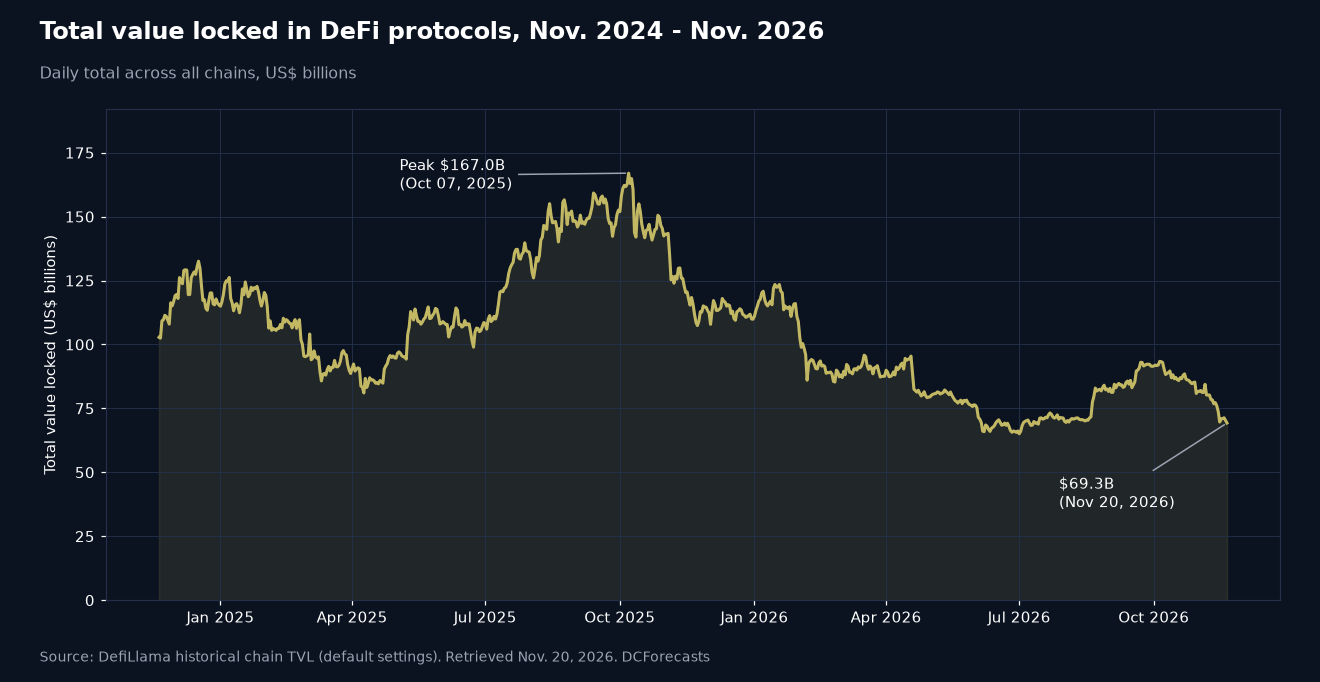
That decline mostly reflects lower token prices across crypto. It also means the sector is rebuilding, and where its developers choose to work will matter for its next phase.
For Bitcoin, the most relevant parts of the letter are its points on node operators and wallet software. Bitcoin is not a DeFi protocol, but it depends on volunteers who run nodes, publish open-source code and build self-custody wallets.
We believe a rule that targets real control, not code or node operation, is the right standard. It protects consumers where a business actually holds the keys, while leaving the infrastructure that Bitcoin users rely on free to grow.
Europe is working through similar questions, as our report on France’s MiCA wish list showed.
The FCA’s January guidance will show whether London lands on the same line. If it does, the UK could make a stronger case for developers who build open systems and the Bitcoin infrastructure around them.
DC Forecasts is a leader in many crypto news categories, striving for the highest journalistic standards and abiding by a strict set of editorial policies. If you are interested to offer your expertise or contribute to our news website, feel free to contact us at [email protected]











Discussion about this post