


The Securities and Exchange Commission has charged eight Colorado-registered entities with running fake investment advisers and fake crypto exchanges that took more than $37 million from U.S. investors.
The SEC announced the case on Nov. 19, saying the firms were likely operated by individuals overseas. According to the complaint, more than 1,500 people sent money between August 2024 and May 2026.
The case stands out for its structure. Rather than one long-running scam, the operators ran four near-identical adviser and exchange pairs, one after another. Each lasted about six months before it vanished and the next one opened.
Four Pairs, One Playbook
The complaint, filed in federal court in Colorado, names four fake advisers and the fake trading platform each one steered clients toward:
- Advisor WeChat Capital with Tech Brokerage Asset Alliance (TBAA), from about August to December 2024.
- HB Wealth Advisors with IdeaCrypto Exchange, from about January to July 2025.
- Convergent Wealth Advisors with RealSimple Crypto Exchange, from about July to December 2025.
- Associated Wealth Advisors with Essential Crypto Exchange, from about January to May 2026.
The SEC says the pairs shared more than timing. They reused contact details to register websites, and HB Wealth even left WeChat’s name on one of its own web pages.
Each pair also ran the same contest, inviting investors to vote daily for one of two fake human advisers. The winner was supposedly chosen to manage a $10 billion fund.
How the Money Moved
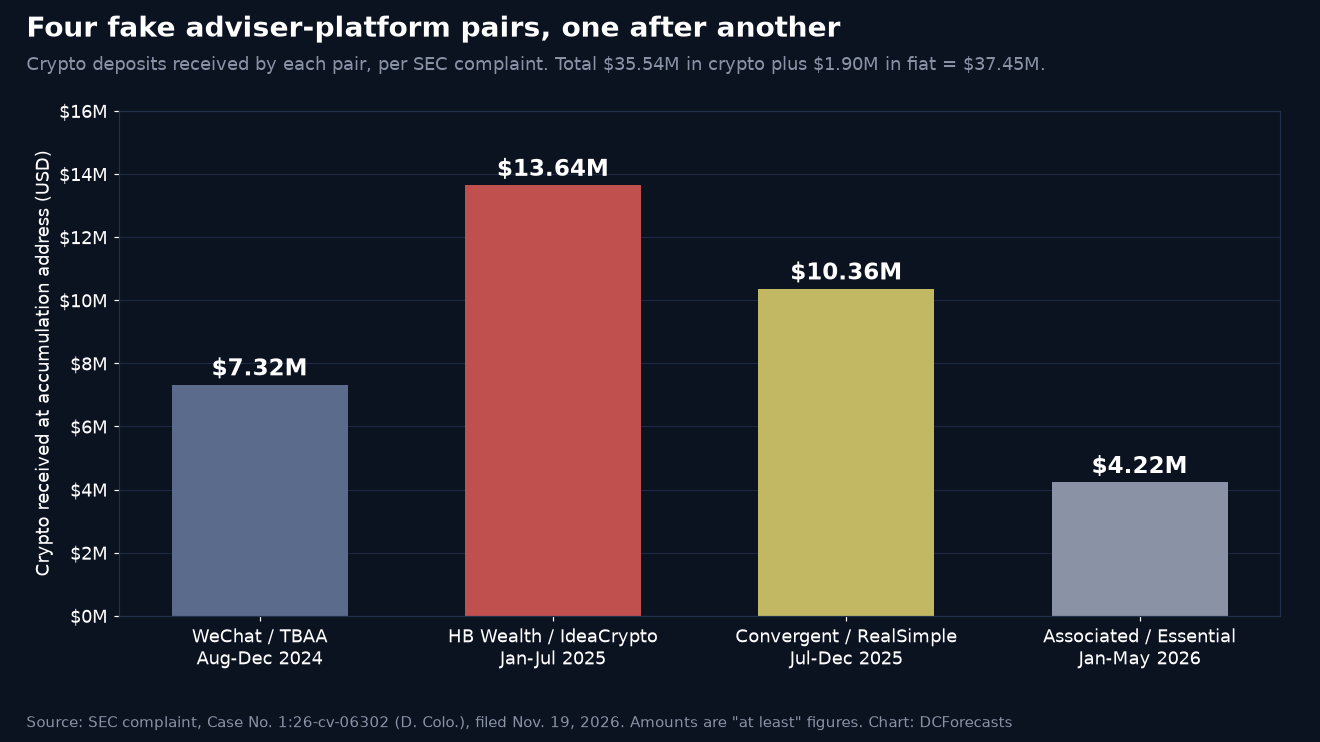
According to the complaint, investors sent about $35.54 million in crypto and another $1.90 million in fiat, for a total of $37,445,800.
The HB Wealth and IdeaCrypto pair took in the most, at least $13.64 million. RealSimple’s address received at least $10.36 million, TBAA’s at least $7.32 million and Essential Crypto’s at least $4.22 million.
The path was the same each time. Victims were told to deposit dollars at a well-known U.S. crypto platform, convert them to ether, tether or USD Coin, and move the coins to a wallet they controlled. They were then instructed to send the funds to an address supplied by the fake adviser.

That last step was the theft. Every pair collected funds at one of four accumulation addresses on Ethereum, which the SEC lists in the complaint. From there, the money left investors’ reach.
The detail matters. The crypto that victims first bought on a legitimate, regulated platform was real. The losses came when they handed it to a platform that existed only to take it.
Stock Tips First, Then a Fake “IEO”
The scheme started far from crypto. Social media ads featured supposed market experts and sent prospects to WhatsApp group chats.
In the chats, the fake advisers first gave stock trading advice to build trust. Then they pushed clients to sell stocks and buy tokens on the paired platform, often pitched as an Initial Exchange Offering.
One Associated Wealth representative told an investor that IEOs offer “lower entry barriers, higher growth potential,” while IPOs were “less accessible, smaller profits for retail investors,” the complaint says. The tokens turned out to be fake, and so did the account gains investors saw on screen.
Fake Certificates and Real Filings
To look legitimate, the operators leaned on regulators’ names. Some investors received a made-up SEC “certificate.” Others were pointed to real filings.
TBAA filed a Form D with the SEC in July 2024, which WeChat representatives falsely described as proof that the platform was “registered.” Several platforms also registered with the Treasury’s Financial Crimes Enforcement Network as money services businesses, and Convergent Wealth and Essential Crypto filed Forms ADV claiming to be exempt reporting advisers.
The SEC says it has removed TBAA’s Form D and the Forms ADV filed by Convergent Wealth and Essential Crypto from its website. A filing on its own does not mean the SEC has approved or vetted a firm.
What the SEC Is Seeking
All eight entities are charged with violating Section 10(b) of the Securities Exchange Act and Rule 10b-5. The four adviser entities face added charges under the Investment Advisers Act, and Convergent Wealth and Essential Crypto are charged with filing false reports.
The agency is seeking permanent injunctions, disgorgement with interest and civil penalties. It credited help from regulators in Hong Kong, Singapore, China and Switzerland.
“The SEC continues to seek out and expose fraudulent investment scams that prey on U.S. investors,” said Laura D’Allaird, chief of the SEC Enforcement Division’s Cyber and Emerging Technologies Unit.
The case follows Treasury’s sanctions on scam compound bosses earlier this week, part of a wider U.S. push against investment fraud that uses crypto as its payment rail.
How Investors Can Protect Themselves
The warning signs in this case are familiar ones. Unsolicited investment advice in a group chat, pressure to move funds off a known exchange and promises of outsized returns are all red flags.
The SEC encourages investors to check anyone offering investments on Investor.gov. Keeping coins on established, regulated platforms or in a wallet you control, and never sending them to an address supplied in a chat, would have stopped this scheme at its final step.
DC Forecasts is a leader in many crypto news categories, striving for the highest journalistic standards and abiding by a strict set of editorial policies. If you are interested to offer your expertise or contribute to our news website, feel free to contact us at [email protected]












Discussion about this post