



Hong Kong crypto regulation is about to reach well beyond the city’s exchanges.
The government published the Virtual Asset Services Legislation (Amendment) Bill 2026 in the Gazette on Nov. 20. It would require anyone running a crypto dealing, advisory, management or custody business in Hong Kong to be licensed by, or registered with, the Securities and Futures Commission (SFC).
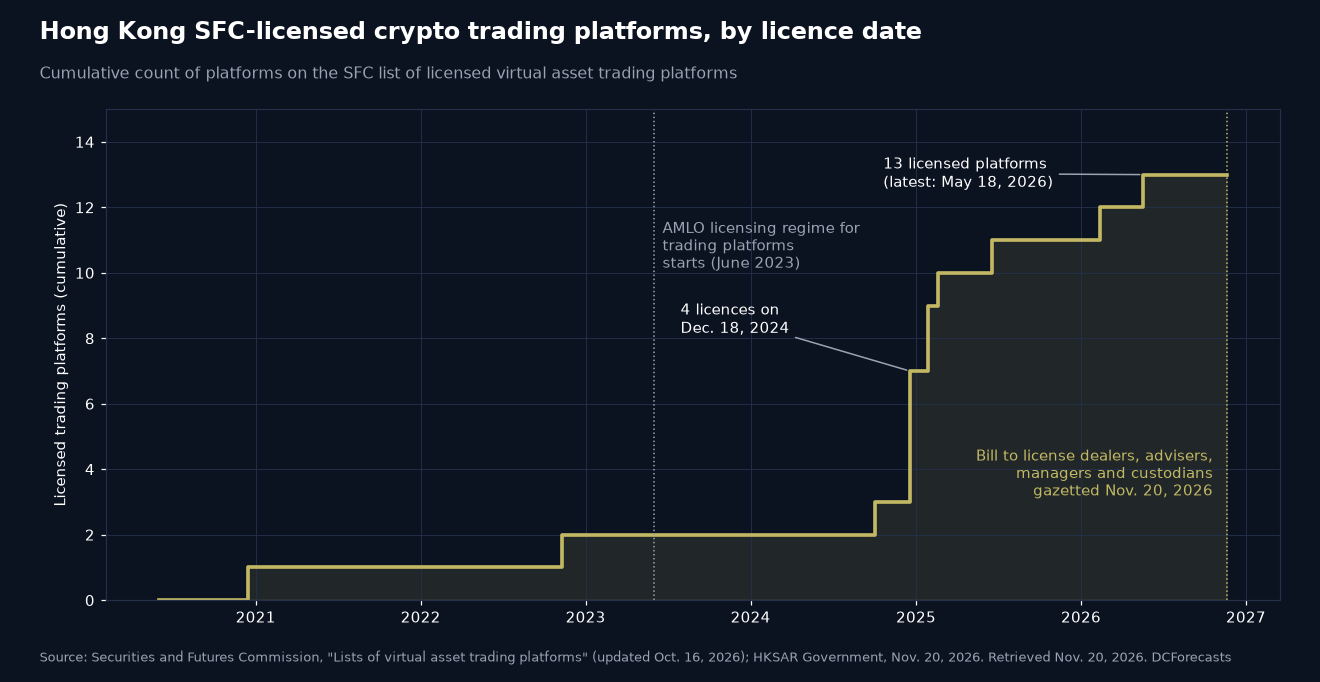
Until now, the only crypto businesses the SFC licenses under that framework are trading platforms. Its public list names just 13 of them.
For Bitcoin investors, the change touches the brokers, advisers, fund managers and custodians that sit between them and the market.
The bigger question is how quickly Hong Kong can turn a bill into working licences without pushing firms out along the way.
What the Bill Would Change
The bill amends the Anti-Money Laundering and Counter-Terrorist Financing Ordinance, the law that has governed licensed crypto trading platforms since June 2023.
It adds four new types of regulated service: dealing, advisory, management and custody. Firms offering any of them would face a fit-and-proper test and other SFC requirements.
Banks and stored value facility licensees regulated by the Hong Kong Monetary Authority (HKMA) would also need to register with the SFC to offer crypto services.
The bill will go to the Legislative Council for its first reading on Dec. 2.

Secretary for Financial Services and the Treasury Christopher Hui tied it to the “same activity, same risks, same regulation” principle.
SFC chief executive Julia Leung called it “an important milestone in completing Hong Kong’s regulatory framework for virtual assets.”
Why Hong Kong Crypto Regulation Has Centred on Exchanges
The SFC’s list of licensed virtual asset trading platforms shows how slowly the first regime filled up.
OSL was licensed in December 2020 and HashKey Exchange in November 2022. Most of the rest came in a burst from late 2024, including four licences granted on Dec. 18, 2024. The two newest went to VDX in February 2026 and Bixin.com on May 18, 2026.
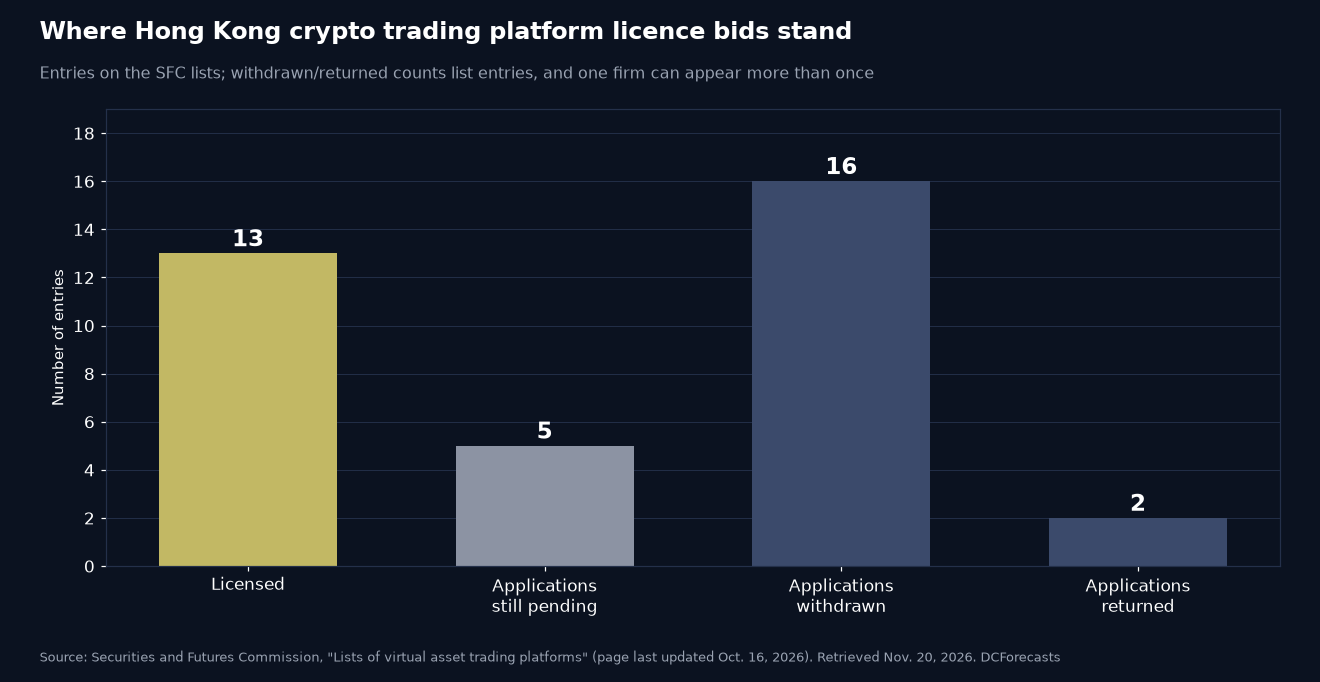
The same page shows how demanding the process has been. Five applicants are still pending, including two deemed to be licensed while they are assessed, one of which has stopped running its platform.
Another 18 entries were taken off the applicant list: 16 because the application was withdrawn and two because the SFC returned it. Several large global exchanges, including OKX and Gate, withdrew in May 2024.
The most recent removal was Matrixport HK, withdrawn on Oct. 12, 2026. The SFC lists it as closing down by Jan. 12, 2027.
What the Consultations Proposed
The bill follows two rounds of public consultation run by the Financial Services and the Treasury Bureau (FSTB) and the SFC.
The first, which closed in August 2025, drew 101 submissions on dealing and 93 on custody. When the conclusions were published on Dec. 24, 2025, officials said most respondents “expressed clear support” for widening the regime.
Under those conclusions, crypto dealing rules would largely mirror Type 1 securities dealing, with minimum paid-up capital of HK$5 million and required liquid capital of up to HK$3 million, depending on the business model.
The custody conclusions set a baseline of HK$10 million in paid-up capital and HK$3 million in liquid capital. They focus on the core risk of safekeeping clients’ private keys in Hong Kong.
A follow-up consultation, which ended on Jan. 23, 2026, proposed separate regimes for advisory and management services, modelled on Types 4 and 9 under the Securities and Futures Ordinance.
Both conclusions also said there would be no deeming arrangement for existing dealers or custodians. Instead, the government and the SFC would weigh a commencement date that gives firms time to adjust. The bill’s final details and start date will only be clear once it moves through the Legislative Council.
What Licensed Custody and Dealing Mean for Bitcoin
We see this as a constructive step for Bitcoin’s place in Asia’s financial system.
Licensed dealers and custodians would give institutions a regulated route to buy and hold BTC through firms with known capital and conduct standards.
The custody rules are especially relevant. Bitcoin’s security model rests on one idea: whoever controls the private keys controls the coins. A regime built around how custodians protect those keys takes that seriously.
Investors who prefer to hold their own keys are not the target. The bill covers businesses that provide these services, not individuals managing their own wallets.
It also fits a wider pattern. The SFC has kept up pressure on unlicensed venues, as our report on its suspicious-platform alert for Hyperliquid showed, while Europe refines its own rulebook, as in France’s MiCA wish list.
What Comes After Dec. 2?
First reading is only the start. The bill still needs LegCo scrutiny, a commencement date and SFC rules for each new licence type.
The trading platform list suggests approvals could again come slowly. A strict system, though, gives investors more confidence in the firms that pass.
We believe Bitcoin benefits when the doors into it are clearly marked and well guarded. Its fixed 21 million supply does not change with any law, but who can safely offer access to it does.
If LegCo passes the bill, Hong Kong will have licensing for nearly every type of crypto intermediary, and Bitcoin will have one more regulated gateway into Asian capital.
DC Forecasts is a leader in many crypto news categories, striving for the highest journalistic standards and abiding by a strict set of editorial policies. If you are interested to offer your expertise or contribute to our news website, feel free to contact us at [email protected]












Discussion about this post