



Coinbase’s planned single-stock futures now have a margin rulebook, and one line in it looks further ahead than the rest.
In a filing published in the Federal Register on Friday, Nov. 20, Coinbase Derivatives set a 15.05% minimum customer margin for futures on individual stocks and ETFs, including perpetual contracts.
The same filing says the exchange intends to let brokers collect payment stablecoins as margin, as soon as U.S. rules allow it.
For crypto investors, that is the detail to watch. Dollar tokens would move from trading pairs on crypto venues to collateral backing positions in Wall Street’s biggest stocks.
The bigger question is how quickly regulators will open that door.
What Coinbase Derivatives Filed
The notice, SEC Release No. 34-106923 (File No. SR-COIN-2026-003), is posted on the Federal Register. Coinbase Derivatives filed it on Nov. 3, and it took effect on Nov. 4.
The exchange has been a CFTC-registered futures market for years. On Sept. 1, it also notice-registered with the SEC as a national securities exchange for security futures, which the SEC acknowledged on Sept. 8.
That second registration is what allows it to list cash-settled futures on single stocks and ETF shares. Its new margin rule, Rule 1215, sets how much collateral customers must post on those positions.
This is also a second attempt. Coinbase withdrew an earlier version, published in September, that would have exempted registered market makers and allowed lower margin on offsetting positions.

According to the new filing, both features require a different, slower type of SEC rule filing. The cleaner version now on file simply sets a higher floor than federal law demands.
Why 15.05% Margin Matters for Single-Stock Futures
Federal rules require at least 15% customer margin on security futures, a level the SEC and CFTC cut from 20% in a 2020 rule. Coinbase sets its floor slightly higher, at 15.05%, and adds that the higher of that figure or the federal minimum applies.
In practice, that caps leverage at about 6.64 times. A trader would need at least $1,505 of collateral to hold a $10,000 position.
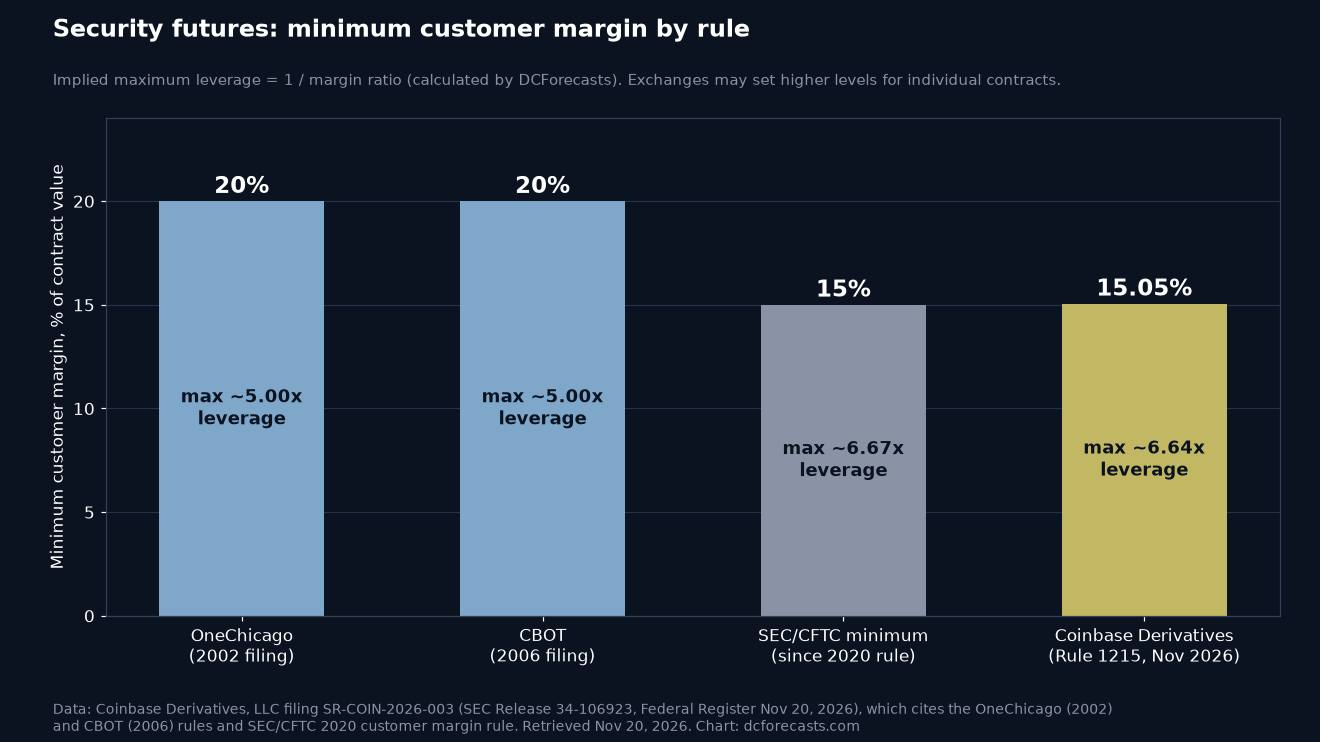
That is well below the up-to-20x leverage that Kalshi’s own filing cited for offshore stock perpetuals, and close to the 15.50% floor we found when we covered Kalshi’s 36 new stock perpetual futures.
The perpetual format also gets its own treatment. Funding payments, the periodic transfers that keep a perpetual’s price in line with the stock, count as daily variation settlement when account equity is calculated.
Coinbase Derivatives is not itself a clearing agency or clearinghouse. It says it will name a third-party clearing organization registered with the SEC or CFTC.
The Stablecoin Margin Clause
For now, acceptable margin is limited to the assets federal rules already list. Those include cash, margin-eligible securities, exempted securities and assets allowed under the Federal Reserve’s Regulation T.
Then comes the forward-looking sentence. If the SEC, the CFTC or the Federal Reserve amends those rules, or grants exemptive or interpretive relief, Coinbase Derivatives “intends to permit Participant Firms and Clearing Firms to collect payment stablecoins as margin.”
The earlier September version of the rule contained no stablecoin language. Coinbase also wrote in a catch-all for “any other assets permitted” by future SEC and CFTC rules.
We believe that matters. It puts a regulated U.S. exchange on record as ready to treat dollar tokens like cash collateral, once regulators sign off.
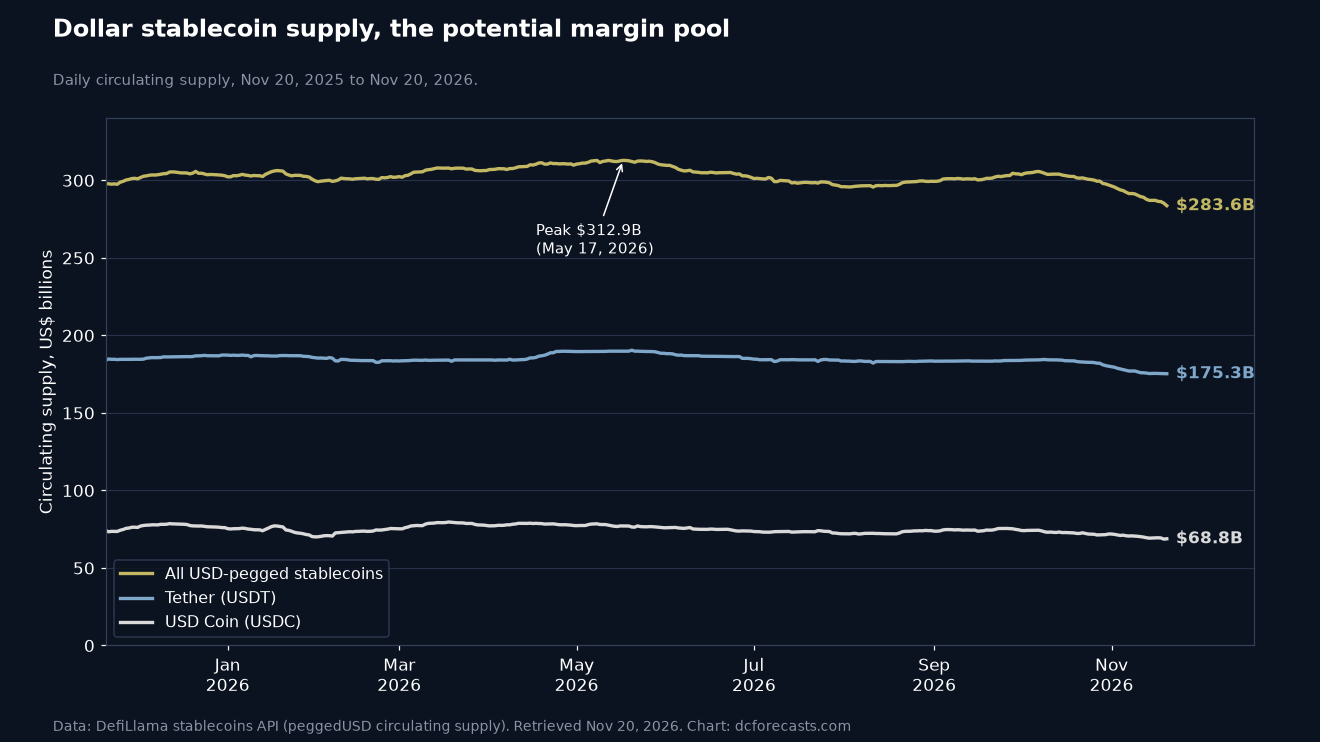
The potential pool is large, even after a soft patch. DefiLlama data puts dollar stablecoins at about $283.6 billion on Nov. 20, down 9.3% from a $312.9 billion peak on May 17 and 4.8% below a year earlier.
Tether’s USDT ($175.3 billion) and Circle’s USDC ($68.8 billion) make up about 86% of that total. Whether each token would qualify depends on how “payment stablecoin” is defined in any relief regulators grant.
Which Stocks Could Qualify for Coinbase’s Perpetuals?
Coinbase’s listing standards, published in September, are strict. An underlying stock needs a market value of at least $100 billion and average daily trading of at least $450 million over six months.
Newer listings can qualify with $1 billion of average daily trading over the prior month. The share count available for delivery must also exceed 20 million.
Those thresholds limit the product to megacaps. As we reported, Coinbase, Kalshi and Bitnomial each filed with the CFTC in September to list stock perpetuals, and Coinbase later backed the CFTC against a Wall Street lawsuit over the contracts.
What Comes Next for Stablecoin Margin
The SEC has 60 days from the Nov. 4 effective date to suspend the rule, after consulting the CFTC, and order a full refiling. Public comments are due by Dec. 11.
Collateral is already on regulators’ agenda. The CFTC’s December roundtable will ask how tokenization and stablecoins could support 24/7 clearing, as we detailed in our look at the CFTC roundtable agenda.
The industry is moving the same way. Kalshi Prime already lets institutions margin perpetual futures with Bitcoin held at Anchorage.
For us, the takeaway is simple. Crypto-native collateral keeps working its way into regulated U.S. markets, one filing at a time.
Bitcoin’s own futures already sit on the same exchange. Coinbase Derivatives’ BTC Perp contract traded near $58,800 on Friday evening.
If regulators sign off, the next wave of collateral backing Wall Street trades may be digital dollars, and the coming weeks will show how fast that shift arrives.
DC Forecasts is a leader in many crypto news categories, striving for the highest journalistic standards and abiding by a strict set of editorial policies. If you are interested to offer your expertise or contribute to our news website, feel free to contact us at [email protected]












Discussion about this post