



Backward Hat Capital told investors its funds had not suffered a single month below 6% since August 2023. Federal regulators now say the Indianapolis firm barely traded at all.
On Nov. 20, the SEC announced a temporary restraining order and asset freeze against Backward Hat Capital, co-founders Phillip Williams and Devin Johnson, Johnson’s firm Traders Point Capital, and a third man, Joseph Anderson.
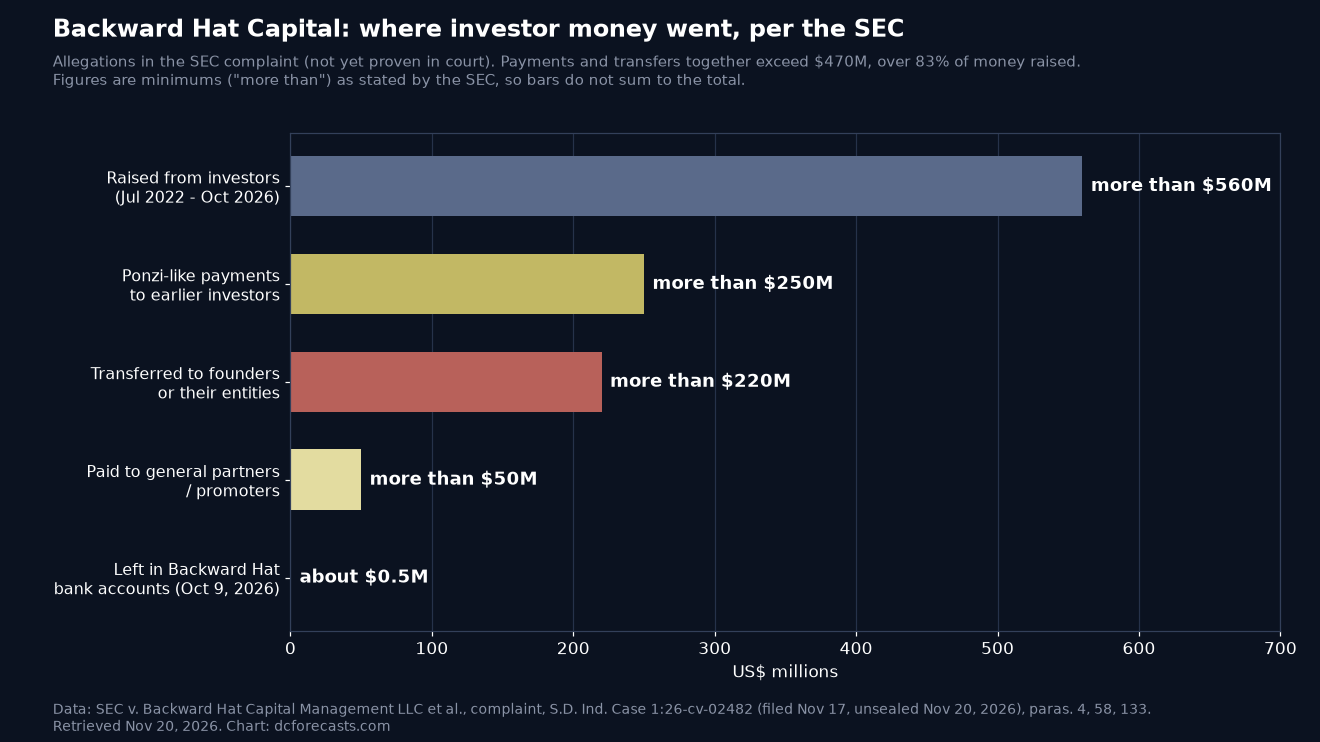
The agency alleges the group raised about $560 million from more than 2,000 investors since July 2022.
The pitch leaned on crypto vocabulary: investor cash would be turned into a crypto asset, then used for “AI-driven” foreign exchange arbitrage.
The bigger question is how a promise this extreme kept attracting money for four years.
What Regulators Say Happened at Backward Hat Capital
The SEC’s complaint, filed under seal on Nov. 17 in federal court in Indianapolis and unsealed on Nov. 20, describes a web of 25 private funds sold as high-frequency FX trading vehicles.
According to the complaint, more than $470 million, over 83% of the money raised, went either to Ponzi-like payments to earlier investors (more than $250 million) or to the founders and their entities (more than $220 million).
Promoters who brought in new money collected more than $50 million on top of that.
The SEC says the money paid for exotic cars, expensive homes and private air travel, and helped fund Johnson’s gambling.

The case is not just civil. The CFTC said the FBI arrested Williams and Johnson on Wednesday, Nov. 18, and that federal prosecutors in Manhattan have filed parallel criminal charges.
The CFTC’s own count is slightly different: more than $550 million from at least 2,100 participants. A court appointed Kevin B. Duff as temporary receiver on Nov. 20.
None of the allegations has been proven in court.
Why the “6% a Month” Claim Should Have Been the Red Flag
Investors could log in to a portal that, from at least March 2024 to February 2026, showed monthly returns between 6.05% and 7.03%.
The SEC notes that 6% a month equals more than 70% a year without compounding, and more than 100% a year with it.
Our own math puts the compounded figure at 101.2%. If the best portal month of 7.03% repeated for a year, it would reach about 126%.
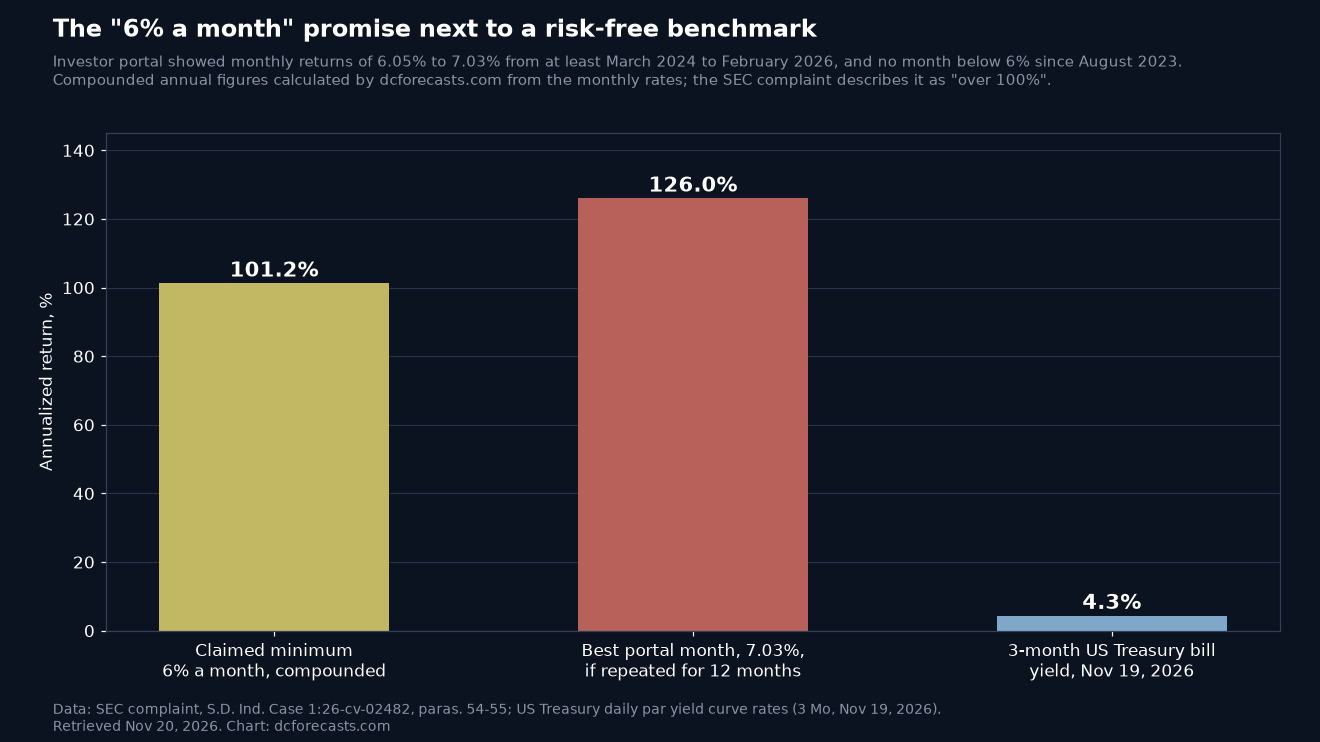
For comparison, a three-month U.S. Treasury bill yielded 4.34% on Nov. 19, according to Treasury data.
Smooth returns are the real tell. Real trading strategies rarely deliver near-identical gains month after month for years, especially one that claimed to keep about 70% of its capital idle at any time.
The firm also had a ready story when things broke. After the trading platform it first named collapsed in June 2023, the founders told investors they had personally repaid the losses to prove their credibility.
How Much of the Money Ever Touched Crypto?
Here the complaint is revealing. Fund documents said investor deposits would be “converted to digital liquidity through Coinbase,” and some appendices said the money would become “bitcoin.”
Between July 2022 and September 2025, about $109 million of the more than $210 million raised did go to the fund’s Coinbase account.
The SEC says more than $56 million of that moved to personal crypto accounts of Williams, Johnson and a relief defendant. About $18 million came back as dollars, and about $40 million reached three platforms where some was used to trade other crypto assets.
Little to no money or crypto was used to trade FX, the agency says.
From October 2025 to Oct. 9, 2026, the scheme raised about $350 million, and none of it was sent to Coinbase.
We think that detail matters. The crypto step was part of the sales pitch, not the business.
Fake Audits and a Bid to Go Institutional
Skeptical investors got paperwork. Anderson allegedly drafted two “audit reports” and a “quality of earnings” report under the name of the Institute for Process Excellence, presented as an independent audit firm.
The SEC says the firm does no financial audit work and that Anderson received about $2.5 million of investor money.
One report put a fund’s assets at $246 million as of July 2025. The complaint says the matching bank account held $1.00 on July 31, 2025.
Johnson was also expanding. Traders Point Capital applied to register with the SEC as an investment adviser on Sept. 11, 2026, and had raised at least $5.5 million by early October.
By then, the cracks were showing. Withdrawals had stalled since September, and as of Oct. 9 the firm’s bank accounts held about $500,000.
What Bitcoin Holders Can Take From the Case
The case fits a pattern we have tracked all year, from the SEC’s fake crypto trading platform cases to its fiscal 2026 enforcement results.
Crypto is often the costume, while the scheme itself is old-fashioned.
Bitcoin itself promises no yield. Its supply schedule is public, and every transaction can be checked on an open ledger. Anyone selling a guaranteed monthly return on top of it is offering something the network does not provide.
We believe the best defense is the habit Bitcoin encourages: verify, don’t trust. That means checking registrations, asking who actually holds the assets, and treating a perfect track record as a warning.
The SEC’s Investor.gov site offers free tools for checking advisers.
For Backward Hat’s investors, the next step is the receiver’s work to trace and recover what is left. For everyone else, the lesson is simple: real returns come with real volatility.
DC Forecasts is a leader in many crypto news categories, striving for the highest journalistic standards and abiding by a strict set of editorial policies. If you are interested to offer your expertise or contribute to our news website, feel free to contact us at [email protected]












Discussion about this post