



Euro area crypto holders reach for Bitcoin before anything else, and when they do hold a stablecoin, it is usually a dollar token rather than a euro one.
That is the picture painted by a new box in the European Central Bank’s Economic Bulletin, Issue 7/2026, which draws on household-level answers from the ECB’s Consumer Expectations Survey.
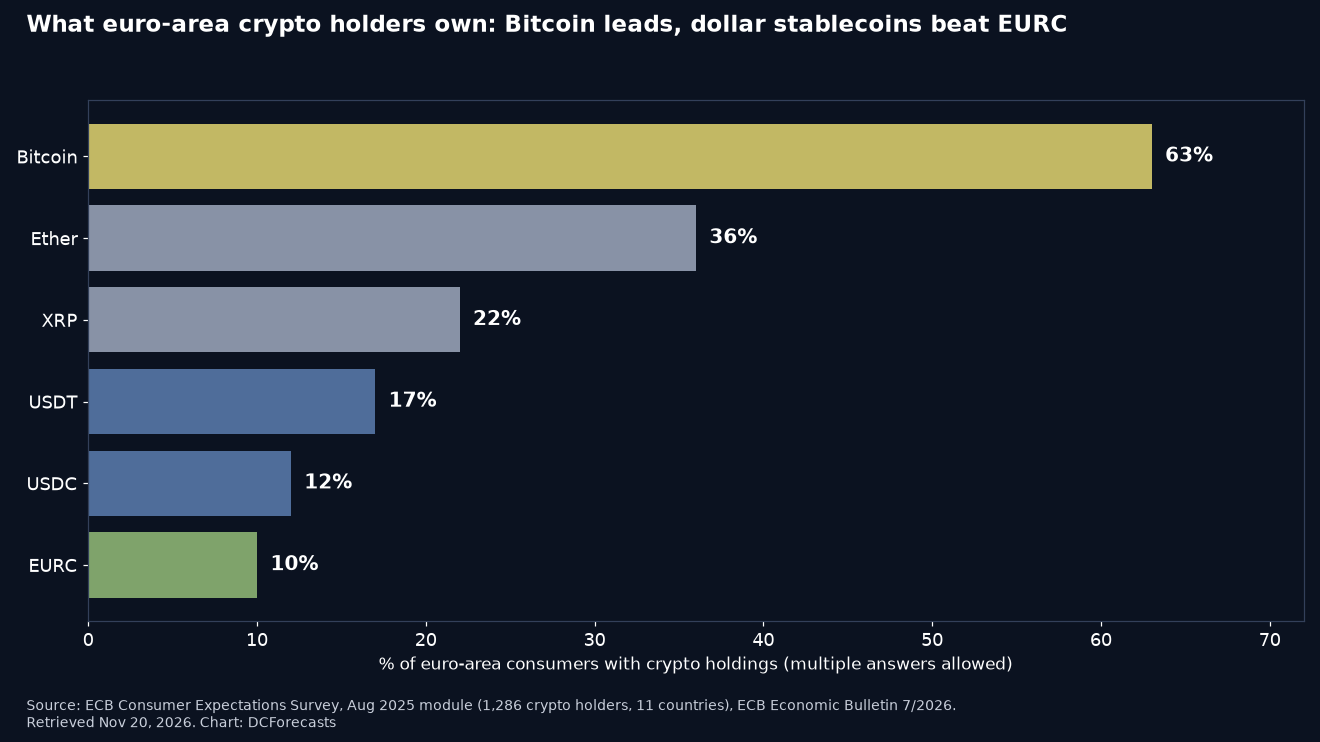
Around 63% of euro area consumers with crypto exposure own Bitcoin. Tether’s USDT shows up in 17% of those portfolios, Circle’s USDC in 12% and the euro-denominated EURC in just 10%.
For Bitcoin investors, the most telling detail is that the asset the ECB’s own researchers keep returning to as the default holding is not a stablecoin at all.
The bigger question now is whether Europe’s central bankers, already uneasy about dollar tokens, will lean harder on euro alternatives as more households come in.
What the ECB’s Survey Actually Measured
The box, titled “Who holds stablecoins? New evidence on euro area consumer holdings,” was prepared by eight authors, including ECB financial stability expert Alexandra Born and research section head Geoff Kenny.
It uses two topical modules of the Consumer Expectations Survey, run in August and November 2025 and weighted to the population of 11 euro area countries.
The headline trend is slow but steady growth.
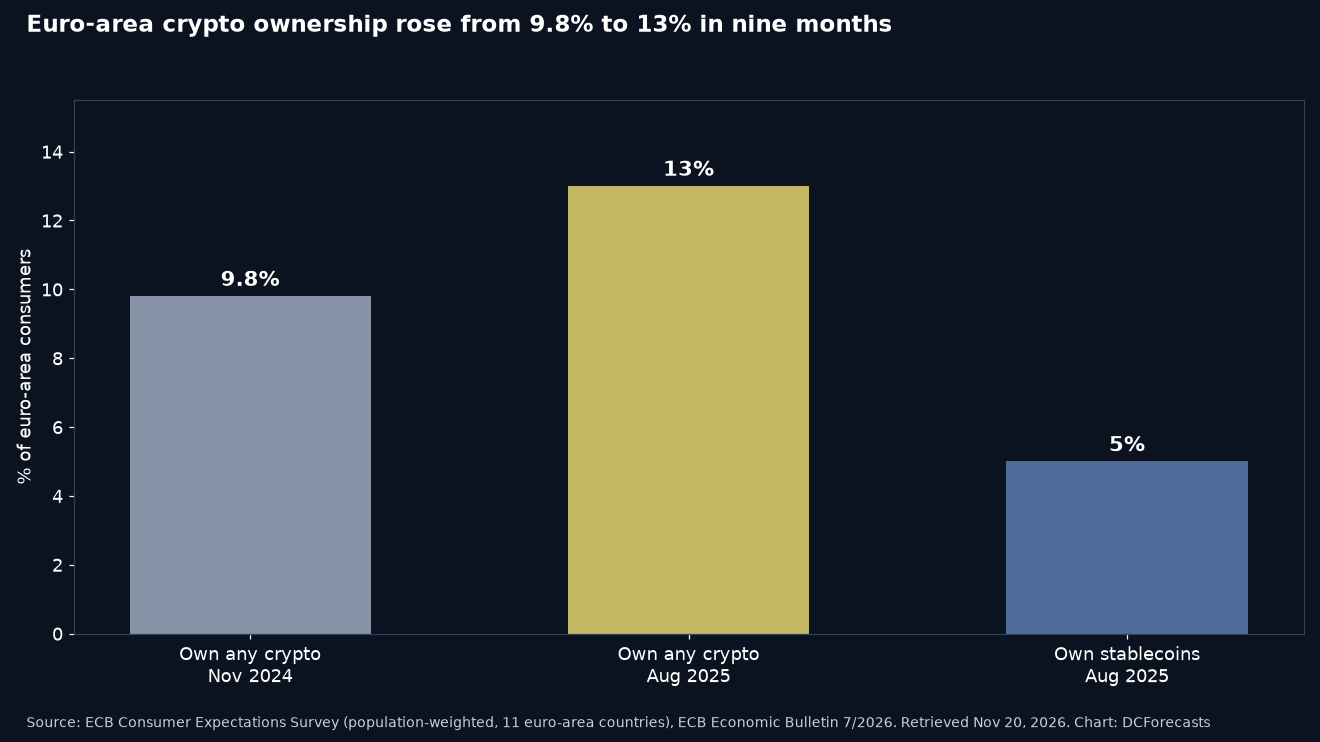
The share of consumers owning any crypto-asset rose from 9.8% in November 2024 to 13% in August 2025, a gain of 3.2 percentage points in nine months.

In the August module, 5% of all consumers said they held stablecoins. That is more than a third of everyone who owned crypto at all.
Most stablecoin positions were small. Even so, the ECB estimates that close to 10% of stablecoin owners held €10,000 or more in November 2025.
That range matters, because it shows a meaningful group of savers is using these tokens for more than pocket change.
Bitcoin Leads, and Dollar Stablecoins Beat EURC
The asset breakdown comes from 1,286 respondents who reported owning crypto in the August module. Because they could tick several boxes, the shares do not add up to 100%.
Bitcoin sits far ahead at roughly 63%. Ether follows at 36% and XRP at 22%.
Among stablecoins, USDT leads at 17%, ahead of USDC at 12%. EURC, the main euro-denominated token, reaches 10%, and all other stablecoins combined account for less than 9% of reported holdings.
The ECB’s explanation is simple: consumers tend to hold the crypto-assets with the largest market capitalization.
We believe that is the quiet endorsement in this data. Without marketing campaigns or bank distribution, Bitcoin has become the first choice of nearly two in three European crypto owners.
It also helps explain why regulated institutions are building around it. As we covered when Deutsche Bank’s digital asset custody went live with Bitcoin, the infrastructure is following the demand.
Why Stablecoin Holdings Worry Frankfurt
The ECB’s concern is not Bitcoin. It is what happens if dollar stablecoins spread beyond crypto trading.
The authors list three future vulnerabilities if usage grows significantly: runs and de-pegging events, spillovers from a forced sale of US dollar stablecoin reserves, and currency substitution away from the euro.
They write that dollar token use outside crypto transactions “could affect deposit funding, monetary transmission and the role of euro-denominated payment instruments.”
For now, the bank is clear that exposures look limited. Stablecoins make up a small share of consumers’ financial assets and are mostly held alongside other crypto.
The survey also found foreign-born respondents were 2.1 percentage points more likely to hold stablecoins, after controlling for other traits. The ECB says that pattern is consistent with use for cross-border payments or remittances.
That fits a wider push in Frankfurt. Christine Lagarde argued on Nov. 20 that Europe has only a short window to shape tokenized finance, as we reported in our coverage of her warning on a €23 billion tokenized market.
A Two-Way Channel Between Crypto and Household Wealth
One of the more interesting passages describes stablecoins as a “two-way channel” between crypto-assets and investor wealth.
Because most stablecoin holders also own other crypto, a shock to a stablecoin hits the rest of their portfolio. In the other direction, a sharp drop in crypto prices could trigger stablecoin selling.
That framing lands at a tense moment. Bitcoin touched $57,655 on Coinbase on Nov. 20, its lowest level since September 2024, as we detailed in our report on the cross-asset selloff that also hit gold and the Nasdaq.
The ECB data offers useful context here. The holders it describes are mostly small, diversified across a handful of large assets and anchored by Bitcoin.
For us, that looks less like a fragile bubble and more like an early, broad base of ownership that can grow through market cycles.
Can Euro Tokens Close the Gap on Dollar Stablecoins?
The ECB notes that the market for MiCA-authorized euro stablecoins has grown but remains small, and that the global stablecoin market has recently plateaued.
EURC’s 10% reach among crypto holders is a respectable start. Still, it trails USDT by 7 points and USDC by 2.
We would watch three things next: the next Consumer Expectations Survey modules, any changes to MiCA rules on stablecoin reserves, and whether euro area banks begin offering euro tokens directly.
None of those debates changes Bitcoin’s core design. It has no issuer to run on, no reserve portfolio to liquidate and a supply capped at 21 million coins.
That may be why it already sits at the top of European crypto portfolios while policymakers argue over which stablecoin should win. If ownership keeps climbing from 13%, the coming surveys will reveal how far that lead can stretch.
DC Forecasts is a leader in many crypto news categories, striving for the highest journalistic standards and abiding by a strict set of editorial policies. If you are interested to offer your expertise or contribute to our news website, feel free to contact us at [email protected]












Discussion about this post